For many mobile apps, email is easy to underestimate. It’s often labeled old-school, yet it consistently ranks among the highest-ROI marketing channels when used well. The catch? Opens and clicks alone don’t show real business impact. To unlock email’s true value, you need to understand where ROI actually comes from and how to measure it beyond surface-level metrics.
In this guide, we’ll break down how to calculate email marketing ROI correctly, explore benchmarks, and discuss how to improve ROI with smarter segmentation and automation.
What is email marketing ROI?
Email marketing ROI (return on investment) measures how much revenue or profit your email campaigns generate compared to the total cost of running them. In simple terms, it shows how much value email brings back for every dollar you invest.
Unlike engagement metrics such as open rate or click-through rate, ROI reflects real business impact. Opens and clicks show whether people interact with your messages, but they don’t indicate whether those interactions lead to subscriptions, in-app purchases, renewals, or other revenue-generating actions. ROI connects email performance directly to outcomes that matter to the business.
In practical terms, email marketing ROI is often expressed as a ratio — for example, $1 spent on email returns $X in revenue — making it easier to compare email performance with other marketing channels and decide where to invest budget and effort.
How to calculate email marketing ROI (formula + examples)
Calculating email marketing ROI starts with a simple formula, but getting an accurate number depends on what you include as revenue and how you account for costs. Many teams calculate ROI too narrowly, which leads to inflated results and poor optimization decisions later on.
Email marketing ROI formula
The standard formula for email marketing ROI looks like this:
Email marketing ROI = (Revenue − Cost) / Cost
If you want to express ROI as a percentage, multiply the result by 100:
Email marketing ROI (%) = ((Revenue − Cost) / Cost) × 100
This formula shows how much value email generates relative to the investment you make in running your email marketing program.
What counts as revenue in email ROI for mobile apps?
Revenue should reflect the business outcome your emails drive. Depending on your app’s monetization model, this may include:
- Subscription starts, renewals, or upgrades
- In-app purchases or paid feature unlocks
- E-commerce purchases completed after email interactions
- Indirect revenue, such as increased sessions or engagement, that contribute to ad monetization
For mobile apps, revenue attribution often goes beyond a single click. Users may open an email, return to the app later, and convert days after, which is why ROI should be measured with lifecycle context, not just last-click attribution.
What costs should you include?
To calculate ROI realistically, include all costs associated with email marketing, such as:
- Email marketing platform or automation tools
- Sending volume or deliverability-related costs
- Design and copywriting costs
- Developer or technical resources used for setup and tracking
- Analytics or attribution tools required to measure performance
Email marketing ROI example
Let’s look at a simple example:
- Total monthly email marketing cost: $2,500
- Revenue attributed to email campaigns: $15,000
ROI = (15,000 − 2,500) / 2,500 = 5
That means your email marketing ROI is 5:1 — for every $1 spent on email, you generate $5 in revenue. Expressed as a percentage, that’s a 500% ROI.
Email marketing ROI calculator
Now that you understand how email marketing ROI is calculated, you don’t need to run the numbers manually every time.
For convenience, we’ve created a ready-to-use email marketing ROI calculator. You can enter your revenue and cost data, and the calculator will automatically show your ROI as both a ratio and a percentage, along with the break-even point.
Using a calculator helps standardize ROI measurement across teams and makes it easier to track trends over time.
How pricing models affect email ROI calculations
Not all email platforms price email the same way. Some charge based on the number of emails sent, while others use subscriber-based or platform-level pricing. This distinction matters when calculating email marketing ROI.
With per-message pricing, like Pushwoosh’s, email costs scale directly with sending activity rather than list size. This means ROI depends more on the campaigns that drive conversions and revenue than on a fixed monthly platform cost.
Email marketing ROI benchmarks: what’s “good” email ROI?
Email marketing continues to deliver exceptional returns compared to other digital channels. According to Litmus’ email survey, businesses generate an average return of $36 for every $1 spent on email marketing, which translates to a 3,600% ROI.
However, top performers achieve even better results. Research shows that 18% of companies achieve an ROI greater than $70 for every $1 invested, nearly double the industry average. This highlights how much ROI depends on execution, not just channel choice. How can you achieve these results? This is exactly what we describe in the following section on how to increase ROI.
Automated vs. one-off campaigns
Email automation significantly impacts ROI:
- Automated email campaigns deliver 320% more revenue per email compared to one-off campaigns
- 37% of all email-generated sales come from automated emails, despite representing only 2% of email volume
For mobile apps specifically, welcome emails achieve an average open rate of 50%, making them 86% more effective than standard newsletters.
What does “good” email marketing ROI look like for mobile apps
Based on these benchmarks from multiple industry research studies, here’s what you can consider strong performance:
- ROI of $36-40+ per $1 spent
- Email conversion rate of 2.5-3%+
- Open rates of 20-25%+
- Click-through rates of 3-5%+
Remember that your specific benchmarks will vary based on your app category, audience, and monetization mode. Rather than chasing a single number, focus on consistent, measurable contribution to revenue and retention.
Key indicators to monitor over time include:
- ROI is positive and improving over time
- Automated lifecycle emails outperform one-off campaigns
- Revenue per user and per message increases as segmentation improves
- ROI remains stable as send volume grows, indicating efficiency rather than oversending
How to improve email marketing ROI
Improving email marketing ROI is about sending the right messages at the right time and measuring their real impact on revenue. While benchmarks show email’s potential, consistent ROI growth comes from how well your campaigns are targeted, automated, and integrated into the user lifecycle.
In this section, we’ll break down proven strategies to increase email marketing ROI.
Protect deliverability and avoid spam filters
Before you can improve email marketing ROI, you need to make sure your emails actually reach the inbox and get opened. Deliverability is a foundational ROI lever: if messages land in spam or go unopened, even the best offer won’t generate revenue.
Deliverability determines whether your emails appear in the primary inbox, promotions tab, or spam folder. Poor inbox placement limits reach, reduces engagement, and directly caps the revenue your email campaigns can generate. In other words, ROI can’t grow if deliverability breaks first.
To maintain strong inbox placement and protect long-term email ROI, focus on these best practices:
- Send only to users who opted in. Permission-based lists reduce spam complaints and protect sender reputation.
- Use verified domains and proper authentication (SPF, DKIM, DMARC) to signal legitimacy to inbox providers.
- Avoid spam-triggering or overly “salesy” content, such as ALL CAPS, excessive punctuation, misleading subject lines, or image-heavy layouts.
- Monitor IP and domain reputation regularly and avoid sudden spikes in send volume.
- Warm up new domains or IPs gradually, starting with your most engaged subscribers.
- Always include a clear unsubscribe link and physical address to stay compliant and maintain trust.
Improve email open rates
Once deliverability is stable, improving email open rates becomes the next priority and a direct driver of email marketing ROI. If emails aren’t opened, they can’t generate clicks, conversions, or revenue.
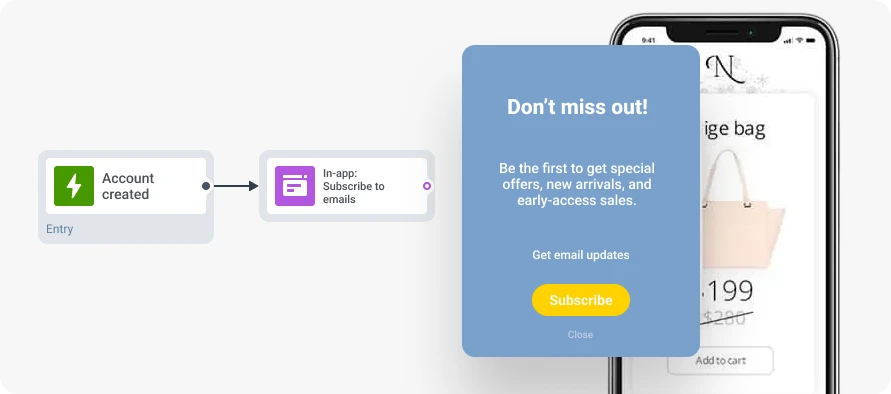
One of the most effective ways to improve open rates is to set clear expectations at opt-in and consistently deliver on that value. Users are far more likely to open emails when they understand why they’re receiving them and what’s in it for them. This starts by asking for email opt-in at the right moment — for example, after a meaningful action such as registration, account creation, or a purchase — and clearly explaining the value of email communication upfront.
Here is how you can automate effective email opt-in in Pushwoosh’s Customer Journey Builder:
Timing also plays a critical role. Sending emails when users are most likely to engage significantly increases open rates. Instead of relying on fixed schedules, allow users’ behavior to guide timing, frequency, and cadence. Practices such as send-time optimization help emails reach inboxes at peak engagement moments, improving visibility and increasing the likelihood of opens.
When open rates improve, every downstream metric benefits: from click-through rates to conversions and revenue.
Segment audience by behavior
Personalization is one of the strongest drivers of email performance, but true personalization starts with segmentation. The most effective way to make every email feel relevant is to segment users not just by who they are, but by what they do.
The biggest impact on ROI comes from behavior-based segmentation. By tracking how users interact with your app and messages — from recent activity and feature usage to purchases or subscription status — you can tailor emails to match each user’s position in the lifecycle.
For more advanced personalization, RFM segmentation (Recency, Frequency, and Monetary value) helps identify users based on the quality of their engagement. RFM makes it easier to distinguish loyal users from those at risk of churn, to prioritize high-value segments, and to determine where email can have the greatest incremental impact.
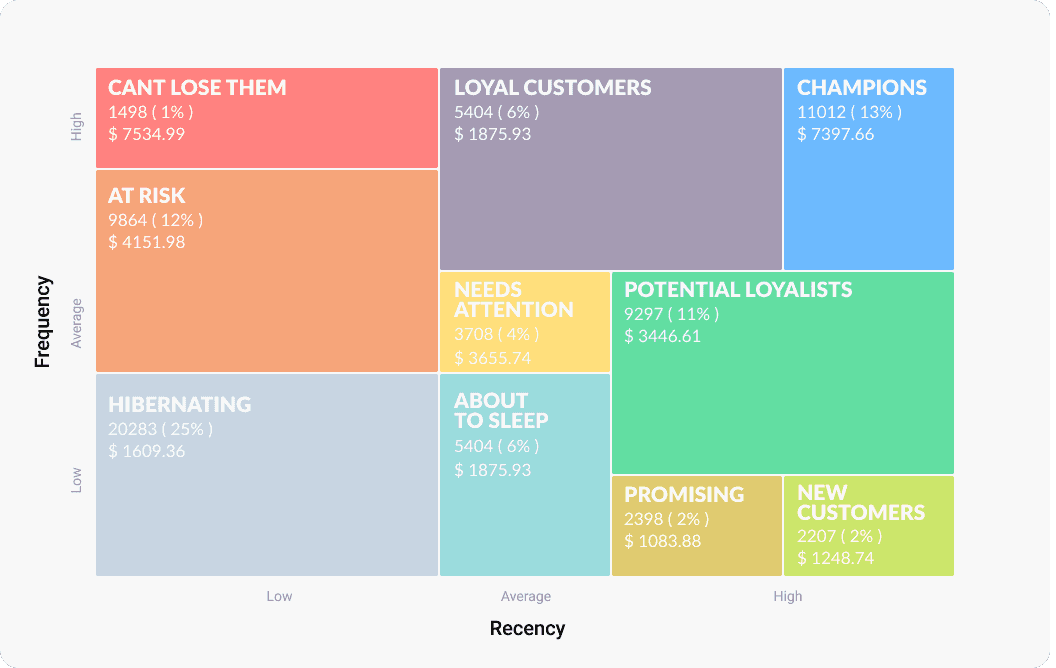
Instead of treating your audience as a single list, you can focus efforts on the segments most likely to convert, renew, or re-engage, directly improving email marketing ROI.
Run lifecycle email campaigns
One of the clearest insights from email marketing ROI benchmarks is that automated lifecycle emails consistently outperform one-off campaigns. They don’t just improve open rates or email CTR; they drive higher overall email performance and revenue because they’re sent exactly at moments of high user intent.
Lifecycle emails are usually triggered by user actions or status changes, which makes them inherently more relevant than scheduled blasts. Instead of guessing when to send, you respond to what users are already doing: whether they’ve just signed up, completed a purchase, or started drifting away.
Here are the standard stages of the mobile app user lifecycle:
- Onboarding (welcome emails, first-use guidance, helping users reach their first “aha” moment faster)
- Engagement (feature discovery, content recommendations, usage nudges that build habit)
- Conversion (trial-to-paid prompts, abandoned actions, upgrades, first purchase reminders)
- Retention & loyalty (value reinforcement, renewals, repeat purchases, personalized updates)
- Re-engagement & re-activation (win-back campaigns for inactive users and churn-risk segments)
Because these messages align with real behavior, they convert more consistently and contribute to revenue more predictably than one-off campaigns.
A typical lifecycle email example is a welcome message sent immediately after the first login or registration.
- Trigger: First login or registration event
- Action: Send a welcome email
- Outcome: Guide users to the next meaningful step (feature setup, subscription activation, or purchase)
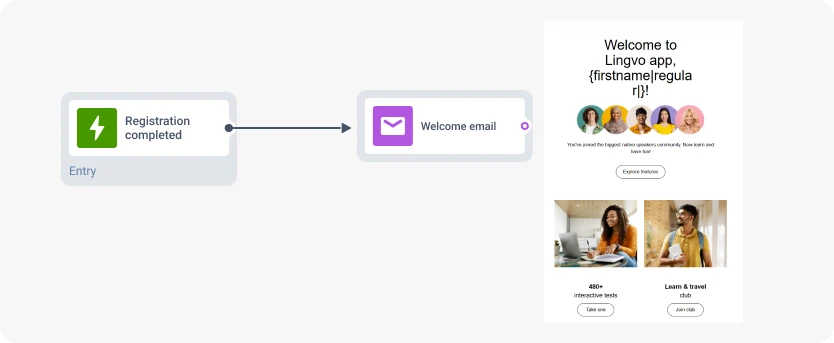
By responding instantly to user intent, lifecycle emails help shorten time-to-value, improve early engagement, and set the foundation for stronger long-term email marketing ROI.
Optimize emails for mobile-first reading and clicks
For mobile apps, most email engagement happens on smartphones. When emails aren’t optimized for mobile, CTR often drops, not because users aren’t interested, but because interacting with the message feels inconvenient. If tapping a CTA requires zooming, precise scrolling, or extra effort, many users simply won’t engage.
To improve mobile-first engagement design, emails for fast scanning and effortless tapping:
- Use a single-column layout that adapts naturally to mobile screens
- Keep copy concise and scannable, broken into short paragraphs or bullet points
- Place the primary CTA high enough to be visible without excessive scrolling
- Use large, thumb-friendly buttons with enough spacing to avoid mis-taps
Mobile-first optimization doesn’t stop at the email itself. If the click leads to a slow-loading page or a poorly optimized experience, interest drops instantly. For mobile apps, the best practice is to link users directly into the app with deep links, so the action feels immediate and frictionless.
A/B/n test what actually drives clicks and conversions
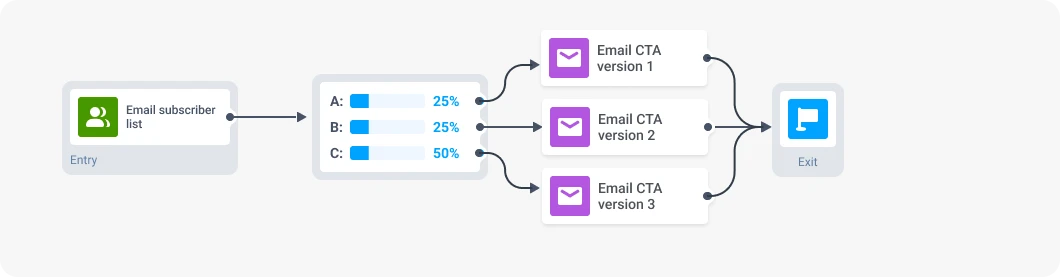
If you want to improve email marketing ROI consistently, testing is essential, but only when you test the right elements. A/B/n testing replaces assumptions with real user behavior and helps you understand what actually drives clicks, conversions, and revenue, not just opens.
For ROI-focused optimization, prioritize testing elements that influence post-open action:
- CTA copy and email copy (value-driven vs action-driven)
- CTA placement (above the fold vs deeper in the email)
- Email layout (short vs detailed, text-heavy vs visual)
- Personalization depth (generic content vs dynamic, behavior-based content)
In Pushwoosh, A/B/n testing can be built directly into an email campaign journey:
Recover revenue with omnichannel follow-ups
Not every subscriber will click an email, and that’s completely normal. What hurts email marketing ROI isn’t non-clickers themselves, but treating them as a dead end. In reality, a missed email is often a signal to continue the conversation in a more effective channel.
Email ROI improves when non-clickers are handled intentionally. Instead of resending the same message, add an omnichannel follow-up for users who don’t open or click within a defined timeframe. For mobile apps, channels like push notifications, in-app messages, or SMS are often better suited to capture attention in the moment.
For example, in Pushwoosh, you can track if a user opens an email within a set period. If they didn’t, the journey can seamlessly route them to the next channel, such as push notifications, in-app messages, or SMS.
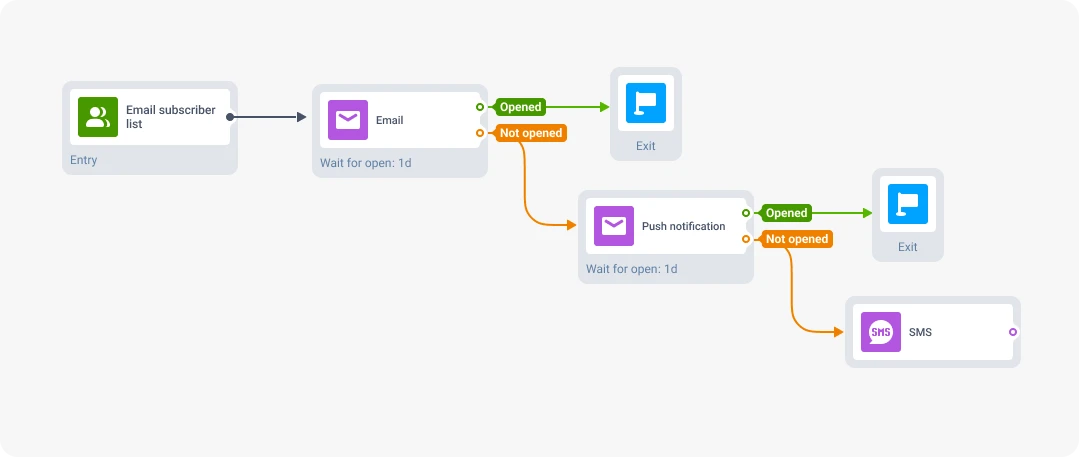
This omnichannel approach helps improve overall engagement and often revenue — not by forcing more clicks in email, but by meeting users where they’re most reachable. For mobile apps focused on retention and monetization, omnichannel follow-ups turn email from a standalone tactic into a compounding ROI driver.
Use AI to optimize email ROI
At scale, improving email marketing ROI manually becomes unrealistic. As audiences grow and journeys get more complex, small inefficiencies, such as poor timing, irrelevant segments, and underperforming messages, quietly drain budget. This is where AI becomes essential, not for vanity metrics, but for protecting and growing revenue.
Revenue-focused Pushwoosh’s ManyMoney AI goes beyond helping you write better subject lines. They continuously analyze campaign performance, identify what’s actually driving conversions, and intervene when email spend stops paying off.
This is especially important for mobile apps, where email costs often scale with send volume, meaning low-performing campaigns don’t just underperform, they actively reduce ROI.
Watch the video to see a real case of how ManyMoney analyzes performance and creates revenue-focused email campaigns in real time:
In other words, ManyMoney doesn’t just help you send emails; it helps you spend smarter.
Improve email marketing ROI with Pushwoosh
Improving email marketing ROI requires building a system that consistently delivers relevant messages, reaches users at high-intent moments, and turns engagement into measurable revenue.
Pushwoosh helps mobile app teams improve email marketing ROI through behavior-based segmentation, lifecycle automation, omnichannel follow-ups, and continuous improvement via AI-powered optimization, not manual overhead.