You spend hours optimizing email campaigns, yet the open rate barely moves. Is it your subject line? Your timing? Your deliverability? Or something deeper?
This article breaks down what a good email open rate looks like in 2026, why your email open rate might be low, and proven ways to get more people to actually open your emails.
Along the way, you’ll also see how Pushwoosh helps increase email open rates with smarter segmentation and automation.
What is email open rate?
Email open rate is the percentage of delivered emails that your recipients opened. In simple terms, it tells you how many people saw your message and were interested enough to open it.
Email open rate formula
Most email platforms calculate open rates by the simple formula:
Email open rate = (Number of opened emails ÷ Number of delivered emails) × 100
However, pay attention to what your email platform counts as “opens”:
- Unique email opens: each recipient is counted only once, regardless of how many times they open your email.
- Total email opens: counts all opens, including multiple opens by the same recipient.
Unique opens give you a cleaner engagement signal, while total opens show depth of interest.
How to track email open rates
The easiest way to monitor email open rates is through an email automation platform. Most tools automatically calculate the metric and display it alongside related stats such as CTR, bounce rates, unsubscribes, and conversions.
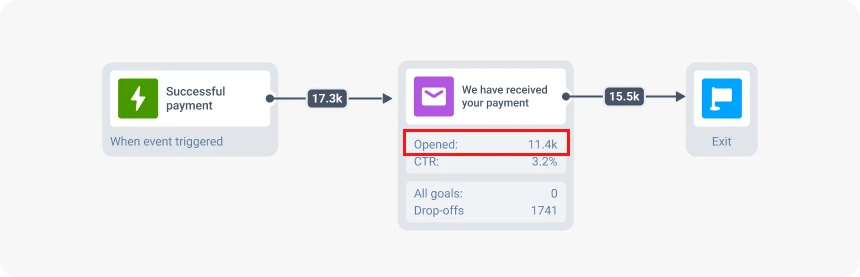
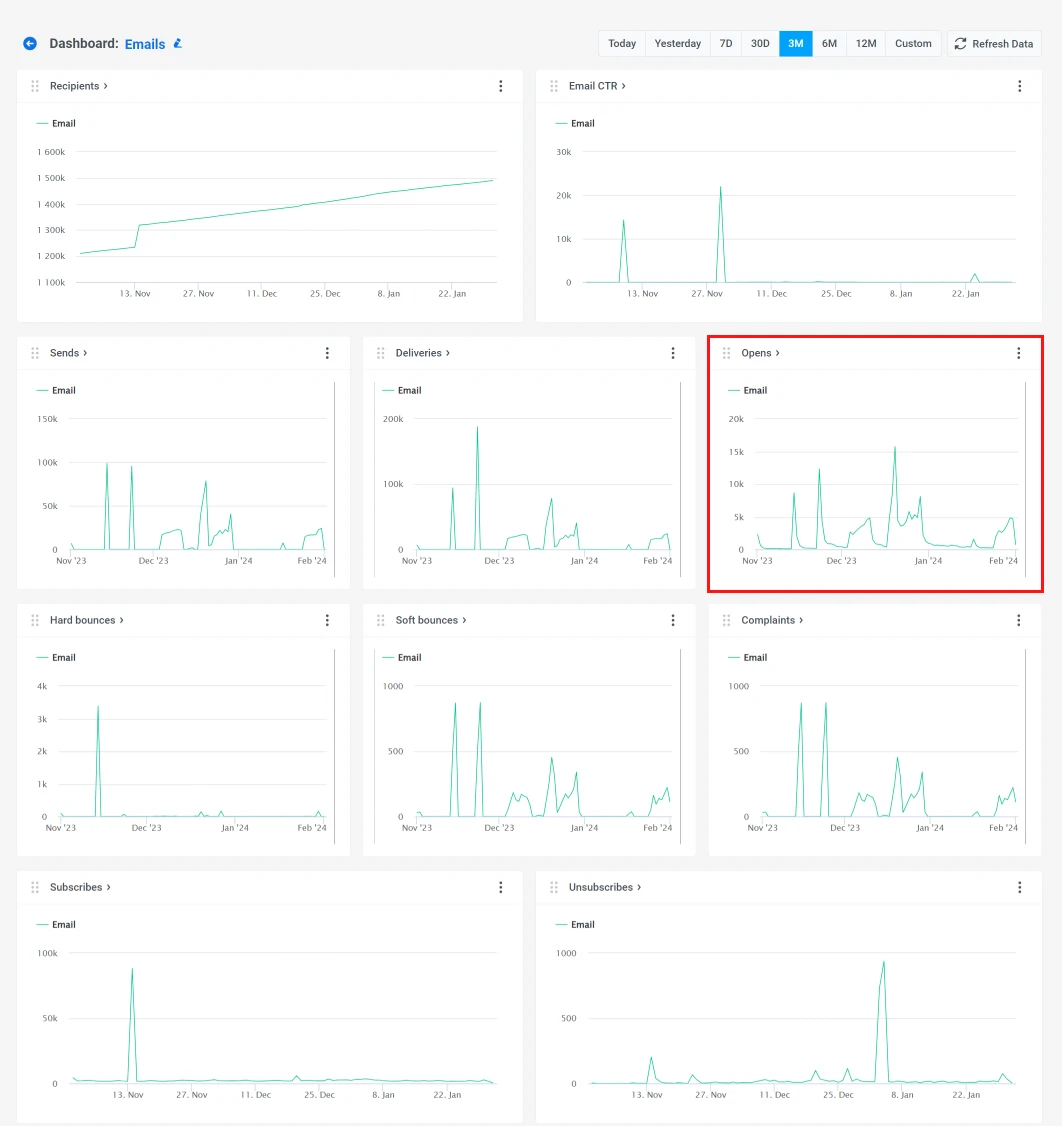
For example, in Pushwoosh, you can track email performance on two levels:
- Individual message performance inside a customer journey — visible right on the Journey canvas, so you can instantly see how each step contributes to engagement.
- Campaign-level performance in the dashboard, where you can compare open rates across messages, analyze trends, and spot opportunities to optimize.
What is a good email open rate?
According to MailerLite’s 2025 data, the average email open rate across all industries in 2025 is 43.46%, up slightly from 2024’s average of 42.35%.
However, a “good” email open rate depends on your industry, audience, email type, and the frequency of your campaigns. As a general rule for 2025, most brands can consider:
- 20–25% → below average (needs attention)
- 25–35% → solid, healthy email open rate
- 35–50%+ → excellent, especially for engaged audiences
- 50–60%+ → common for triggered or transactional emails
💡Important context for 2026:
Email open rate has become a less straightforward metric due to the recent changes in how inbox providers handle email previews and tracking.
On the one hand, Apple’s Mail Privacy Protection (MPP) has inflated open rate metrics since 2021 by automatically preloading email content for Apple Mail users, even when they never actually open the email. With Apple Mail holding about 46% of the email client market, open rates are estimated to be overstated by up to 18 percentage points.
On the other hand, Gmail rolled out AI-generated summaries powered by Gemini AI and “Automatic Extraction,” which replaces preview text with AI-generated content, images, and discount codes. These AI summaries could lead to fewer opens since subscribers can get key points without fully opening the email.
As a result, open rate today can be either inflated or suppressed, depending on the email client and user behavior. That’s why many marketers now evaluate email performance using a combination of metrics — CTR and CTOR, alongside open rate — to get a more accurate picture of real engagement.
Average email open rates by industry
According to MailerLite’s 2025 data, email open rate benchmarks by industry range from 30.1% to 55.71%.
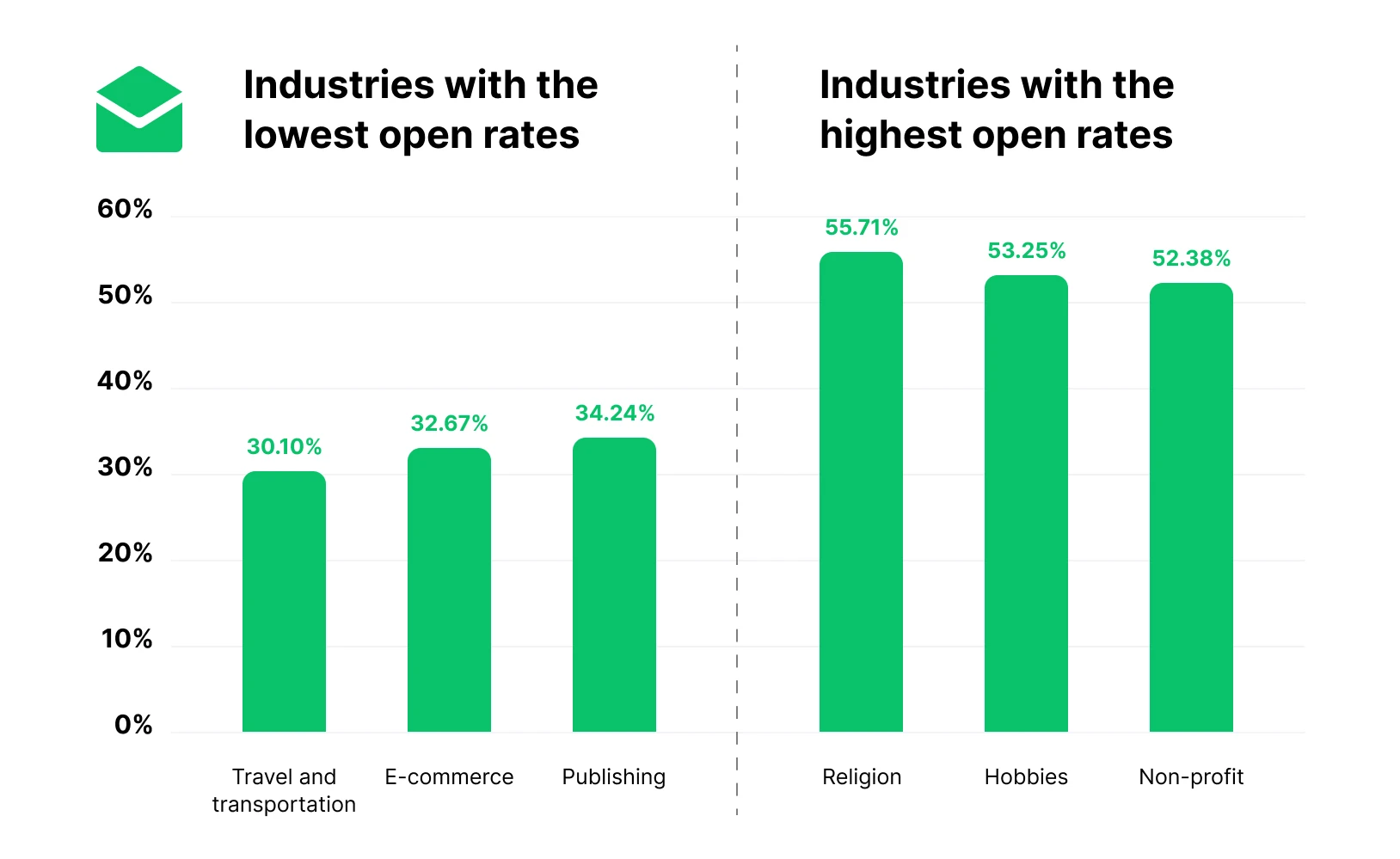
These differences are primarily driven by audience intent and engagement, not just email quality. Industries with lower average open rates, such as travel & transportation, e-commerce, and publishing, typically send emails to broader audiences more frequently, often with promotional messaging. Without strong segmentation, open rates naturally decline.
Industries with the highest open rates, including non-profits, hobbies, and religious organizations, tend to communicate with highly motivated, high-intent audiences. Subscribers actively opt in because the content aligns with their interests or values, resulting in stronger engagement.
Key takeaway: Industry benchmarks reflect the audience intent more than channel performance. With behavior-based segmentation and triggered messaging, many brands can outperform their industry’s average open rate.
Average email open rates by email type
The type of email you send has a dramatic impact on open rates. Here’s how different email types perform:
| Email Type | Average open rate | Notes |
|---|---|---|
| Welcome emails | 83.63% | Highest engagement due to peak subscriber interest |
| Transactional (shipping confirmation) | 62.47% | Highly relevant & expected |
| Transactional (back-in-stock) | 59.19% | High intent |
| Automated emails (overall) | 51.05% | Higher engagement compared to a regular campaign |
| Newsletters | 40.08% | Lower than automated emails, but stable performance when value-driven |
| Promotional campaigns | 17–28% | Lower due to sales focus & higher frequency |
Key takeaway: Email open rates vary widely by industry and email type, but the most significant drivers are intent and personalization: the more timely and relevant the message, the higher the open rate.
For example, automated emails are triggered by specific subscriber actions, making them highly personalized and relevant, while newsletters or promo emails are sent to broader audiences with mixed content.
Let’s break down the key factors that affect your email open rate and the strategies you can use to improve it.
Factors that affect your email open rate
Email open rate doesn’t depend on a single element. A combination of technical, behavioral, and content factors shapes it. Understanding these variables helps you diagnose low performance and optimize your email campaigns more effectively.
Below are the seven core factors that influence whether your emails get opened.
1. Deliverability
If open rates drop sharply, email deliverability is often the first place to look.
Deliverability issues are among the biggest drivers of declining open rates. If your emails land in spam or the “Promotions” folder, your open rate will drop regardless of content quality. Authentication (SPF/DKIM/DMARC), list hygiene, and complaint rates all influence inbox placement.
2. Sender name & reputation
Recipients decide whether to open an email based mainly on who it’s from.
A recognizable, human-friendly sender name increases credibility, while a poor sender reputation (high spam complaints, authentication issues, inconsistent sending) leads to spam filtering and lower open rates.
3. List quality & segmentation
A list filled with inactive subscribers, outdated contacts, or broadly targeted segments naturally drags down open rates. Highly segmented, interest-based audiences open emails at much higher rates because content feels more relevant.
Healthy open rates require consistently updating the subscriber list and building behavior-based segments (recent purchasers, active users, trial subscribers, etc.) to deliver higher open rates.
4. Subject line & preheader relevance
These are the first elements subscribers see, and they heavily influence whether they open. Clear, specific, value-driven subject lines consistently outperform vague or overly promotional ones. Preheaders act as a secondary headline and can significantly boost open rate when used strategically.
5. Email timing & frequency
Send too often, and subscribers tune out. Send too rarely, and they forget who you are.
Subscriber’s time zone, day of week, and time of day also influence open rate, and the optimal window varies widely by audience and industry.
6. Content value & email type
If subscribers consistently find value in your emails, they will open the next one. If your emails feel repetitive, overly promotional, or misaligned with expectations set at signup, open rates decline over time.
Also, behavior-based emails like shipping updates, reminders, or back-in-stock alerts outperform newsletters because they’re timely and expected.
However, with high-quality personalization, promotional emails can have significantly higher open rates than regular email blasts.
7. Mobile optimization
Most email opens now occur on mobile devices. Subject lines that are too long, broken layouts, or slow-loading content can turn readers away before they even open the following message.
How to improve email open rate: 8 practical tactics
If your email open rate is lower than industry benchmarks or trending downward, the good news is that most issues are fixable.
Below, you’ll find proven strategies to increase email open rates.
Protect and improve deliverability
Before improving your email open rate, you need to make sure your emails actually reach the inbox.
Deliverability determines whether your messages land in the primary inbox, promotions tab, or spam. Even the strongest subject line won’t help if filtering happens first.
Here are the best practices to avoid spam filters and maintain strong inbox placement:
- Send only to people who opted in — permission-based lists keep spam complaints low.
- Use verified domains + proper authentication (SPF, DKIM, DMARC) to prove your emails are legitimate.
- Avoid spam-triggering or “salesey” content such as ALL CAPS, excessive punctuation, spammy phrases, or image-heavy layouts.
- Check your IP/domain reputation regularly and avoid sudden sending spikes.
- Warm up new domains or IPs slowly by sending first to your most engaged subscribers.
- Include your physical address and a clear unsubscribe link in every email.
Want more detailed guidance? Explore our post on email deliverability and avoiding spam filters
Keep your email list fresh
A healthy email list is one of the strongest drivers of a high open rate. Over time, subscribers change inboxes, lose interest, or stop engaging, and continuing to email them can hurt both engagement and deliverability. Regularly cleaning and refreshing your list ensures your messages reach people who actually want to hear from you.
One simple way to do this is by running a Reachability Check in Pushwoosh Customer Journey Builder. Before sending a campaign, you can confirm whether each user on your list can receive your email. If a user is unavailable via email, redirect them to other channels, such as push notifications, in-app messages, WhatsApp, or SMS.

You should also identify inactive subscribers by reviewing engagement over the past several months. If a user hasn’t opened or clicked any emails in your chosen timeframe, treat them as inactive and consider removing them from your list.
Before removing them, try to re-engage. You can send a single win-back email or build a short sequence to remind them about your brand and spark interest again. Here are effective options:
- Send a friendly “We miss you” message
- Offer a discount or incentive to return
- Share new features, products, or major updates
- Invite them to update their content preferences
- Ask for feedback to understand what changed
If they still don’t respond, you can safely sunset them to keep your list fresh and engagement strong.
Set clear expectations at opt-in and offer value
Make sure subscribers know exactly what they’re signing up for and why it’s worth opening your messages. When expectations are clear from the beginning, users look forward to your emails rather than ignore them.
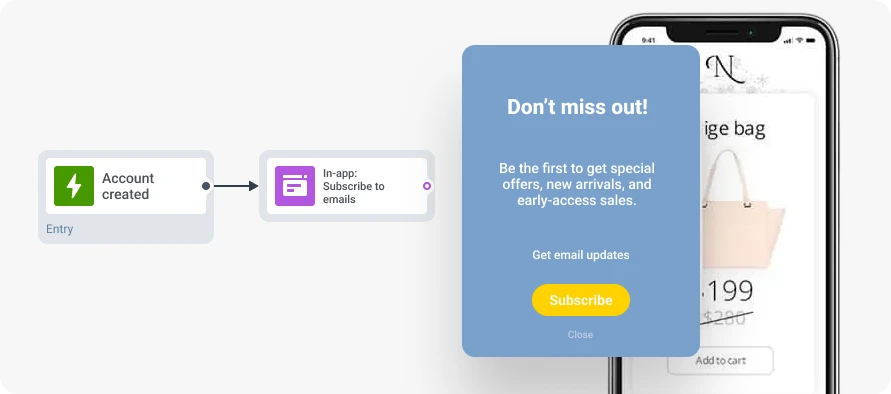
One effective approach is to explain the value at the right moment. For example, after a meaningful action such as registration or purchase, trigger an in-app message (or a banner on the website) that briefly introduces what kind of content the user will receive next — tips, updates, exclusive offers, product insights, or guidance. This creates anticipation and sets a clear expectation for future emails.
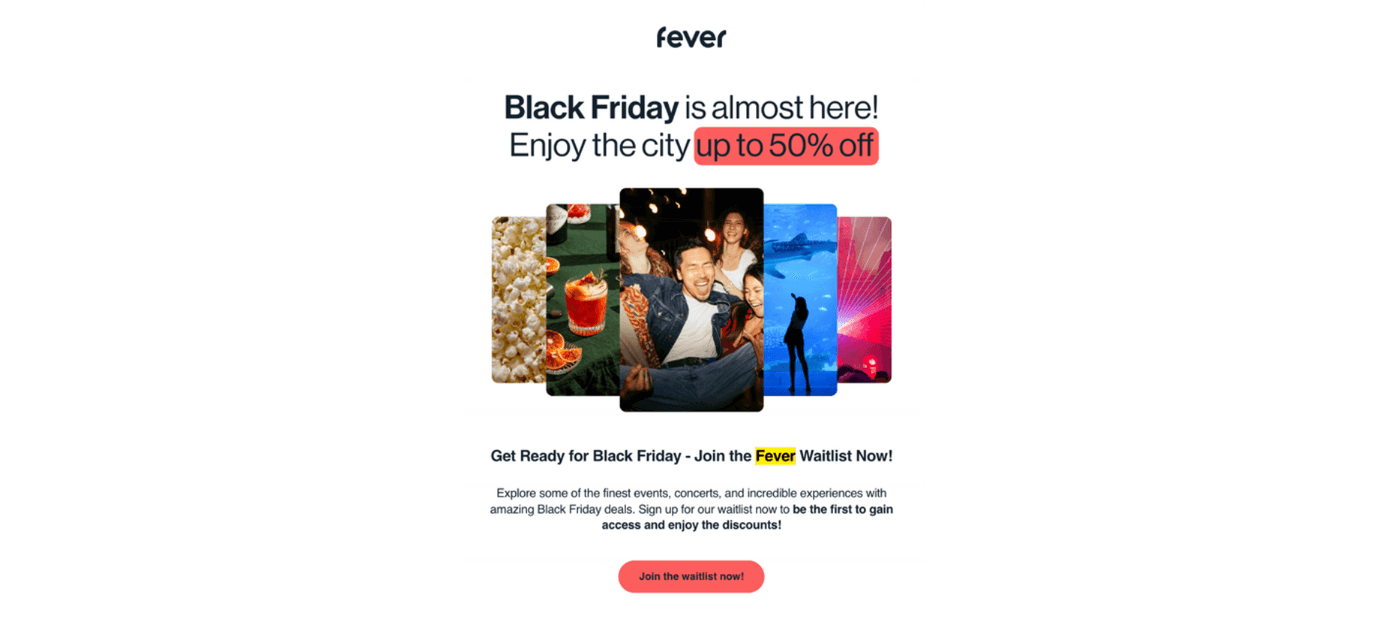
You can also strengthen engagement by offering exclusive benefits for subscribers, such as early access, VIP tiers, or waitlists. When users know they’ve unlocked something special, they look forward to your emails rather than ignoring them. The events app Fever uses this strategy during Black Friday, offering a waitlist that guarantees first access to limited-time deals, which naturally boosts open rates.
To keep open rates high over time, give subscribers the ability to choose their preferred timing. Let them set the day, time, or frequency of communications. When emails arrive exactly when users expect them, they’re more likely to be opened and far less likely to feel intrusive or overwhelming.
For extra clarity and list quality, you can also use double opt-in. After a user subscribes, send a confirmation email asking them to verify their intent. This extra step ensures subscribers are genuinely interested, improves deliverability, and leads to higher open rates over time by keeping your audience clean and engaged.
Craft subject lines that earn the open
Your subject line is the very first decision point in the inbox. It’s the moment a subscriber decides whether your email is worth their attention. If you want consistently higher open rates, your subject lines need to be clear, relevant, and compelling enough to stand out from the crowd.
Here are proven strategies to improve your subject lines and lift your open rate:
Pique curiosity
Ask a surprising question, hint at something unexpected, or create an information gap your reader will want to close. Curiosity sparks instant interest and encourages opens.
Examples:
- “Don’t open this email…”
- “Is this the hottest skill in marketing right now?”
- “A small surprise waiting for you 🎁”
Use numbers to highlight value
Numbers make subject lines more concrete and easier to scan. They help readers recognize relevance quickly.
Examples:
- “3 mistakes killing your conversions”
- “20% early-access code is here”
- “Your 7-day plan is ready”
Add personality or humor
A light touch of humor or a conversational tone makes your message feel more human and less like another marketing email in the inbox. When done naturally, it boosts both email opens and brand affinity.
Examples:
- “We made something for you (and no, it’s not another promo 😉)”
- “We made a tiny mistake (you’ll like this one)”
- “Your cart is crying again 😢”
Match your tone to your audience
Write subject lines the way your users speak. A friendly, familiar tone feels more like a personal message than a broadcast, helping your email stand out among automated notifications and corporate senders.
Keep it short and mobile-friendly
Most opens happen on mobile, so subject lines should be concise and readable at a glance. Aim for 40 characters or fewer, and make the key value clear from the start.
Pair subject lines with compelling preheaders
Your preheader is your second chance to win the open. Use it to reinforce or expand your subject line, not repeat it.
Segment the audience to send relevant messages
We’ve already identified that personalization is one of the strongest drivers of email open rate. And the most effective way to make every email feel personal is to segment your audience, not just by who they are, but by what they do.
Start with basic segmentation such as geography, gender, interests, or device type. Even simple filters help ensure subscribers receive content that speaks directly to them.
But the biggest lift comes from behavior-based segmentation. By tracking users’ actions — from message engagement to recent purchases or app activity — you can send emails that reflect where they are in their journey. For example, you can segment users based on products they’ve bought and follow up with replenishment reminders, category-specific updates, or personalized offers.
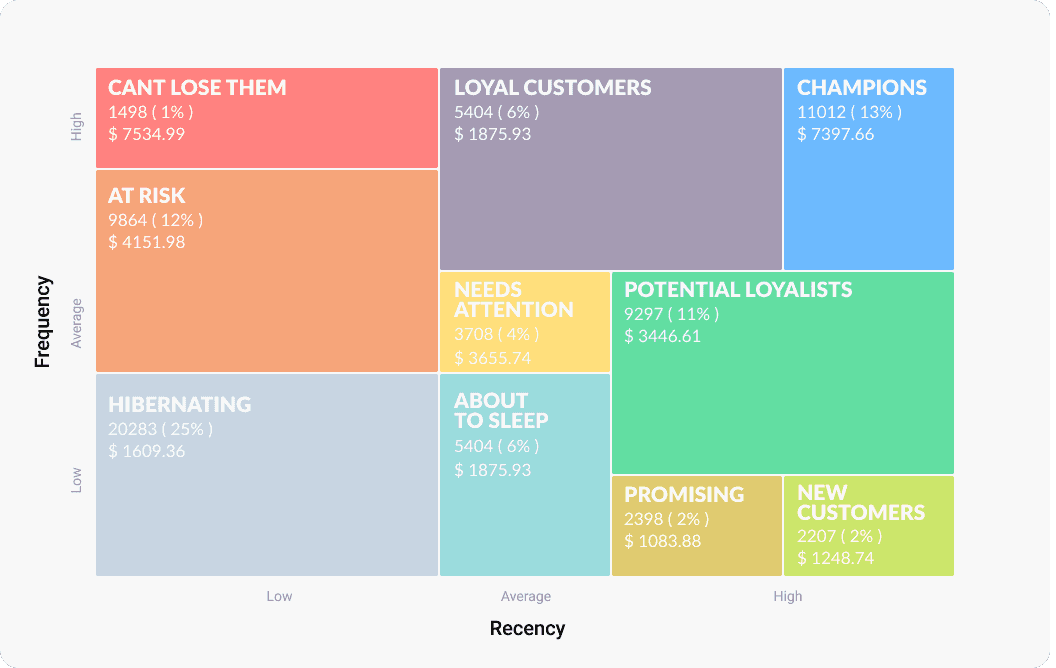
For even deeper personalization, use RFM segmentation (Recency, Frequency, Monetary value). RFM highlights each user’s exact engagement state, helping you predict who is loyal, who is drifting away, and who needs attention right now.
Choose the best time to send emails
As we mentioned earlier, another significant factor influencing your email open rate is timing. Even if your message is relevant, sending it at the wrong moment can bury it under inbox clutter.
General engagement patterns offer a helpful starting point:
- Weekdays: late mornings (9 AM–12 PM) and early evenings (5 PM–8 PM)
- Weekends: early mornings (7 AM–9 AM), especially for e-commerce and lifestyle apps
Still, averages can only take you so far. Your audience has its own unique habits, which means the real “best time” varies. Instead of guessing, you can rely on the Best time to send feature to automatically deliver emails at each user’s highest-engagement window, based on their past behavior.
We switched from fixed schedules to Best time to send, which tailors messages to each user’s behavior. As a result, our product email open rates increased from 28.5% to 43%. It not only delivers better results, but it’s also faster to use: just switch the feature on, no calendars or time zones to worry about.

Also, it’s important to consider time zones and schedule messages when your audience is most likely to engage. In Pushwoosh, you can easily set time-zone-based delivery to ensure emails arrive at the right local time for each subscriber.
A/B test to learn what drives opens
Even strong emails won’t always perform the way you expect, because what resonates with one audience segment may fall flat with another. That’s why A/B testing is essential for improving email open rates. Instead of guessing which subject line, timing, or content variant works best, testing lets real user behavior guide your decisions.
A/B testing means sending two versions of an email to a small portion of your audience, measuring the performance, and then sending the winning version to the rest.

What you can test to boost open rates:
- Subject lines: experiment with the value proposition, key message, tone, length, personalization, urgency, or curiosity
- Send times: compare morning vs. evening or weekdays vs. weekends, send time optimization vs. scheduled email
- Inbox preview elements: preheader text, sender name, emoji usage
- Standalone email vs an email sequence
Test one variable at a time so you can clearly identify what caused the performance change. Over time, consistent testing transforms your email strategy into a data-driven engine that steadily lifts your open rates and overall engagement.
Use AI tools to increase email open rates
In 2026, relying solely on manual workflows is no longer enough to stay competitive in the inbox and achieve high open rates.
AI-powered email automation platforms help you eliminate guesswork, reduce repetitive work, and ensure every subscriber receives the most timely and resonant message possible.
Here is how you can automate email marketing with Pushwoosh’s ManyMoney AI:
- Generate high-performing subject lines and email content tailored to your tone and goals
- Optimize send time for each individual user based on their past engagement patterns
- Localize emails and translate content to a subscriber’s language
- Build behavior-based segments automatically, increasing personalization and message relevance
- Craft email campaigns and get actionable recommendations to improve them
And true to its name, ManyMoney is revenue-focused. Beyond creating campaigns, it monitors performance in real time, detects leaks that could hurt your results, and automatically fixes or pauses underperforming flows so you don’t overspend.
Increase email open rate with Pushwoosh
Improving email open rates isn’t about one quick fix. It’s about consistently delivering relevant, timely, high-quality messages that your audience actually wants to receive. From strengthening deliverability and segmenting smarter to refining subject lines and using AI to automate the heavy lifting, each improvement compounds over time.
As an email automation platform, Pushwoosh gives you everything you need to create, personalize, automate, and continuously optimize your campaigns — all in one place.