Running email and SMS marketing as separate channels is one of the most common (and costly) mistakes in omnichannel marketing. You end up with duplicated messages, inconsistent timing, and no clear picture of what actually drives customer engagement.
This guide covers how to build an integrated email and sms marketing strategy that scales. You’ll find real-world examples across industries, best practices for managing costs, and a practical framework for choosing the right email and sms marketing platform.
And along the way, you’ll see how Pushwoosh helps you orchestrate both channels — plus push notifications and in-app messages — from a single customer journey builder.
What is email and SMS marketing?
Email and SMS marketing is an integrated email and sms marketing approach that uses both channels as part of a unified messaging strategy. Instead of treating email and text message marketing as separate efforts, this method coordinates them to deliver the right message through the right channel at the right time.
The email and sms marketing definition is straightforward: it’s the practice of combining email’s capacity for detailed, rich content with SMS’s immediacy and high open rates to create a seamless customer experience across multiple touchpoints.
When done well, this approach eliminates gaps in communication, reduces redundant sends, and gives your audience a consistent brand experience — whether they’re reading a promotional email or receiving a time-sensitive text.
What is email marketing?
Definition and core characteristics
Email marketing is the practice of sending targeted messages to a subscriber’s inbox to inform, engage, and convert. It remains one of the most established digital marketing channels, with an average ROI of 3600% — meaning $36 returned for every $1 spent.
At its core, email marketing supports long-form communication: product updates, educational content, newsletters, promotional campaigns, and transactional messages like receipts or password resets.
Strengths of email
- Rich content capabilities — emails support images, HTML layouts, interactive elements, and detailed copy, making them ideal for storytelling and product showcases
- Cost efficiency at scale — sending emails is significantly cheaper per message than SMS, making it the go-to channel for broad campaigns
- Nurturing long-term relationships — drip sequences, onboarding flows, and lifecycle campaigns help build trust over time
- Measurable performance — open rates, click-through rates, and conversion tracking provide clear visibility into campaign effectiveness
What is SMS marketing?
Definition and core characteristics
SMS marketing is the practice of sending short, targeted text messages directly to a customer’s phone. Unlike email, SMS doesn’t require an internet connection or app to deliver — it reaches the recipient’s default messaging inbox instantly.
This channel excels at urgency. With 98% open rates and 90% of messages read within three minutes of delivery, SMS is the fastest way to capture attention, according to Validity’s research.
Strengths of SMS
- Immediacy and directness — messages land on the lock screen and are read almost instantly, ideal for time-sensitive alerts
- High open and response rates — SMS consistently outperforms every other channel in terms of visibility
- Universal reach — works on any phone, with or without internet access, broadening your audience
- Brevity drives action — the 160-character constraint forces concise, clear CTAs that reduce decision friction
Email vs. SMS: A quick comparison
So, what is the difference between email and sms marketing? Here’s a side-by-side breakdown:
| SMS | ||
|---|---|---|
| Key strength | Rich content, storytelling | Immediacy, urgency |
| Best use case | Newsletters, onboarding, promos | Alerts, confirmations, flash sales |
| Content style | Long-form, visual, media-rich | Short, text-only, action-oriented |
| Open rate | 15–25% (industry average) | 98% |
| Cost per message | Low | Higher |
| Requires internet | Yes | No |
The takeaway: email and SMS aren’t competing channels. They’re complementary. The real power comes from using them together — which is exactly what an effective email and sms marketing strategy does.
Why combine email and SMS marketing? The unmatched benefits for your business
Using email and SMS as independent channels delivers results. Combining them multiplies those results. Here are the core email and sms marketing benefits — backed by data:
Higher reach across touchpoints
Not every user checks their email consistently, and not everyone responds to texts. By leveraging both channels, you cover more ground. Research shows that multi-channel campaigns achieve 37% higher engagement rates compared to single-channel efforts.
A well-coordinated email and sms marketing campaign ensures your message gets through, regardless of which channel a user prefers.
Improved conversion rates
Email nurtures. SMS converts. When a user receives a detailed product email and then gets a timely SMS reminder before a sale ends, conversion rates climb. Businesses using integrated email and sms marketing report up to 30% higher conversion rates compared to email-only campaigns.
The roi of email sms marketing increases significantly when both channels work in tandem rather than in isolation.
Stronger customer engagement and retention
Consistent, well-timed messaging across channels builds trust and keeps your brand top of mind. Users who receive coordinated email and SMS campaigns show higher retention rates because each channel reinforces the other.
Email sms marketing statistics consistently show that customers engaged across multiple channels have a 30% higher CLV than single-channel users.
Comprehensive customer journey support
From awareness to purchase to post-sale nurturing, email and SMS fill different roles at different stages. Email handles the storytelling and education early in the funnel. SMS drives urgency and action closer to the conversion point.
With a customer journey builder like Pushwoosh’s, you can map out exactly when and where each channel activates — creating a truly seamless experience.
Reduced messaging costs through smart orchestration
Combining channels isn’t just about more messages — it’s about fewer wasted ones. When you can fall back from a push notification to email to SMS based on user behavior, you avoid redundant sends and keep your email and sms marketing cost under control.
Why email and SMS campaigns underperform in mobile apps
1. Disconnected tools = messy logic
Using one platform for email, another for SMS, and a third for push creates silos. There’s no shared segmentation, no unified triggers, and no way to coordinate your messaging logic across channels. This is one of the most common email and sms marketing challenges for growing apps.
2. Overlapping sends = frustrated users
Without orchestration, the same user might get both an email and an SMS about the same offer, often some minutes apart. That’s not just inefficient; it’s annoying. This leads to unsubscribes (in the best scenario) and gets you flagged as spam, hurting your domain rating (in the worst case).
3. No fallback = missed opportunities
If you can’t reach your user via their preferred channel (e.g., SMS), and there is no workflow setup to trigger as a backup channel (e.g., email or push notifications), you’re leaving engagement (and revenue) on the table.
4. No real insight into what drives conversions = poor resource allocation
When campaigns live in different systems, there’s no central reporting. You might see opens and clicks, but not the full customer journey and its impact on ROI. As a result, you may often end up paying for the email and sms marketing tools and channels that don’t benefit your business in any significant way.
5. More time spent on tool management = busier dev teams
Integrating, syncing, and maintaining different ESPs and SMS APIs costs dev hours. Man-hours are better spent building features, not fixing workflows, after all. By managing all the channels from a single platform, you significantly reduce the workload.
If any of this sounds familiar, it’s time to rethink your setup!
Key email and SMS marketing strategies & practical use cases
Here’s how to use email and sms marketing together in practice. This section serves as a hands-on email and sms marketing guide with specific email sms campaign examples across industries.
Leveraging email and SMS communications in a single workflow helps you significantly boost performance and save time on campaign setup. Email is the most cost-effective channel, with an average ROI of 3600%. SMS, in turn, comes through like no other when it comes to time-sensitive communications, with 90% of SMS messages read in the first three minutes upon delivery.
Play to the strengths of each to maximize your campaign’s reach.
🏦 Fintech apps: Transactional & service updates
In fintech, it is crucial to be able to quickly verify user actions, like sign-ups, transactions, or account changes. Delivering these types of messages in a convenient and reliable way is not just a matter of building trust. It’s essential to meet regulatory requirements and reduce fraud by ensuring sensitive actions are authenticated through a reliable communication channel.
That’s why having a steady fallback option for all transactional communications is a must.
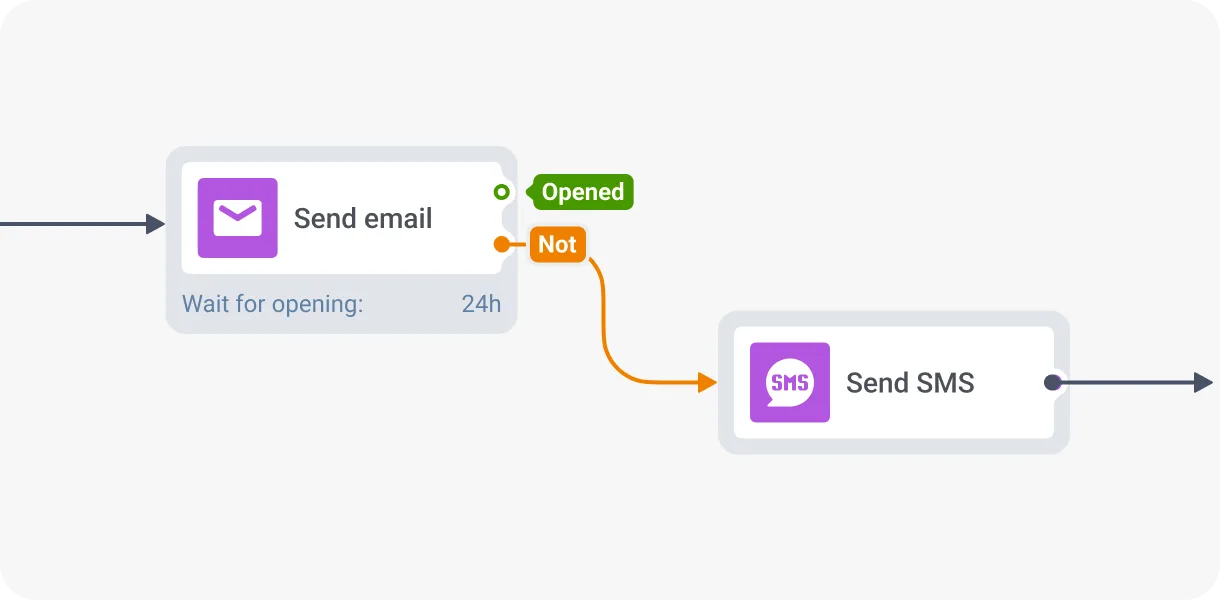
Say a user signs up and needs to verify their identity. → Send a confirmation email first. → If unopened within two minutes, send an SMS notification.
This way, you try to reach the user via their preferred (and/or more cost-effective) channel. But if, for whatever reason, they are unable to interact with it at the moment, you still give them an opportunity to complete the goal.
This is a core email and sms marketing strategy for fintech: use email for detail-heavy communications and SMS as a reliable fallback for time-sensitive actions.
How to do it with Pushwoosh:
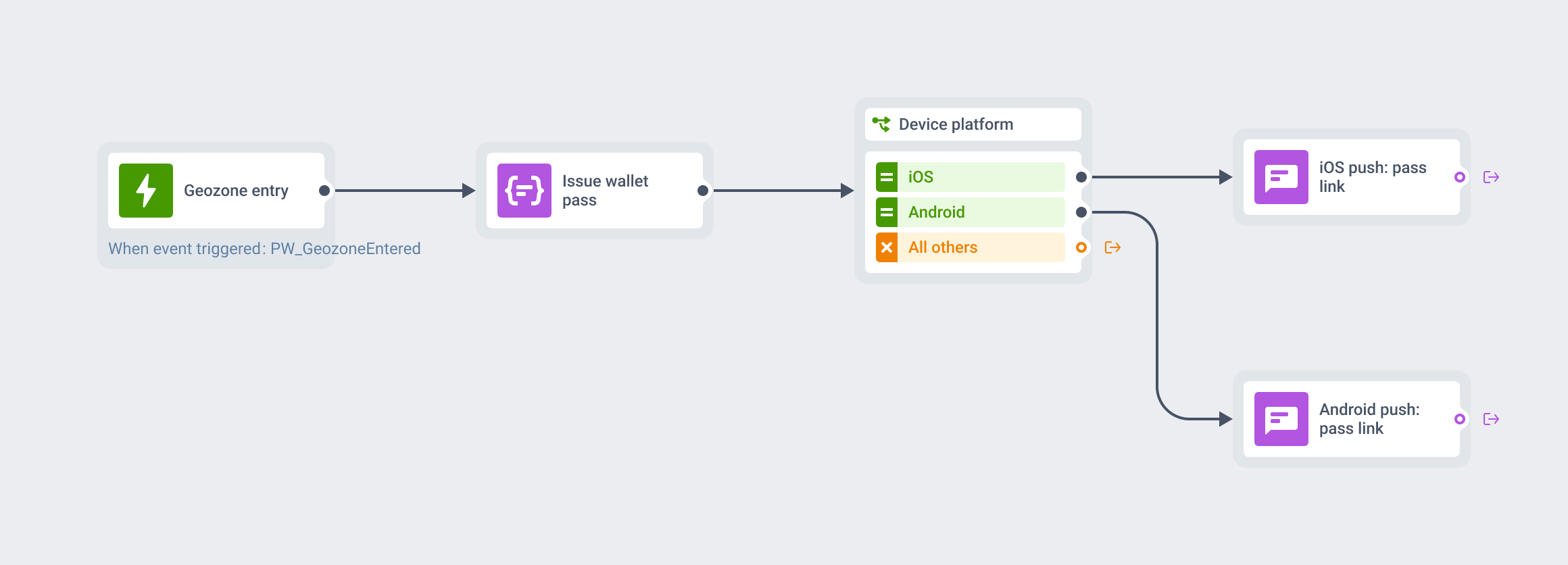
You don’t need to be a developer to build advanced marketing automation with Pushwoosh! Customer Journey Builder allows setting up conditions like “if [email] not opened, then send [SMS].” An automated cross-channel communications workflow like this can be built in seconds:
🎮 Game apps: Re-engage inactive users
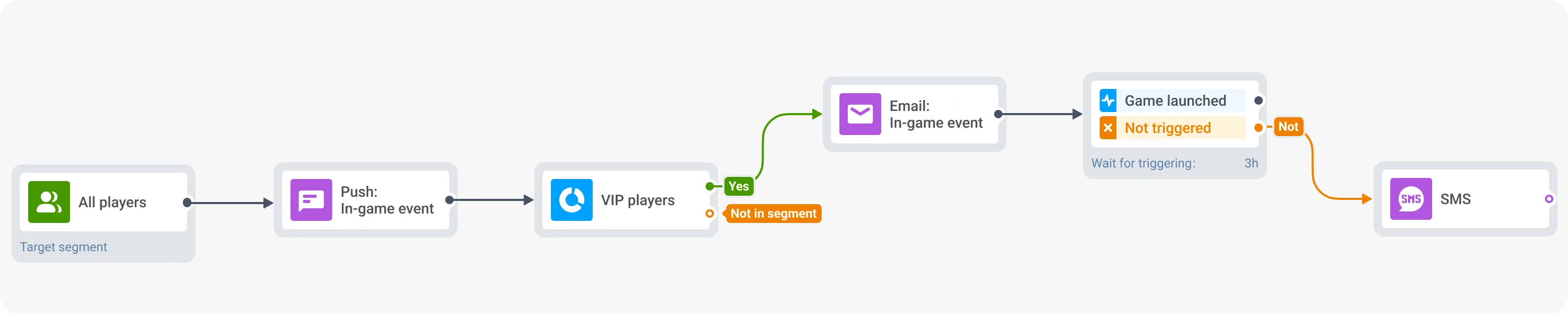
In the gaming industry, it’s all about building user retention without spending a fortune on communications. Here, the effectiveness of your email and SMS marketing campaigns can be increased by adding a third channel, like push notifications and in-app messages.
For example, if you want to announce a new in-game event with maximum reach and minimum cost: → Send a push notification or an in-app message to all players featuring the event’s detailed overview. → Based on their in-app behavior, identify the most active, VIP players, and notify them personally via email. Since they are already highly engaged with your game, they are less likely to miss the update! → Follow up with an SMS to the VIPs who haven’t launched the game within the first three hours to re-engage these high-value users.
🛍️ E-commerce or delivery apps: Abandoned cart recovery & promotions
Promotions are at the heart of all e-commerce communications. But sometimes, a single email is just not enough.
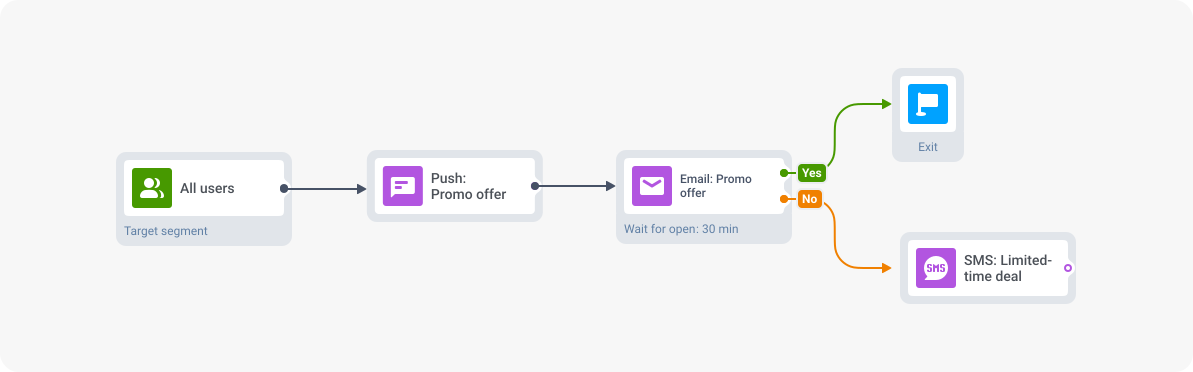
If, for example, you’re launching a flash sale on a limited-time deal, missing that one email may cause a customer to lose a valuable discount. So, why not try a cross-channel approach instead?
→ Send an email and a push notification to your full segment, personalizing the copy of your message: a push can speak of urgency, while an email may cover more details of the promo offer. You can choose the best channel based on pre-determined user preferences. → If a user hasn’t interacted with any of these communications within 30 minutes, send them an SMS with a limited-time deal.
Abandoned cart recovery is another powerful email sms campaign example for e-commerce. Here’s a typical sequence: → Hour 1: Send an email with the cart contents, product images, and a direct link back. → Hour 4: If no action, send a push notification with a reminder. → Hour 12: If still no response, send an SMS with a discount code to create urgency.
This layered approach uses each channel’s strengths and can recover 5–15% of abandoned carts that would otherwise be lost.
📰 News & media apps with subscription-based monetization
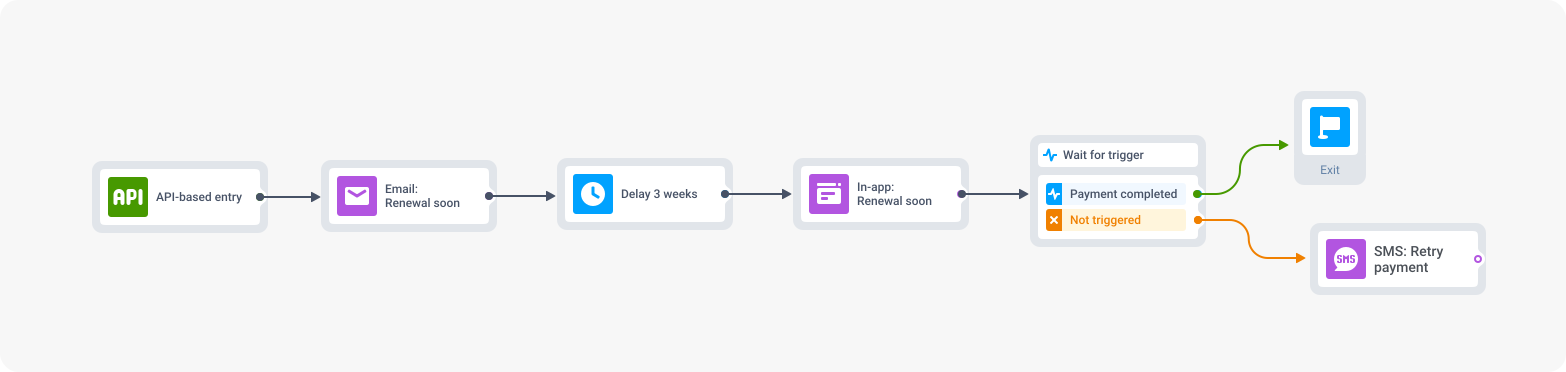
Email is commonly used to remind users their next payment cycle, but an additional channel may be as effective in reducing churn.
→ First, send a reminder email one month in advance, giving the user some time to prepare. In the email, you can also explain the benefits of renewal or justify the price change, if that’s the case. → One week before the new billing cycle, send an in-app notification to active users, making sure the charge won’t be sudden. → And in case the payment fails on the day of the renewal, turn to SMS for urgent actions.
🧾 Retail applications: Loyalty & feedback collection
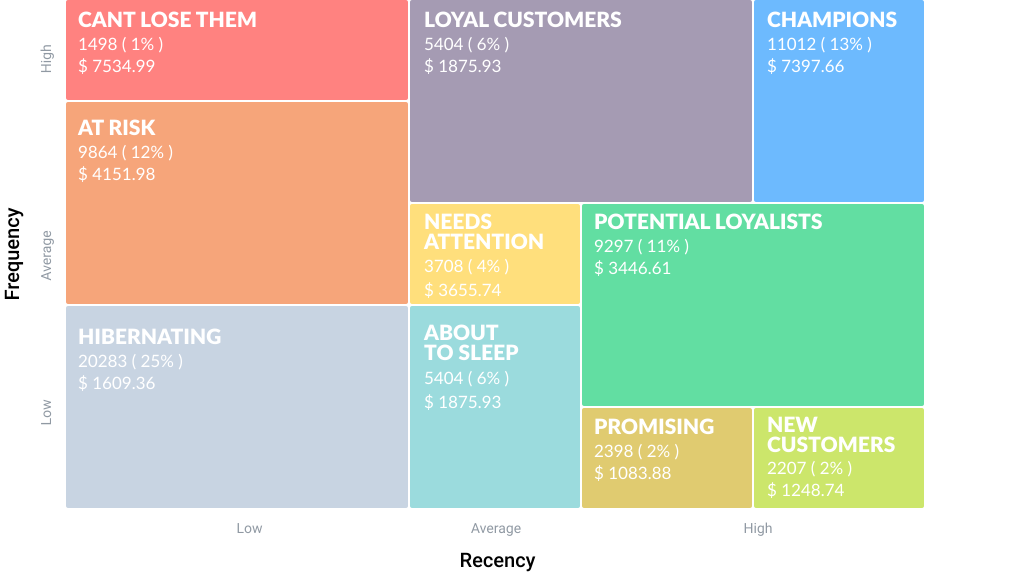
To successfully grow your retail revenue, you need to invest in customer loyalty and communicate with audience segments based on their levels:
→ New users: Onboard them via in-app messages and emails to illustrate all the benefits your business brings to the table. → Loyal customers: Engage them via cost-effective push notifications that you can afford to send regularly to maintain interest in your brand. → Users at risk of churn: Take urgent action with personalized SMS offers.
Feedback collection is another area where the combination shines. After a purchase or app interaction: → Send an email with a detailed survey link for in-depth feedback. → If no response within 24 hours, follow up with a short SMS asking for a quick 1–5 rating.
This dual-channel approach significantly increases response rates and gives you richer customer insights.
How to do it with Pushwoosh:
You can easily identify core user segments based on engagement thanks to Pushwoosh’s RFM segmentation and tailor your communications strategy accordingly.
Best practices for effective email and SMS marketing campaigns
These email and sms marketing best practices will help you get the most from both channels without overspending:
1. Use SMS only when it matters
SMS is more expensive than other marketing channels, so use it only when you absolutely have to: for transactional alerts, confirmations, or time-sensitive promos. Keep your email and sms marketing cost manageable by reserving SMS for high-impact moments.
SMS also makes an excellent fallback option for delivering urgent communications when a recipient doesn’t have internet access, for example.
2. Prefer push to SMS when possible
Push notifications are more affordable and, at times, less intrusive than SMS. They can be used for both transactional and marketing communications. This is a simple but effective email and sms marketing strategy for reducing costs without sacrificing reach.
3. Prioritize low-cost channels but enable fallback
It’s always better to stick to less costly channels, like push or email, for most of your communications, but it’s crucial to have an effective fallback strategy in place.
SMS has a higher open rate than push and can be delivered even when the user doesn’t have internet access, making it a perfect fallback option for critical communications.
4. Invest in segmentation and personalization
One-size-fits-all messaging wastes budget and frustrates users. Use behavior-based segmentation to send the right message to the right user at the right time. Segment by purchase history, engagement level, lifecycle stage, and channel preference.
Email and sms marketing for small business teams can be especially effective when segmentation keeps volumes manageable and messages relevant.
5. Ensure SMS marketing consent and compliance
Obtaining explicit, opt-in sms marketing consent is not optional — it’s a legal requirement under regulations like TCPA and GDPR. Always clearly state what users are opting into and make it easy to unsubscribe. This protects your brand and maintains deliverability.
6. Measure what matters
Don’t just track opens — look at conversions, retention, and CLV impact to track your campaign’s effectiveness. Analyze engagement rates to identify users at risk of churn early and take action. Learn which channels resonate with which audience the most and optimize your campaigns effectively.
Pushwoosh Dashboards provide a complete picture of your campaigns and app performance, while other features, like A/B/n testing, allow for close-up analytics and optimization.
When it’s time to rethink your email & SMS setup
If you’re using SMS and email already, but the results are not there, here are a couple of things that could go wrong:
- You’re using separate ESP and SMS platforms, forced to stitch things together manually
- You can’t track campaign performance in one place
- You’re not sure which messages (or channels) actually drive conversions
- Campaign setup eats up your dev team’s time
- You’re missing SLAs or critical user actions due to poor fallback logic
If any of this rings true, it’s not a messaging problem — it’s a platform problem.
Choosing an email and SMS platform
When evaluating email and sms marketing software, look for these email and sms marketing features:
- Unified channel management — email, SMS, push, and in-app in a single workspace
- Visual customer journey builder — drag-and-drop automation with cross-channel branching
- Behavior-based segmentation — tags, events, and RFM models for precise targeting
- Built-in analytics — cross-channel dashboards that tie messaging to conversions
- Email and sms marketing integration — seamless connection with your existing data sources and tools
- Scalable pricing — a model that grows with your audience, not against your budget
Some email and sms marketing companies offer free tiers to get started. If you’re looking for an email and sms marketing platform free to try, Pushwoosh offers a free plan that includes email, push, and in-app messaging — ideal for email and sms marketing for small business teams who want to test the approach before committing.
Scale your email and SMS marketing with Pushwoosh
Scaling engagement isn’t about choosing between email and SMS. It’s about coordinating them intelligently, efficiently, and with your users in mind. That’s exactly what Pushwoosh — a purpose-built sms and email marketing platform — is for.
Improving customer engagement isn’t about sending more messages. It’s about sending the right message, through the right channel, at the right time.
So, if you want to elevate your users’ mobile app experience and:
- Build smart, automated journeys with marketing automation
- Orchestrate multiple channels in one platform
- Save dev time and reduce messaging costs
- Understand what really drives user action