How to transition from manual to AI-powered marketing in 30 days

Valentina Stepanova
The math is brutal: while you’re manually segmenting a list in Excel, your competitor’s AI has already delivered personalized offers to 10,000 users at the exact moment they were most likely to convert. By the time you hit send, the window has closed.
Let’s talk about what this delay is actually costing you — and more importantly, how to close the gap in 30 days.
The ROI of shifting from manual to AI-first marketing
Every hour you spend on manual campaign operations is an hour your competitor’s AI is out-converting, out-testing, and out-scaling you.
The ROI calculation of implementing AI in your marketing operations is brutally simple:
- Time saved: 40-60 hours per month redirected from execution to strategy
- Test velocity: 10X increase in optimization cycles
- Conversion lift: 2-3X improvement through predictive timing and personalization
- Revenue impact: 40%+ growth in 90 days (documented in real deployments)
But how do you actually achieve these results? Next, we’ll dive into the exact AI automation stack that enables a successful transition.
The marketer’s must-have AI automation stack in 2026
Most marketers still running manual campaigns fall into one of two camps: either they haven’t seen AI in action beyond ChatGPT-style text generation, or they’ve dismissed it as hype that doesn’t apply to their workflow.
But here’s what changes when you see it work: AI isn’t just a productivity tool that helps you work faster. It’s an entirely new operating system that runs and optimizes campaigns autonomously, while you focus on strategy.
Let’s break down exactly how this stack works in practice, and why teams that adopted it early are now outpacing manual operations:
1. AI-powered send time optimization
Stop guessing when users are most likely to engage. AI analyzes individual user behavior patterns and delivers messages when that specific user is most likely to convert, not when a whitepaper said “most people” open notifications.
Manual approach: Send everything Tuesday at 10 AM because that’s when aggregate open rates were highest last quarter.
AI approach: User A gets their message at 7:23 AM (when they typically check their phone), User B at 9:47 PM (their peak engagement window), User C at 2:15 PM (right after their historical purchase pattern).
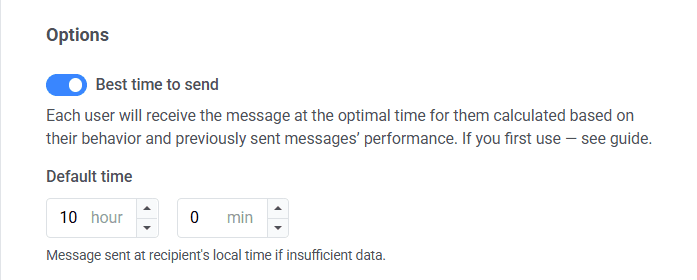
ROI impact: 3x improvement in open rates and up to 30–40% increase in campaign CTRs from optimized timing alone (according to Pushwoosh’s internal study).
2. Intelligent segmentation
Manual segmentation requires you to hypothesize which attributes matter, then build rules accordingly. You’re limited by your assumptions.
AI-powered segmentation analyzes thousands of behavioral signals simultaneously and automatically creates micro-segments based on actual conversion probability, not your best guess.
With tools like Pushwoosh’s AI segment builder, you simply describe your target audience in natural language: “Users who added items to cart but didn’t complete purchase in the last 7 days, located in the US or Canada.” The AI translates this into precise segment conditions instantly:
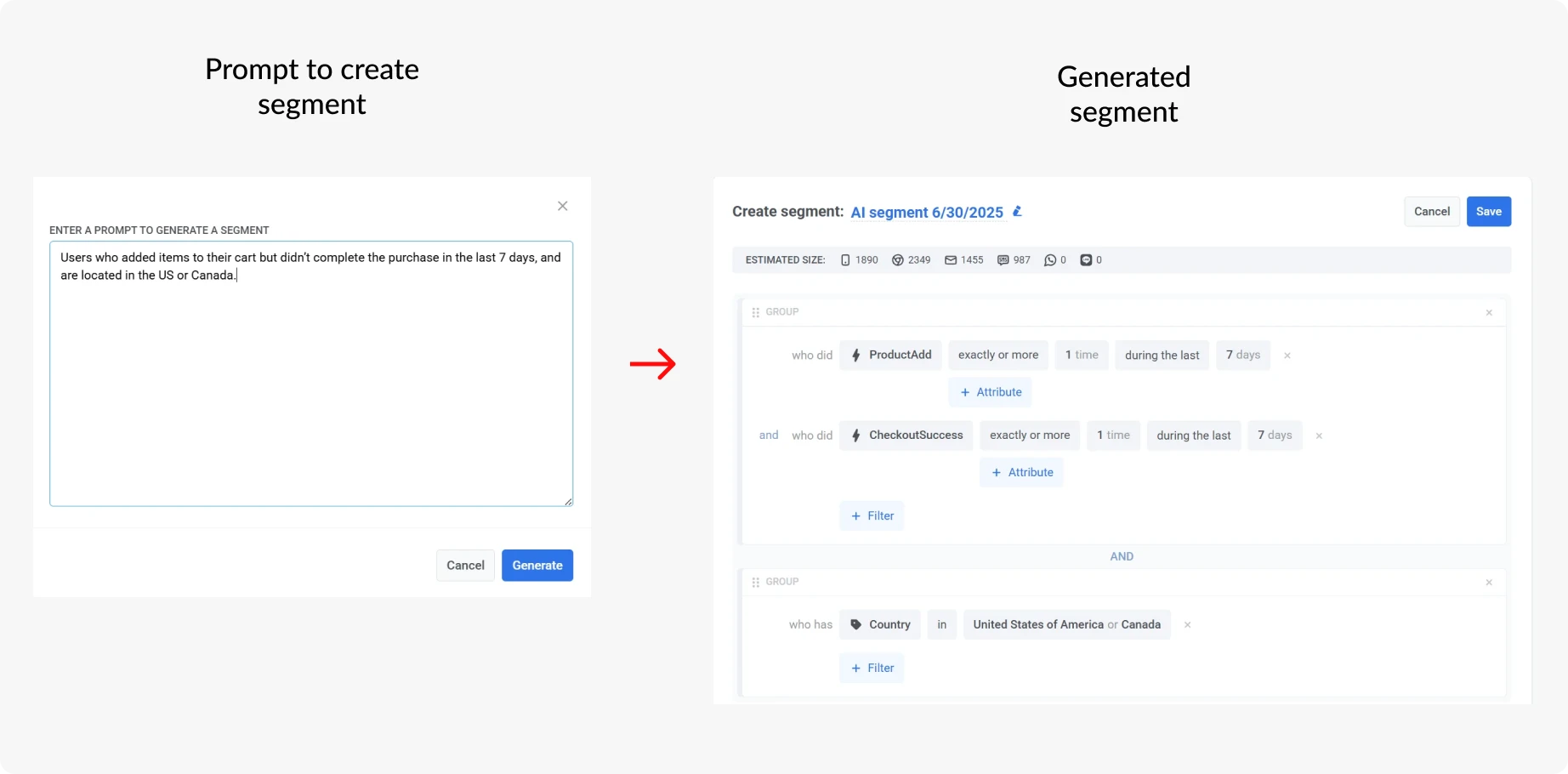
For advanced segmentation, use RFM (Recency, Frequency, Monetary value) to automatically identify and highlight each user’s exact engagement state, helping you predict who is loyal, who is drifting away, and who needs attention right now.
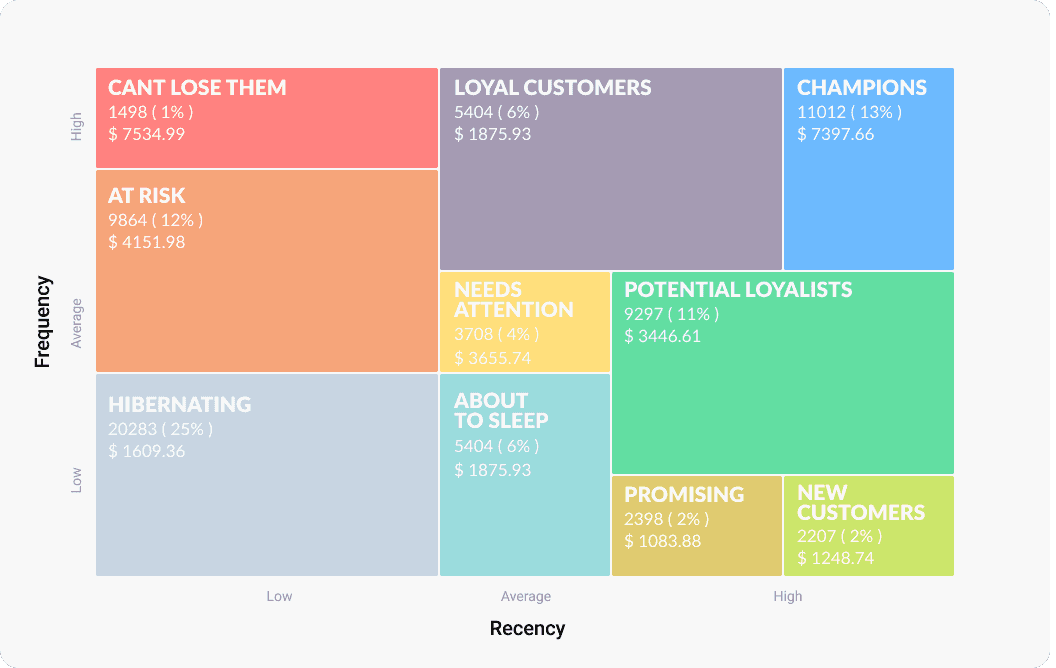
ROI impact: Reduce segmentation time from 4-6 hours to under 30 seconds. Increase campaign personalization and conversion rates by 2-3X through behavior-based personalization.
3. A/B testing at scale
Manual A/B testing means creating 2-3 variants (because that’s all you have time for), waiting days for statistical significance, manually analyzing results, and then implementing the winner for your next campaign.
Automated testing transforms this entirely: Instead of testing isolated elements (“Which push headline converts better?”). You test entire communication strategies inside customer journeys.
That’s channel, timing, copy, and sequence logic tested together:
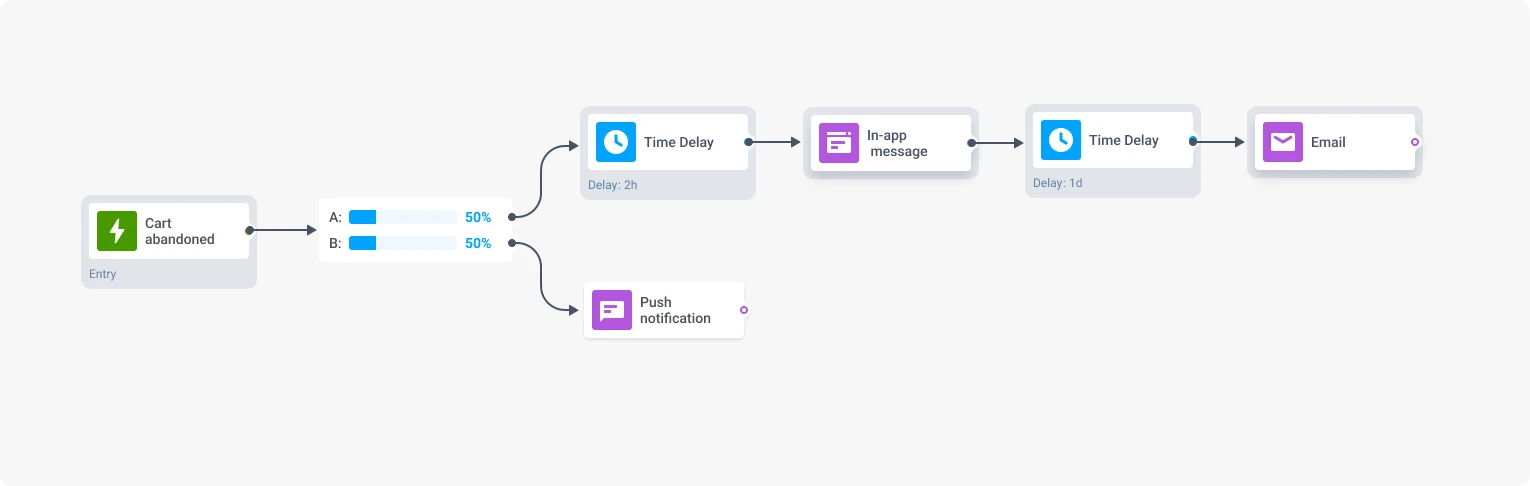
Modern customer engagement platforms like Pushwoosh support A/B/n tests and handle random traffic distribution, real-time performance tracking against actual revenue goals (not just opens), automatic winner detection when variants reach statistical confidence, and seamless scaling — turn off losers, scale winners to 100% with one click.
ROI impact: 10X increase in test velocity (from 2-3 tests per month to 20-30 concurrent experiments). Continuous optimization means every campaign performs better than the last.
4. AI content generation
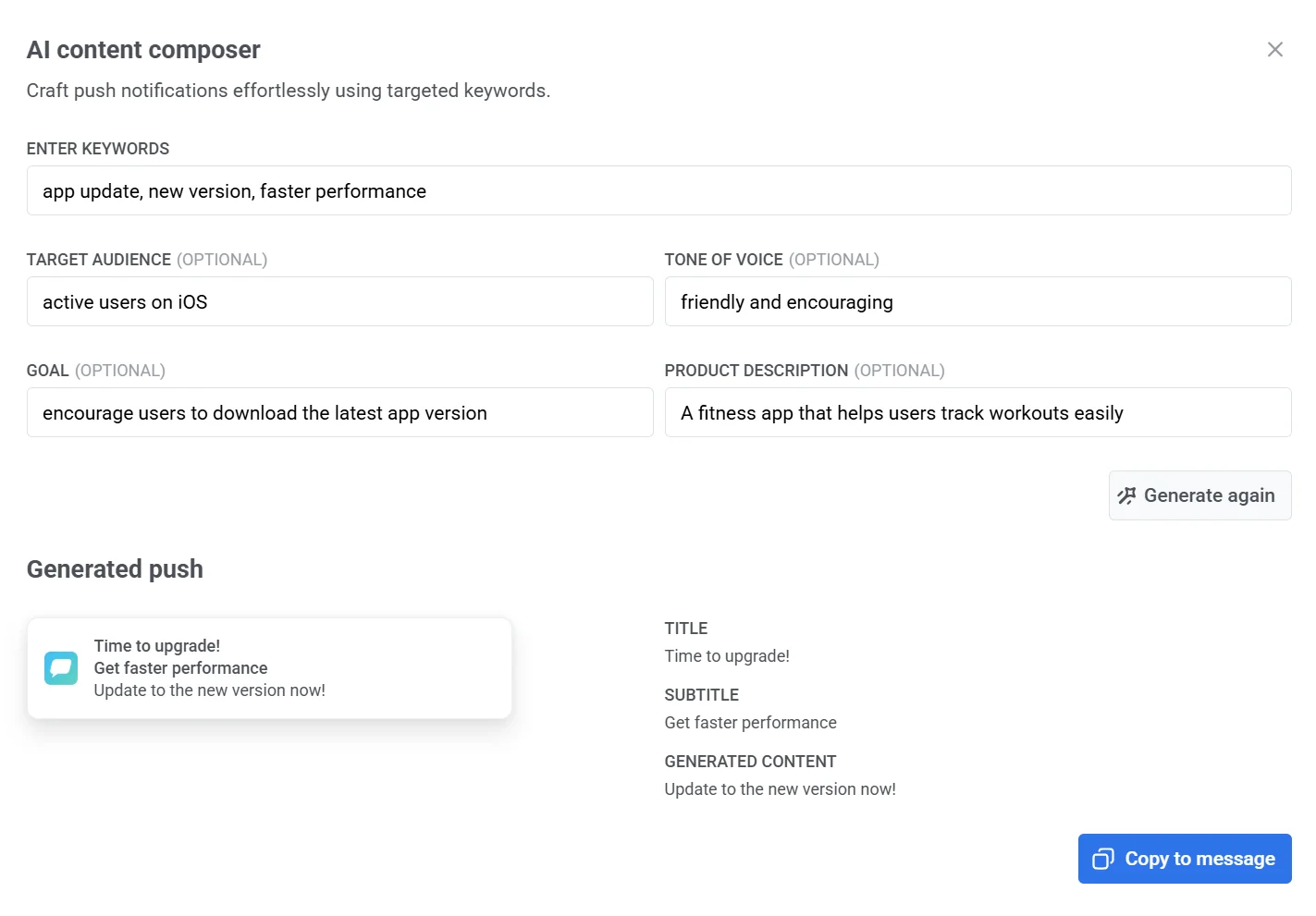
AI content generation tools can create message content in seconds based on prompts: keywords, target audience, tone, and goal.
Based on this input, AI instantly generates a ready-to-send push notification, adapting its length and structure to best-practice guidelines:
You can also localize your message with one click. AI will automatically translate and adapt push notifications to a user’s default language:
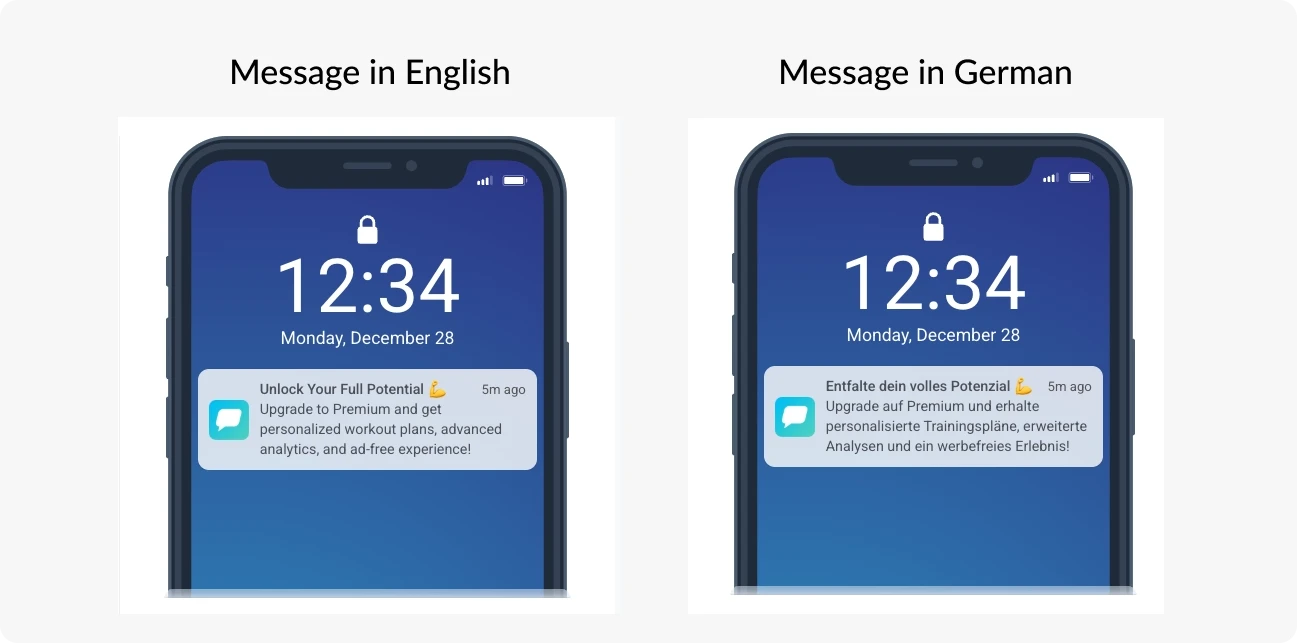
ROI impact: Reduce content creation time from 30+ minutes to under 30 seconds per message. Scale personalized content across multiple languages without hiring translators.
5. Autonomous campaign creation & optimization
Here’s where it gets serious: Most marketing automation still optimizes for engagement (opens, clicks). AI optimizes for revenue.
Pushwoosh’s ManyMoney AI analyzes your specific conversion patterns and revenue events to automatically create and run campaigns that drive actual business outcomes.
All you need to do is provide a prompt like “Create a holiday campaign for our two segments.” ManyMoney AI builds the entire journey structure, creates the message content, sets up conditional logic, and continuously optimizes performance.
Watch the video on how to create an autonomous campaign:
ManyMoney AI identifies performance leaks in real-time and automatically fixes or stops underperforming campaigns to avoid budget waste.
ROI impact: 40-60 hours per month freed from campaign execution. 40%+ revenue growth in 90 days through autonomous optimization focused on actual conversions, not vanity metrics.
Your 30-day roadmap: From manual to AI-first
Transitioning from manual operations to predictive marketing doesn’t mean ripping out your entire stack tomorrow. Here’s a practical implementation roadmap:
Week 1: Audit & baseline
- Document the current time spent on campaign operations
- Establish baseline metrics: conversion rates, campaign creation time, test velocity, revenue per campaign
- Identify your biggest bottlenecks: Is it segmentation? Content creation? Analysis paralysis?
Week 2: Automate manual operations
- Start using AI composer for push notification messages or email content generation
- Build segments with AI using natural language instead of manual condition-building
- Enable send time optimization and track open rates
- Run your first A/B/n test with auto-optimization enabled
Week 3: Test autonomous campaign creation
- Deploy ManyMoney AI on a single use case (recommended: ask the chatbot to create an onboarding or a win-back campaign)
- Give it a clear revenue goal and let it operate autonomously
- Compare results against your manual benchmark campaigns
Week 4: Scale what works
- Expand AI automation to additional use cases based on early wins (for instance, abandoned actions)
- Transition routine campaigns to autonomous operation (welcome series, re-engagement, promotional)
- Redeploy your time to strategic initiatives: competitive analysis, new channel testing, customer research
- Report results to leadership: time saved, revenue impact, test velocity increase
Ready to transition from manual to AI-first marketing?
Pushwoosh’s AI-powered customer engagement platform gives you everything you need to make a successful shift from manual operations to autonomous optimization: AI composer for instant content generation, AI segment builder for intelligent targeting, and ManyMoney AI as your autonomous marketing copilot — all optimized for revenue, not just impressions.
.webp)