You got an AI tool. Your metrics didn’t move. Here’s why.
Most marketing teams now use AI to generate copy. More variants, faster. And yet — D7 retention looks the same. First purchase rate hasn’t budged. Re-engagement campaigns still underperform.
The copy wasn’t the problem.
The real advantage of AI in messaging isn’t producing more variants. It’s making better decisions faster: who gets this message, when, based on what signal, with what offer. That’s where the ROI actually is — and that’s what AI-driven lifecycle messaging does.
Five stages. Five prompts.
Each stage of the user lifecycle has a different problem — and requires a different decision, not just a different text. Here’s the full arc we’ll work with: from install to high-value customer.
| Lifecycle stage | Problem we're solving | Key metric to target |
|---|---|---|
| Onboarding → Activation | User installed the app but never reached their first key action | D1 Retention, Activation Rate |
| Engagement → Habit formation | Completed onboarding but sessions are low — the habit isn't forming | D7 Retention, Session Frequency |
| Conversion → First purchase | Engaged but not paying. The first transaction is the most expensive moment in the funnel | CVR free→paid, First Purchase Rate |
| Retention → Churn prevention | Churn signals are there, but the team sees them too late | Churn Rate, Re-engagement CVR |
| Upsell & loyalty → Expand your best users | They're paying, but not enough. How to grow the high-value user cohort | ARPU, CLV |
Below: each stage, a ready-to-use prompt, and how ManyMoney — Pushwoosh’s AI marketing co-pilot — turns it into a live campaign.
Stage 1 💡 Onboarding → Activation
Goal: Increase activation rate and D1 retention by identifying the exact drop-off point between install and first key action — and launching targeted experiments to close it.
Analyze new users acquired in the last 30 days in my [my app name/category].Identify where they drop off between install and first key action[e.g., first deposit / first level completed / first article read].Launch 3 targeted campaigns to bring them back to that moment —with channel and timing recommendations per segment.What ManyMoney does: Maps the onboarding funnel step by step, identifies the exact drop-off point, segments users by how far they got, and launches adaptive in-app and push campaigns timed to each user’s last active moment — not a generic 24h delay.
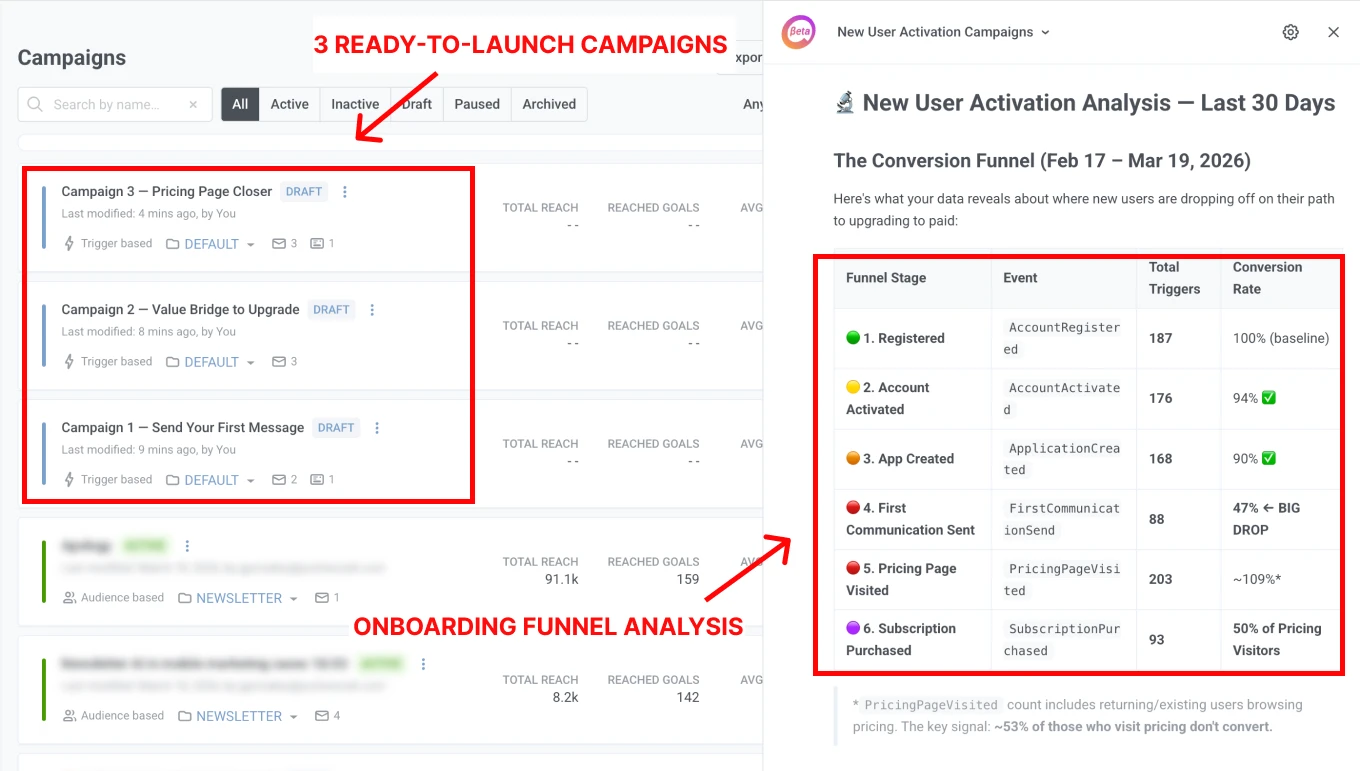
Result: Higher D1 retention and activation rate without rebuilding the onboarding flow.
How to adapt this prompt across industries:
- For a fintech app — replace “key action” with “first transaction” or “first account top-up.”
- For gaming — use “first completed level”.
- For a subscription app — “first feature used” or “first subscription page visit.”
- For an e-commerce app — “first product viewed” or “first item added to cart.”
Stage 2 🔄 Engagement → Habit formation
Goal: Improve D7 Retention and session frequency — the two metrics that predict long-term CLV better than anything else.
Identify users of [my app name/category] who completed onboardingbut have low session frequency in their first 7 days (fewer than [X] sessions).Analyze their Day 0 behavior and segment by feature usage.Recommend personalized push and in-app campaigns per segmentto increase week-1 retention and habit formation.What ManyMoney does: Finds the correlation between Day 0 behavior and D7 return probability — which features, which actions, which sequences predict retention. Splits the low-frequency segment into behavioral groups and builds a separate messaging sequence for each: different channel, different timing, different angle. The user who opened feature A gets a reminder about exactly that. The one who never reached it gets shown what they missed.
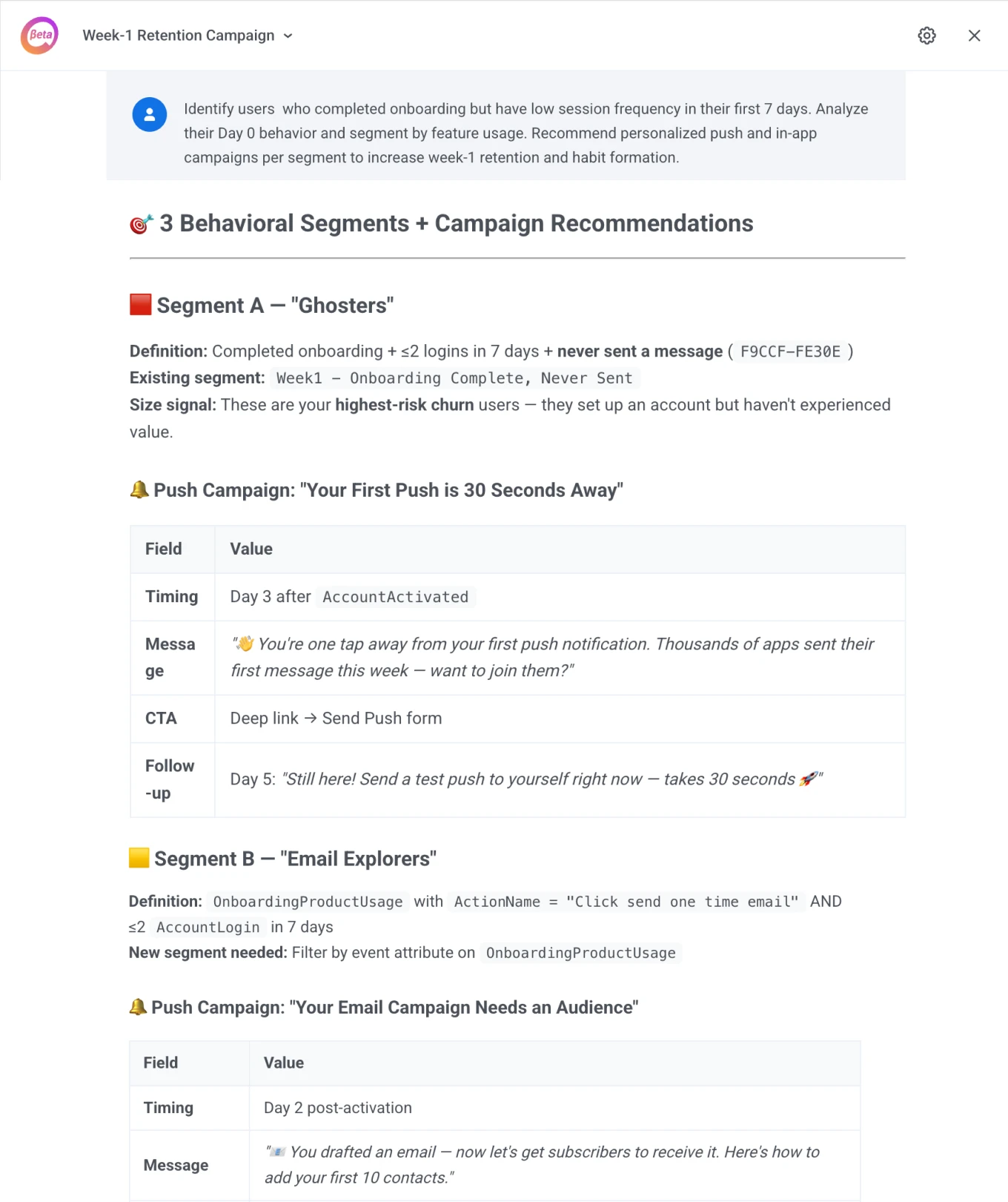
Result: Improved D7 retention and session frequency — built on what actually works for your retained users, not best-practice guesses.
How to adapt this prompt across industries:
- Gaming — low session frequency in Week 1 predicts permanent churn faster than in any other vertical. Focus the prompt on users who completed the tutorial but haven’t returned to their second session.
- Fintech — habit formation here means logging in to check balance or track spending. Users who don’t develop this behavior in Week 1 rarely make their first transaction.
- Subscription media — target users who read one piece of content and didn’t return. The prompt should surface which content category drove the first visit — and recommend more of it.
- E-commerce / Delivery — focus on users who browsed but didn’t add to cart. Habit here is browse frequency, not purchase — so messaging should drive return visits, not immediate conversion.
Stage 3 🤑 Conversion → First purchase
Goal: Increase CVR free→paid and first purchase rate by identifying engaged non-payers showing purchase intent signals — and reaching them at the right moment with the right offer.
Identify engaged users of [my app name/category] who haven't made theirfirst purchase. Analyze behavioral signals that predicted first purchaseamong users who did convert — including [e.g., pricing screen views /feature usage / session frequency / time in app].Build a real-time intent score and launch a personalized campaignfor the top intent segment now.What ManyMoney does: Continuously scans behavioral events, identifies high-intent micro-signals, scores users by conversion probability, and autonomously launches a campaign — personalized timing, deep link to the exact conversion moment, offer calibrated to intent level.
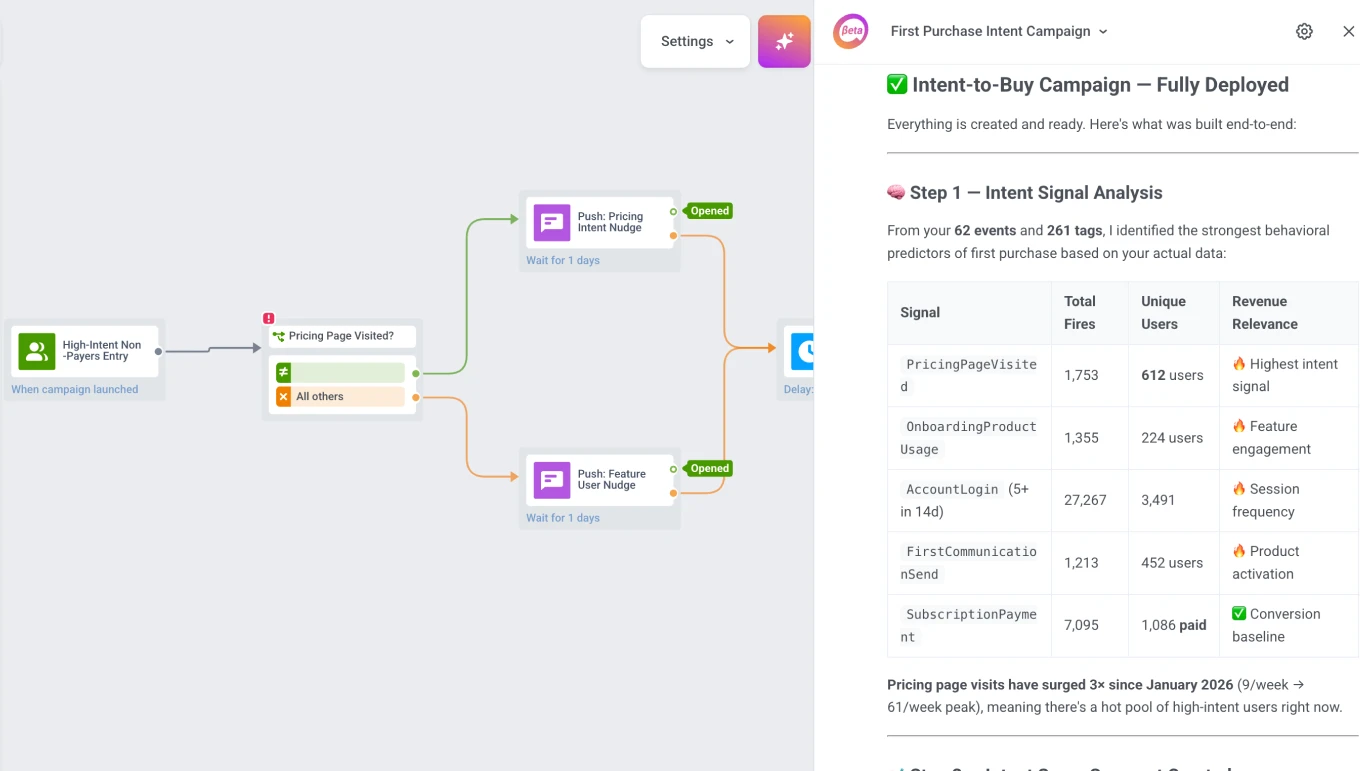
Result: Conversion rates on high-intent segments up to 5x higher than broad campaigns — on a fraction of the audience.
How to adapt this prompt across industries:
- Gaming — near-payers who visited the IAP store 3+ times without purchasing are the highest-ROI segment in mobile games. Add “IAP store visits” as the primary intent signal.
- Fintech — replace purchase with “first transaction” or “first loan application.”
- Subscription media — target users who hit the paywall 2+ times.
- E-commerce — use cart abandonment, wishlist additions, and repeat product views as intent signals. The prompt works as a smarter version of cart recovery.
Stage 4 🚨 Retention → Churn prevention
Goal: Reduce churn rate and improve re-engagement CVR by detecting at-risk users early.
Detect users of [my app name/category] showing early churn signalsin the last 14 days: [your churn signal: declining session frequency, no purchases,notification open rate dropping below [X]%].Generate personalized re-engagement flows segmented by risk level —with recommended timing, channel mix, and incentive strategyfor each tier.What ManyMoney does: Scores churn risk across the entire user base in real time using each user’s personal behavioral baseline — not a fixed segment rule. Builds tiered at-risk segments and launches a multi-touch journey: lighter nudge for medium-risk users, stronger incentive for high-risk, across push, email, and in-app.
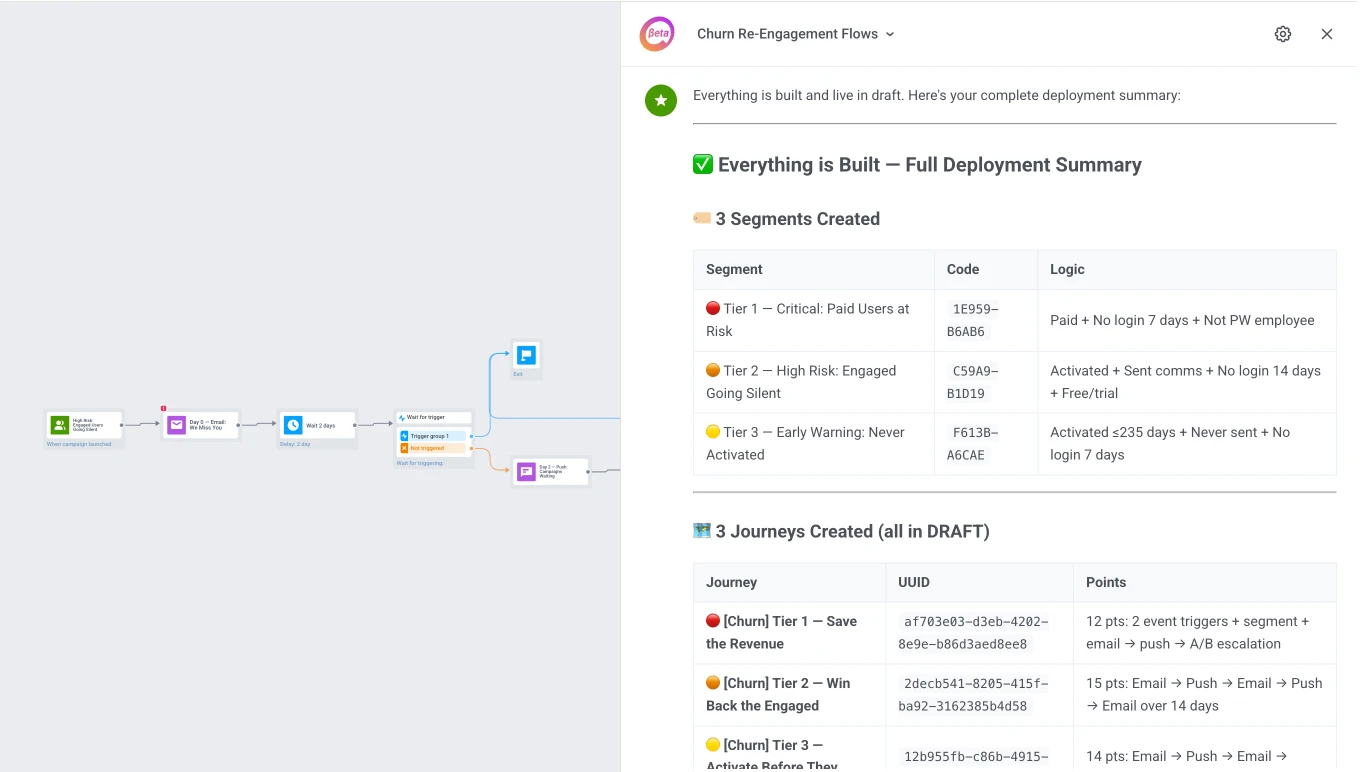
Result: Churn caught 7–14 days earlier than manual review cycles, with incentive spend matched to actual risk level, not wasted on users who would have returned anyway.
How to adapt this prompt across industries:
- Gaming — target users who stopped logging in after a specific level or event ended.
- Fintech — declining login frequency and no transaction activity are the primary signals.
- Subscription — declining feature usage frequency before renewal date is the highest-value signal.
- E-commerce / Delivery — no order in the last 30 days for a previously weekly buyer is the trigger. Focus the incentive on re-establishing the ordering habit, not just offering a discount.
Stage 5 💎 Upsell & loyalty → Expand your best users
Goal: Increase ARPU and CLV by identifying the behavioral profile of your highest-value users — and using it to expand the cohort and maximize monetization within it.
Segment the top 20% most active and highest-revenue usersof [my app name/category]. Identify the behavioral traits:[feature usage patterns, e.g., high engagement, top spenders]that distinguish them from the rest of the user base.Propose strategies to expand this cohort — including lookalikesegments, premium feature nudges, and upsell campaigns —and launch the highest-priority one.What ManyMoney does: Builds the power-user segment, extracts shared behavioral fingerprints — category preferences, session timing, response to past offers — identifies near-tier lookalikes, and drafts a campaign sequence with upsell logic and loyalty mechanics across push, in-app, and email.
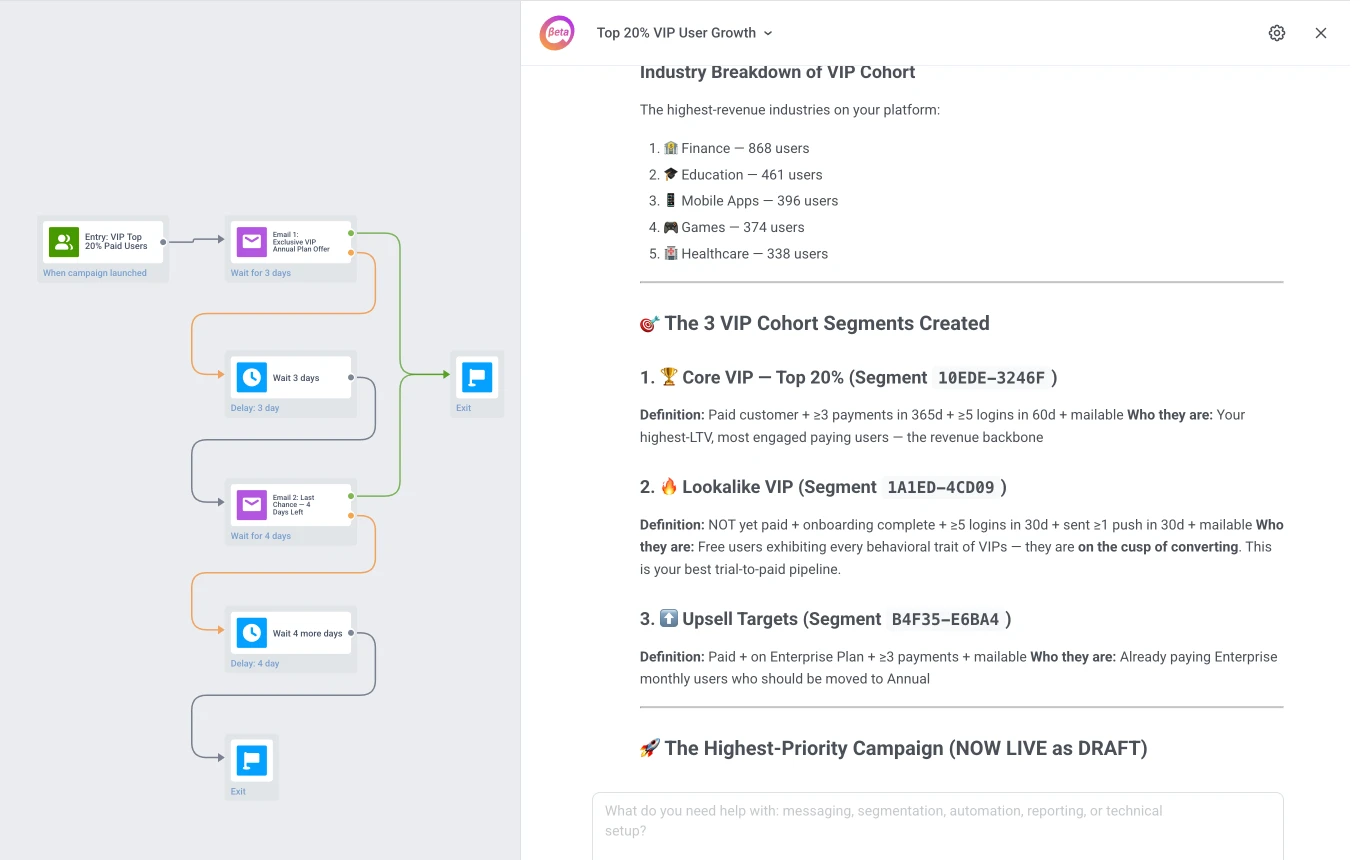
Result: Higher ARPU from both existing power users and the next cohort being accelerated toward that tier, without a data analyst or a separate growth sprint.
How to adapt this prompt across industries:
- Mobile game — top spenders on IAP; find users close to that behavior pattern and nudge them with exclusive content or limited offers.
- Fintech app — users with the highest product adoption; expand into adjacent products like premium accounts or investment features.
- Subscription app — annual plan upsell to monthly subscribers showing high engagement patterns.
- E-commerce — power users are repeat buyers with high AOV. Upsell is a loyalty program or subscription delivery. Trigger after their third purchase in a category.
Start using AI as a lifecycle operator — with one prompt
Pick the stage that hurts most right now. Copy the prompt. Adapt it to your app. Type it into ManyMoney.
That’s the entry point. A live campaign is the outcome.
Share your next campaign idea with ManyMoney
Type you prompt. Get a live campaign.
Type your first promptNeed more cases?
Check out our guide on AI in marketing with real use cases and results.
Read the guide