Reduce churn rate for SaaS and subscriptions
Stop losing customers you could save. Spot churn early, act before they cancel.
What churn is costing you right now
Before you fix churn, you have to feel it. Small monthly percentages compound into massive annual revenue destruction, and every churned customer also burns the acquisition cost you paid to win them.
The real math of monthly churn
| Monthly churn | Annual customer loss | What it means |
|---|---|---|
| 5% | 46% | You replace nearly half your base every year just to stand still |
| 3% | 31% | A third of customers gone annually, plus the cost to replace them |
| 2% | 22% | Healthy for most SaaS, but still hundreds of thousands in lost revenue at scale |
| 1% | 11% | Best-in-class retention, where growth compounds instead of leaks |
Catch churn before it’s too late
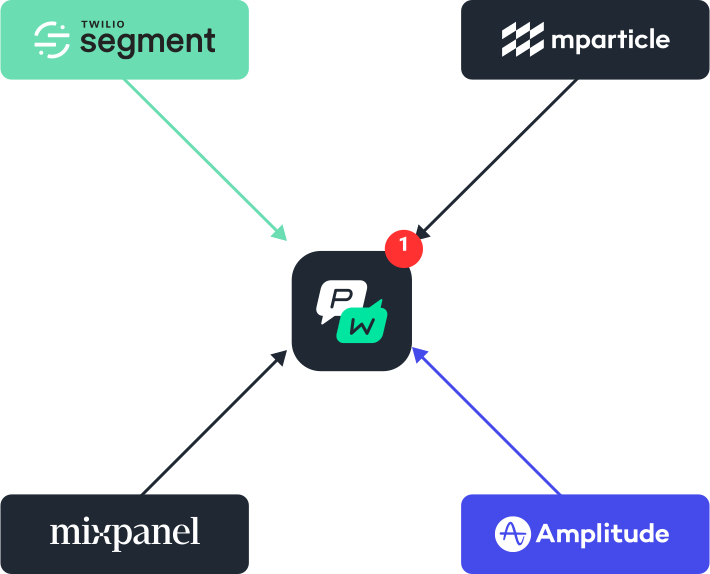
Churn is rarely a sudden decision. It shows up first as a pattern of behavior. Unify every signal in the customer data platform, set risk thresholds for your product, and let automation respond the moment a customer drifts toward the exit.
Four signal categories that predict churn
Most products already collect everything needed to predict churn. The difference is acting on it. These four categories cover the behavioral, commercial, and emotional warning signs that precede almost every cancellation.
Switch between them below to see what to monitor, the thresholds that predict churn, and the automated response each one should trigger.
Engagement decline signals
What to monitor
Login frequency drops, session duration falling more than 30% over 30 days, key features going unused, fewer pages per session, and declining open rates.
- 50% drop in weekly logins: medium churn risk
- 70% drop in feature usage: high churn risk
- 14 or more days without login for a daily product: critical risk
- 3 consecutive missed weekly emails: moderate risk
Automated response
Medium risk enters a re-engagement campaign. High risk gets a retention offer plus a success check-in. Critical risk triggers immediate multi-channel outreach.
Example: a user was logging in daily, now 8 days have passed since their last session. Churn risk fires a “we miss you” in-app message on their next visit, plus an email if there is no visit within 3 more days.
Product adoption signals
What to monitor
Core feature usage, feature breadth (one feature versus many), integration usage, advanced feature adoption, and setup completion.
- Using only 1 of 5 core features: moderate risk
- Never completed onboarding: high risk
- Removed an integration: high risk
- Usage declining back to baseline: moderate risk
Retention response
Low adoption triggers a feature education campaign. Incomplete setup triggers a guided onboarding prompt. A removed integration triggers a “what happened?” outreach.
Example: a SaaS user only ever used 1 of 6 core features in 90 days. An education series on the features they are missing lifts adoption, and churn risk drops. Deliver it with in-app education campaigns.
Commercial and billing signals
What to monitor
Payment failures (soft and hard), plan downgrade requests, repeated billing page visits, pricing page visits, invoice disputes, and cancellation page visits.
- Failed payment: immediate dunning campaign
- Billing page visited more than 3 times: price sensitivity signal
- Pricing page plus competitor comparison: active shopping
- Downgrade request: churn precursor
Retention response
Failed payments enter a dunning sequence (day 1, 3, 7). Price sensitivity triggers a value demonstration campaign. Competitor shopping triggers a competitive retention offer.
Example: a user visits the pricing page 4 times in 2 weeks. A price sensitivity flag fires a proactive value email: “here is what your plan gets you,” paired with an ROI calculator.
Support and sentiment signals
What to monitor
Support ticket volume, ticket sentiment, NPS and CSAT responses, rejected feature requests, community activity, and review site activity.
- 3 or more support tickets in 30 days: frustration signal
- NPS score below 6: detractor, high churn risk
- Negative CSAT after support: unresolved frustration
- Went quiet after being active in the community: disengagement
Retention response
High ticket volume triggers proactive success outreach. Low NPS triggers a personal recovery campaign. Negative CSAT triggers an immediate follow-up from the success team.
Example: a user submits 4 support tickets in 2 weeks. A proactive success check-in resolves the issue, and churn is prevented before it starts.
Automated campaigns for every churn scenario
Six campaign types cover the full churn journey, from the first engagement dip to winning customers back after they leave. Each one triggers automatically off the signals above and runs without manual work.
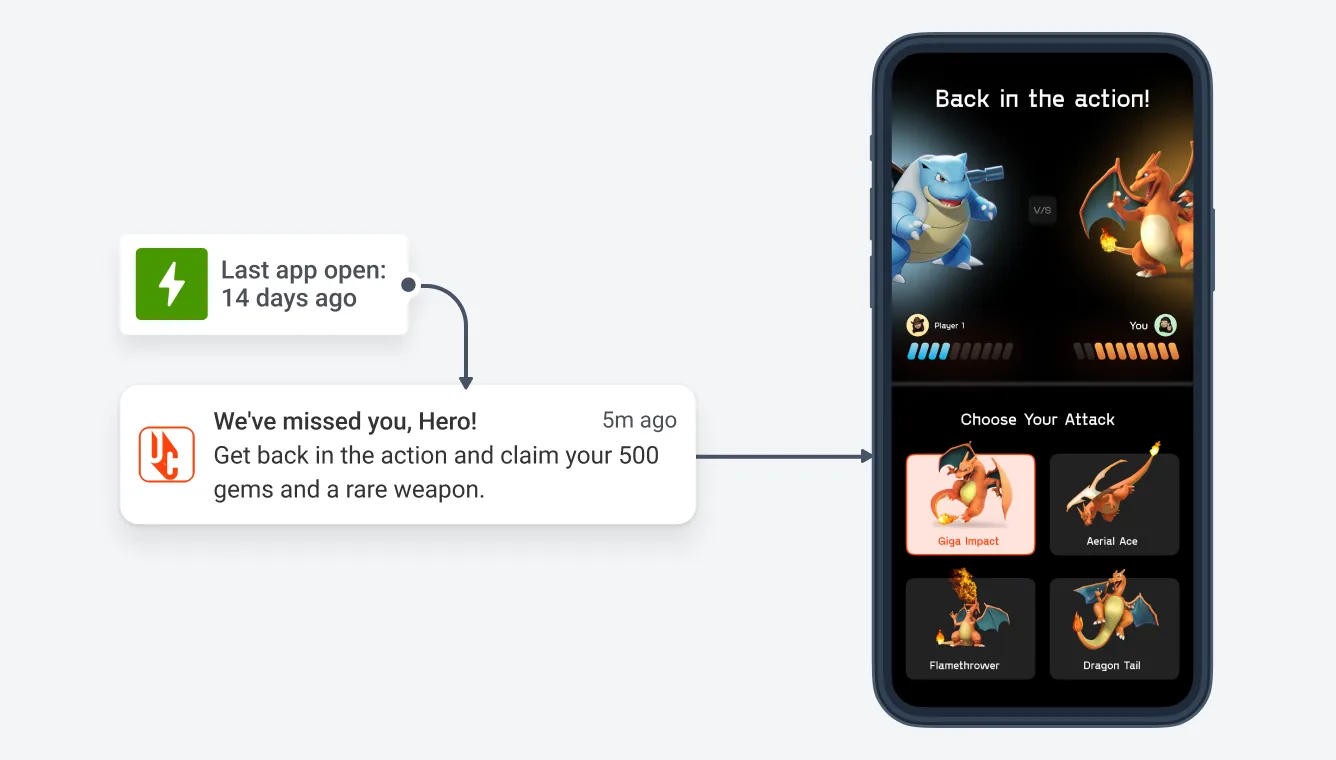
Early warning re-engagement
Trigger
Engagement drop detected (medium risk).
Goal
Re-engage before churn risk escalates.
Flow
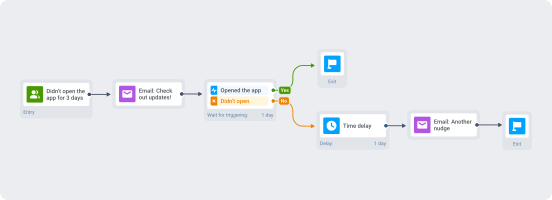
Day 1, in-app message on next visit: “Welcome back, here is what’s new.” Day 3 with no visit, push notification: “You have unread updates.” Day 5, email with quick tips. Day 7, SMS if available.
Result: 45% re-engagement rate from at-risk users.
Feature adoption push
Trigger
User not adopting the key value-driving features.
Goal
Increase product stickiness through education.
Flow
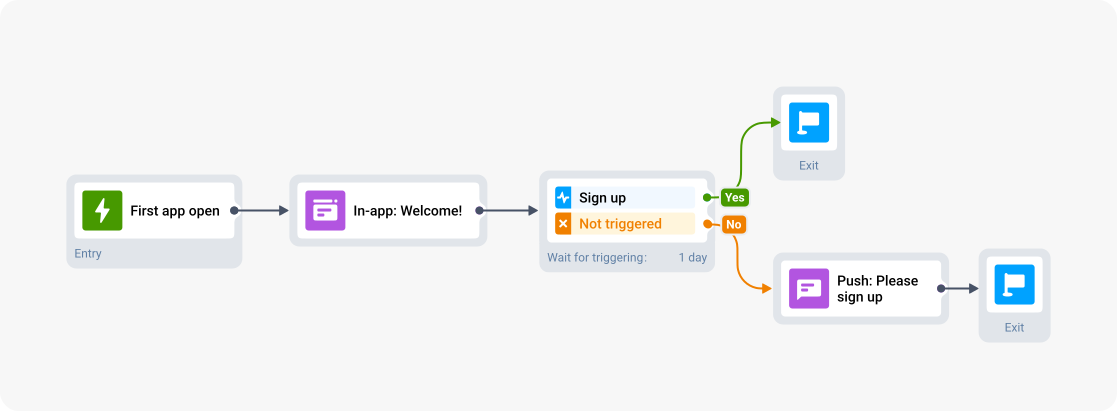
Week 1 email: “You are using only X% of the product.” Week 2 in-app tooltip on the unused feature. Week 3 case study email. Week 4 personal outreach.
Result: 35% feature adoption increase and 28% churn reduction for users who adopt 3 or more features. Pair it with push notification campaigns for reach.
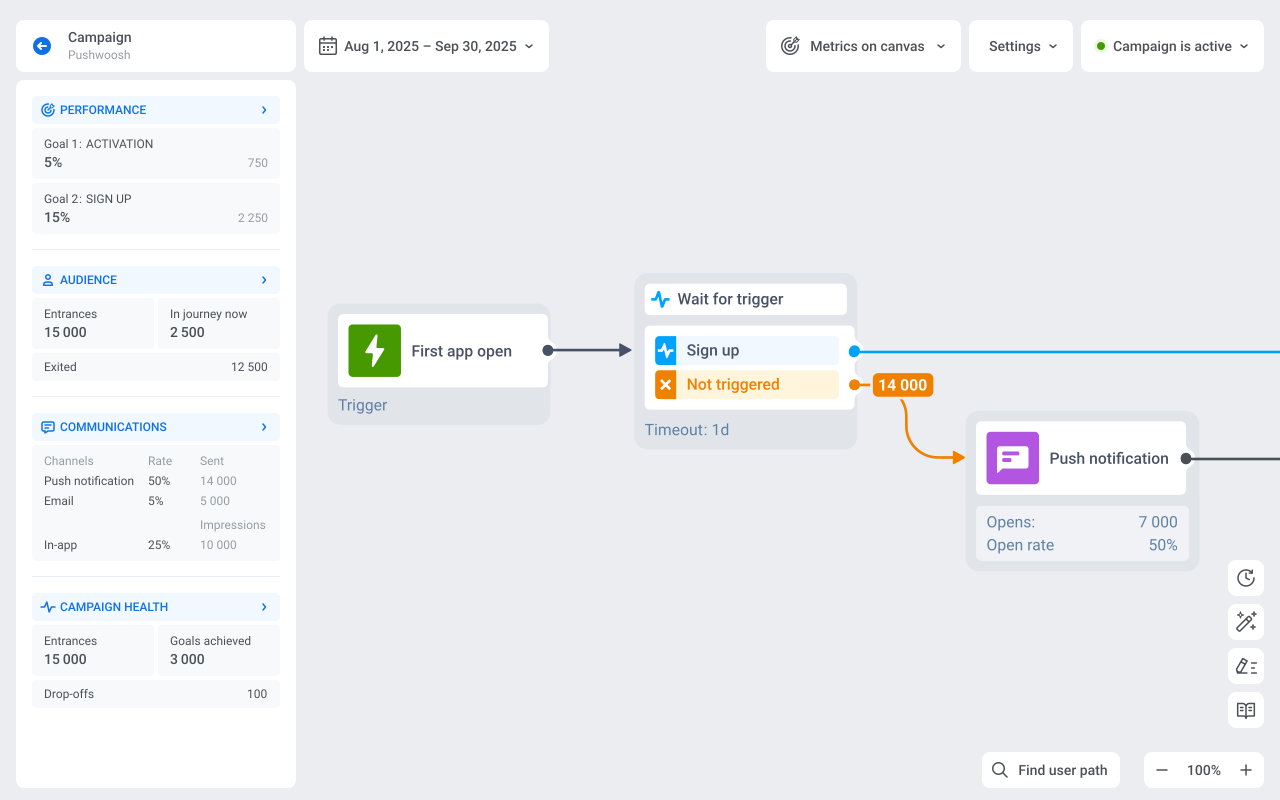
Value demonstration
Trigger
Price sensitivity signals or repeated billing page visits.
Goal
Reinforce ROI before a customer cancels over price.
Flow
Day 1, a personalized value report. Day 3, an in-app ROI dashboard. Day 7, a similar-customer success story. Day 14, a loyalty discount or plan optimization offer.
Result: 32% fewer price-related cancellations and 22% conversion on loyalty offers.
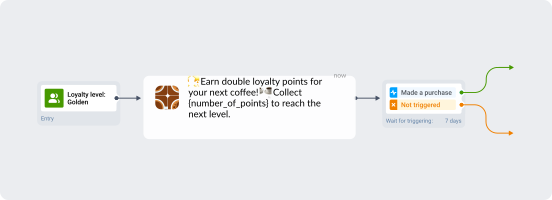
Save the cancel
Trigger
Cancellation page visit or cancellation initiated.
Goal
Last-chance intervention before a confirmed cancel.
Flow
On the cancellation page, surface alternatives. On cancel initiated, offer pause or downgrade. After cancellation starts, send a save offer, then a final attempt 24 hours later.
Alternatives offered: pause for 1 to 3 months, downgrade a tier, extend the trial, switch billing frequency, or apply a loyalty discount.
Result: 28 to 35% save rate on active cancellations, and 42% choose pause over a full cancel.
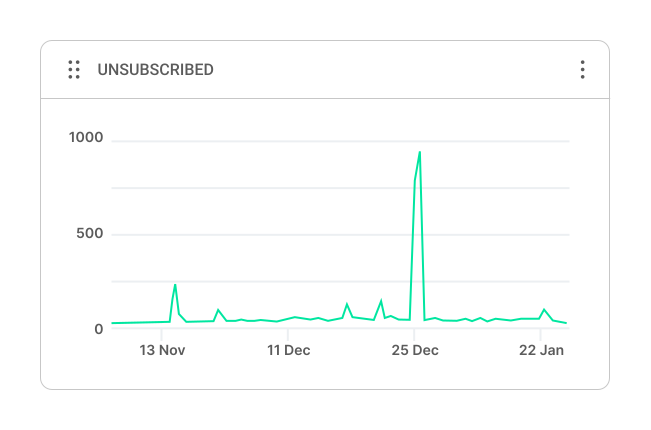
Dunning and payment recovery
Trigger
Payment failure detected.
Goal
Recover failed payments before involuntary churn.
Flow
Day 0 email: “Payment failed, please update your card.” Day 1 push. Day 3 in-app suspension warning. Day 5 SMS final notice. Day 7, suspension plus recovery email. Every message links straight to a one-click payment update.
Result: 68% recovery on failed payments with automated dunning versus 35% without. Build the sequence with automated email campaigns.
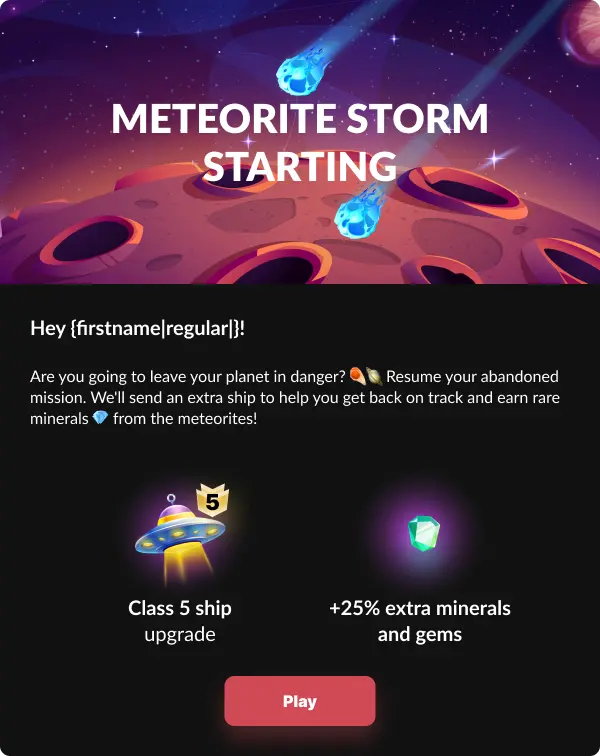
Win-back after churn
Trigger
Customer cancels or churns.
Goal
Re-acquire churned customers.
Flow
Day 1, a “sorry to see you go” feedback request. Day 7, “here is what changed.” Day 30, a comeback incentive. Day 60, a final best offer. Day 90, long-term nurture with product updates only.
Result: 12 to 18% win-back rate from churned customers within 90 days, especially when the offer addresses why they left.
Reach at-risk customers on every channel
Multi-channel retention saves 2.4x more customers than email alone. Start with the least intrusive channel and escalate only when the previous one goes unanswered, all orchestrated in the customer journey builder.
In-app messages
Best for catching users the moment they return: welcome-back messages, feature highlights, value summaries, and pause options on the cancellation page. Helpful, not desperate. A user who returns after a 10-day absence sees a full-screen welcome with a summary of what's new.
Best for detailed value demonstrations, case studies, ROI reports, and win-back sequences after churn. Informative and personal. A monthly value email recaps what the customer accomplished and shows how to do even more.
Push notifications
Best for immediate attention: re-engagement nudges after absence, payment alerts, and time-sensitive offers. Brief and actionable. Seven days since last login triggers a push highlighting three new things to come back for.
SMS
Reserved for critical moments: payment failure final notices, suspension warnings, and high-value at-risk customers. Urgent but not alarming. On day 5 of a failed payment, an SMS warns that access suspends in 48 hours with a one-tap update link.
What works in churn prevention
Eight principles separate retention programs that move the number from those that just send more email.
Act early, not at cancellation
80% of churn is decided weeks before cancellation. Intervening at the cancel page saves 20 to 35%. Intervening 30 days early saves 50 to 65%. Act on the first engagement drop, not the final click.
Segment by reason, not just risk score
Same risk, different reasons, different solutions. A disengaged user needs re-engagement, a price-sensitive user needs a value demo, and a user missing a feature needs roadmap transparency, not a discount.
Make cancellation harder, not impossible
Offer alternatives like pause, downgrade, and plan change, and capture exit feedback. Do not make cancellation so painful it damages the brand. A good flow sees 35% choose an alternative over leaving.
Personalize retention offers
Blanket '20% off' to every churner is lazy. High-value customers warrant more aggressive retention, price-sensitive customers want plan optimization, and feature problems need education, not a discount.
Fix the product, not just the messaging
Churn data points straight at product gaps. The same feedback repeated is a roadmap item. Campaigns buy time, but when 50% of churners cite one missing feature, building it cuts churn from that segment by 60%.
Use exit data to improve onboarding
Churners who never adopted a feature reveal an onboarding gap. Users who skip a key integration in week 1 churn 3x more, so adding an integration prompt to onboarding cuts churn 22%.
Reward loyalty, not just win-back
Spend more on keeping happy customers than on saving leaving ones. Loyalty discounts, milestone rewards, and annual plan incentives pay off: annual plans convert 40% of monthly subscribers and cut voluntary churn 65%.
Measure cohort retention, not snapshots
Cohort retention shows real product improvement, while snapshot churn misleads. Track whether the 2024 cohort stays longer than 2023: a jump from 65% to 78% 12-month retention is genuine progress.
Reduce churn in 4 weeks
You do not need a data science team or a predictive model to start. Behavioral signals and a few core campaigns deliver measurable results in the first month.
-
Week 1: baseline and detection setup
Track key engagement signals (logins, feature usage, billing page visits), define churn risk thresholds for your product, calculate your current churn rate and its cost, and segment customers by risk. Connect the customer data platform for a unified view. Deliverable: you know your churn rate, its cost, and your top 100 at-risk customers.
-
Week 2: first retention campaigns
Launch the three highest-ROI campaigns in order: a dunning sequence for payment recovery, a re-engagement message for lapsed users, and a cancellation intervention with a pause or downgrade option. Deliverable: three campaigns live, with first retention results within days.
-
Week 3 to 4: expand coverage
Add a feature adoption email series, a monthly value report, and a win-back sequence for recently churned customers. Connect more signals: support tickets, NPS and CSAT triggers, and usage analytics events. Deliverable: a full retention suite covering every major churn scenario.
-
Month 2 and beyond: optimize and automate
Layer in predictive churn scoring, personalized offers by segment, and A/B testing on messages and offers. Expect 10 to 15% churn reduction by month 1, 20 to 30% by month 3, and 30 to 40% compounding by month 6.
Start reducing churn today
See how SaaS and subscription companies reduce churn by 25 to 40% with automated retention campaigns. One demo shows you exactly what's possible for your business.
Explore related products
App engagement platform with advanced automation. Increase DAU, drive feature usage, and build loyal user base with behavior-driven campaigns.
Revenue-focused marketing automation that optimizes for money, not vanity metrics. Increase ARPU, boost conversions, and maximize customer lifetime value automatically.
Maximize customer lifetime value with retention strategies. Send timely interventions, personalized offers, and engagement campaigns that reduce churn.
From sports updates to breaking news to weather alerts and travel updates, seconds can make a huge difference. Our powerful High-Speed Delivery technology allows sending up to 500,000 push notifications per second!
In-app messaging by Pushwoosh — onboard, upsell, announce and collect feedback right when app users are paying attention. No-code editor, native SDK layouts, per-element analytics. Free to start.
Mobile push notifications by Pushwoosh — every-device reach, rich content, precise targeting, cross-channel Journeys and 99% uptime. Turn notifications into loyal, paying users.