Let’s face the truth – as a mobile marketer, you might occasionally find yourself tempted to make assumptions about users’ preferences in content and messaging. However, the true power lies in turning your assumptions into hypotheses and revealing what truly works best for your app audience through experiments, such as A/B/n testing.
A/B/n testing helps you avoid guesswork and gain data-driven insights into what messaging captures users’ attention best and makes them convert to a meaningful action.
Let’s delve into how you can use A/B/n testing to scale the most impactful messaging strategies and increase the ROI of your marketing efforts 🚀.
What is an A/B/n test for push notifications?
In A/B/n tests, mobile marketers compare two or multiple variations of a push notification to determine which one gets the highest response from the audience.
During the test, a segment of users is randomly divided into different groups, and each of these groups is exposed to the variations being tested. For example, here are push notifications used in an A/B/C test for a fitness app:
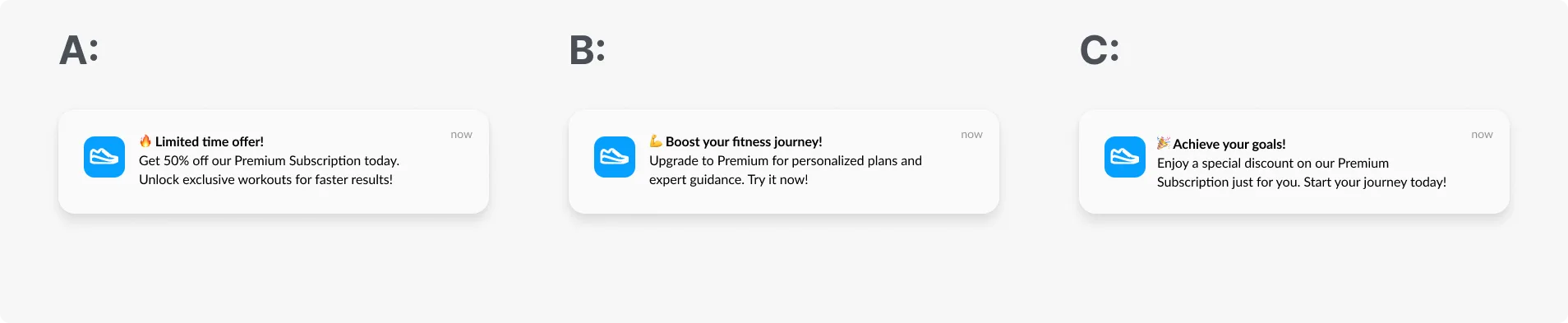
At the course of the experiment, marketers analyze which push notification performs best in achieving a specific goal (in this example, converting users to paid subscribers). Once the most effective variation is identified, it is scaled and spread across the entire audience.
Exploring experimentation horizons: what can you test in push notifications?
In A/B/n testing for push notifications, you can test various elements to understand their impact on user engagement and conversion rates. Some of the elements you can test include:
- Message copy: test different variations of the notification message, such as the wording, tone, and call-to-action, to see which version resonates better with your audience.
- Timing: delivery push notifications at different times to determine the moments when users are most likely to engage with your messages.
- Personalization: compare personalized push notifications with user-specific details, such as the user’s name or previous interactions, against generic messages.
- Rich media: test push notifications with different types of rich media, such as images, videos, and GIFs — or without any.
- Frequency: test different frequencies of sending push notifications to find the right balance between staying relevant and avoiding user fatigue.
- Segmentation: test different user segments to determine which groups respond better to specific types of push notifications.
- Deep links: test using deep links in push notifications to take users directly to a specific page within the app.
Beyond push notifications, you can test different engagement channels
While finding the most converting variant of a push notification is valuable, push notifications might not always be the most effective channel for a given campaign in the first place.This is where an omnichannel approach comes into play.
In addition to push notifications, you may want to include in-app messages, SMS, and emails in your test. This way, you can compare and optimize the effectiveness of different channels, enhancing user engagement and campaign success:
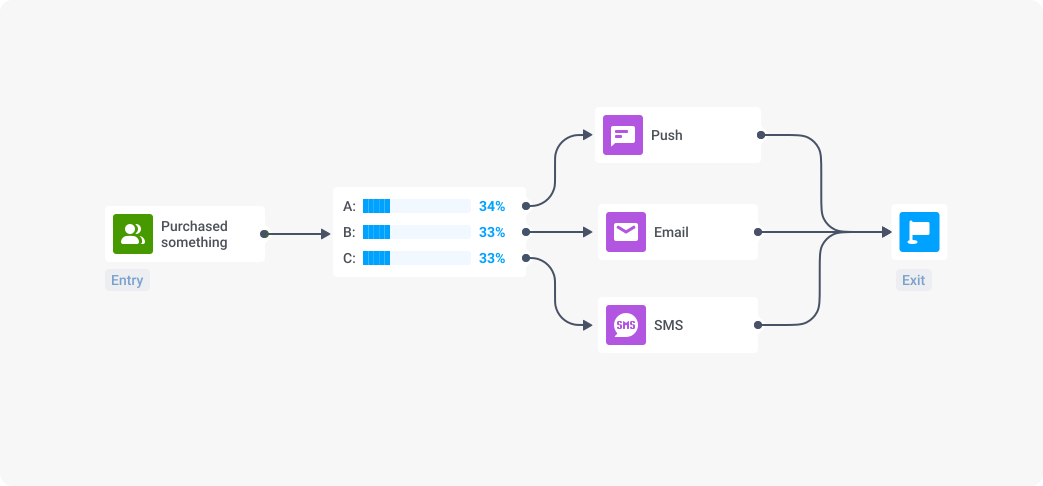
This example is made with Pushwoosh **Customer Journey Builder****,** a campaign planning and automation tool that allows marketers to design and launch engaging cross-channel communications.
💡 With Customer Journey Builder, you can run A/B/n tests right in the interface.
Experiment with entire messaging flows in user journeys
Sometimes marketers need to test not just one, but multiple elements of user journeys. You can test the following elements simultaneously to identify the most effective combination for your messaging strategy:
- Message copy + time delay;
- Message copy + channel;
- User segment + message copy + channel;
- User segment + triggered event, etc.
For example, you may divide the audience into two groups: one will receive your communications straightaway, and another one will have to trigger a certain event (in this example, “Checkout Success”) to get a notification. If the users don’t trigger the event, they will see a different type of message:
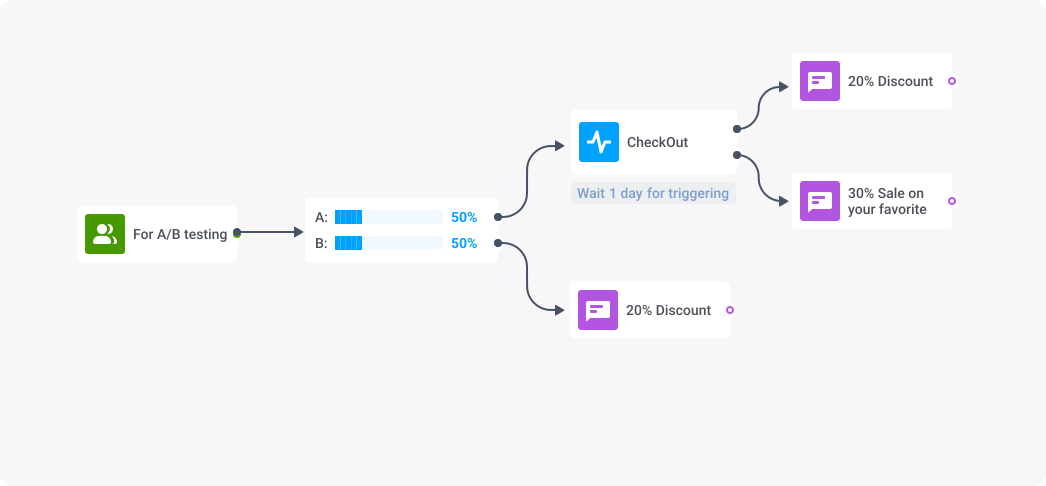
This sort of experiment helps marketers assess user response and align messaging accordingly. They can even take their campaign personalization to the next level, based on the A/B/n test results.
Reasons to use A/B/n testing: increasing user engagement and conquering campaign goals
With A/B/n testing, marketers can unlock the potential for higher ROI by optimizing the effectiveness of their campaigns in two crucial areas:
- User engagement. Through A/B/n testing, teams can analyze the effectiveness of their campaigns by tracking the number of users who have engaged with messages or journey elements. This allows marketers to make data-driven decisions on which variation/element to scale.
- Completion of campaign goals. Marketers can analyze selected variations from the perspective of meeting campaign goals. These goals can include meaningful events in your app, such as any purchase-related events. With the A/B/n testing feature in Pushwoosh Customer Journey Builder, you can track goal conversion rates in real time.
All in all, by leveraging A/B/n testing, mobile apps can optimize their messaging campaigns and fine-tune user journeys. As a result, marketers can significantly improve user engagement rates and achieve higher ROI of their marketing efforts.
Push notification A/B/n testing process
1. Make sure your customer engagement/messaging platform supports A/B/n testing
Before planning an experiment, it’s essential to check with your provider if you can easily segment your audience and create multiple variations. Additionally, ensure that the platform allows you to track metrics related to user engagement and campaign goals effectively.
2. Identify goals
Set events that users have to trigger as your campaign conversion goals. It could be in-app purchase, conversion to a paid subscription, leveling-up in a loyalty program, etc. Having relevant goals will enable you to evaluate the impact of your A/B/n variations accurately, aligning your testing process with the overall success of your app.
💡In Pushwoosh Customer Journey Builder, you can specify several goals for your campaigns – A/B/n testing results will be calculated for each goal separately.
3. Set hypothesis
Formulate hypothesis about how different variations of messages/messaging flows may impact user engagement and conversion goal completion.
4. Create variations
Design different versions of your push notifications or experiment with various channels and elements of the messaging flow.
🧠 With extensive experimentation in push notification copy during your A/B/n tests, Pushwoosh AI composer comes to the rescue!
5. Run a test
Choose a segment of users to participate in your test, and then set the percentage of users for each variation. Set a specific test duration during which the variations will be sent to their respective groups.
6. Analyze results
Upon completion of the test, analyze the results for each variation, comparing engagement rates and goal completion rates. Identify the most successful variation that resonates with your audience and effectively drives the desired actions.
⚡ In Pushwoosh Customer Journey Builder, engagement metrics resulting from the test are shown right on the canvas, making it easy for you to track and analyze users’ interaction with each variation:

Also, you can see full statistics, including conversion goal completion and statistical significance, in the dedicated section. Understanding the statistical significance helps you gain confidence in the validity of your test results:
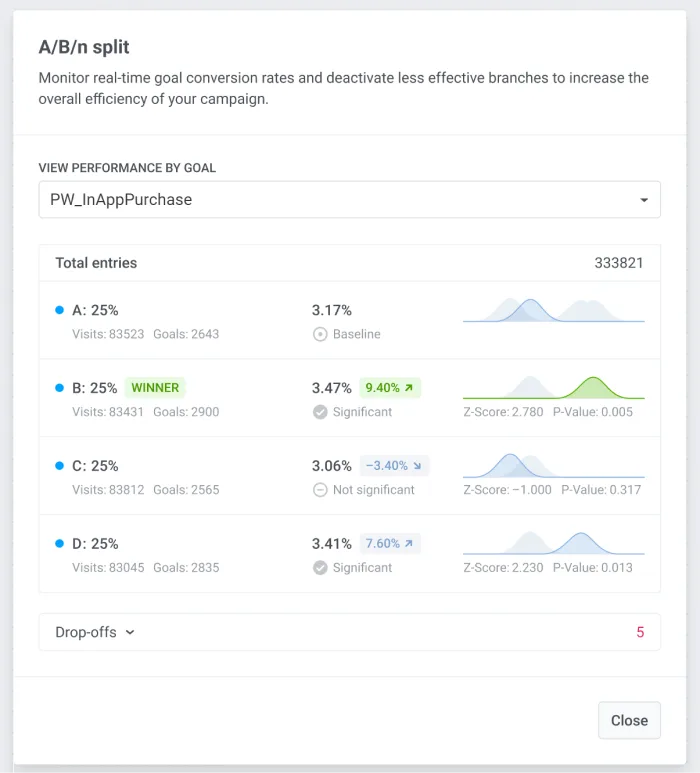
Based on these statistics, marketers can confidently make decisions about transforming their campaigns. For example, if certain variations perform poorly, you may choose to deactivate them.
A/B/n testing with Pushwoosh: optimize messaging strategies and boost the ROI of your campaigns
By implementing A/B/n testing in your push notification campaigns, you can unlock the potential for higher ROI and drive greater success in engaging your audience.
With Pushwoosh Customer Journey Builder, you can extend your testing beyond push notifications, comparing the effectiveness of various channels and messaging flows. By analyzing engagement and conversion rates resulting from A/B/n tests, you can make data-driven decisions and optimize your messaging strategies to boost the bottom line.
Unleash limitless experiments with Pushwoosh A/B/n testing capabilities:
Contact Pushwoosh Team to learn more about the capabilities of Customer Journey Builder and start optimizing your marketing efforts today: