For a lot of small retailers, loyalty already exists in three places and works in none of them. There’s a punch-card stack by the register, a points plugin on the online store, and a spreadsheet someone updates by hand on Fridays. A regular who shops both online and in person is three different records, and none of them add up to a reward they’ll actually chase.
The rewards are rarely the problem; the fragmentation is. A loyalty program for small business only pays off when it’s one card the customer carries and one profile you manage, across the counter and the cart. We’ll use Pushwoosh Wallet passes and Customer Journey to show how that comes together.
Ecommerce loyalty program vs. in-store: where wallet passes fit
The economics are on your side before you start. In ecommerce, a customer’s odds of buying again climb with every order: roughly 27% after the first purchase, around 45% after the second, and past 80% by the ninth. Loyalty members tend to spend 15-20% more per transaction than non-members.
Treat these as current industry estimates rather than guarantees. The point is that a small nudge toward the next purchase compounds.
An ecommerce loyalty program and an in-store one pull in different directions, though. Online, loyalty lives in accounts, emails, and order history; in store, it lives at the point of sale, where the customer is holding a phone, not signed into anything. The two rarely share a record, so points earned online don’t show up at the register, and the customer stops trusting the program.
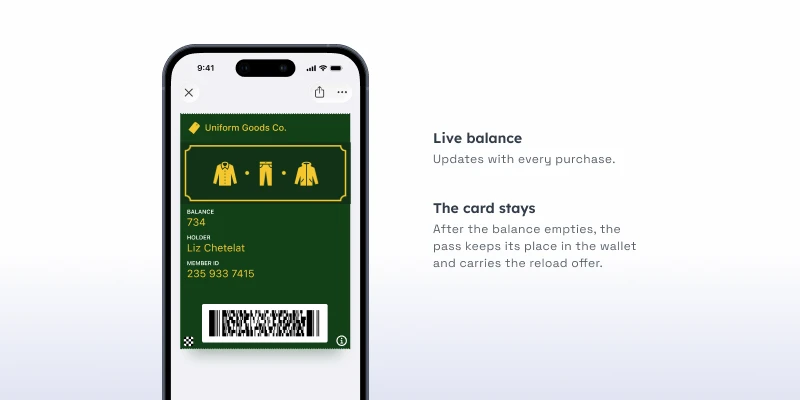
A wallet pass is where they meet. The same loyalty card sits in Apple Wallet or Google Wallet, scans at the register, and reflects points earned online, because both channels write to one customer profile. The customer sees one balance whether they shop online or walk in, and you no longer maintain two disconnected systems.
Loyalty program management without spreadsheets
Loyalty program management falls apart when it’s manual: someone tallying points, guessing at tiers, and emailing the odd reward. It holds together when the rules run themselves against real customer data, and three pieces carry most of that load.
Tiering and point rules
Set the earning rule to match your margins: points per dollar for varied baskets, or a simpler stamp for high-frequency buys. Add tiers if it fits, since VIP tiers reliably lift spend, with top-tier members reportedly generating far higher average order value and purchase frequency than non-tier members. Keep the first reward close enough that a new member can picture reaching it, or they’ll never start.
Syncing points across online and in-store
This is the piece spreadsheets can’t do. In Pushwoosh, each customer gets one User ID that links their devices and contact methods into a single profile, so a purchase logged online and a scan at the register both land on the same record.
Your point of sale and online store send those purchase events in, the customer’s wallet card updates from that one profile, and the balance stays the same everywhere. To the customer it’s one program; for you, there’s nothing left to reconcile by hand.
Expiring points without losing the customer
Expiring points are a retention tool that backfires when they’re silent. A customer who loses points they didn’t know about doesn’t come back; a customer reminded in time often does. Set a reminder before the expiry date and send it on whatever channel reaches them, so the deadline drives a visit instead of resentment.
The wider trend backs this up: discount-heavy rewards have been falling out of favor, and reachable, well-communicated value now does more work than a blunt price cut.
Real-world examples
Two patterns from the wider retail market, in a repeatable format. Formats are illustrative; adapt the reward to your margins.
Redemption-driven repeat rate / Points program
Source: reported ecommerce loyalty benchmarks (2026).
The strategy: make rewards easy to reach and redeem, then prompt the redemption instead of letting points sit.
Why it works: customers who actually redeem show a much higher repeat-purchase rate than those who never do, which makes the redemption itself the moment retention is won.
Omnichannel enrollment / Wallet card
Source: reported retail omnichannel loyalty benchmarks (2026).
The strategy: let customers join at checkout and online with the same wallet card, rather than running separate sign-ups per channel.
Why it works: most retailers now support enrollment in both places, and blending the physical and digital record is what keeps a cross-channel shopper engaged instead of dropping between systems.
From spreadsheet to wallet card in one setup
You don’t need a custom app or a developer to replace the spreadsheet. With Pushwoosh Wallet passes, you design one loyalty card, generate an “Add to Wallet” link and QR code, and share it at the register, on receipts, and on your site, so customers join in one tap from either channel.
From there, Pushwoosh Customer Journey handles the management the spreadsheet used to: it updates the card from purchase events your systems send, moves members between tiers as they qualify, and sends the birthday, milestone, and expiry reminders on the right channel. One card for the customer, one profile for you, across online and in store. For the broader case beyond retail, see loyalty cards for business.
Manage loyalty across every channel with Pushwoosh
Replace the punch cards, the plugin, and the spreadsheet with one card and one profile. Pushwoosh Wallet passes and Customer Journey let a small retailer run loyalty across online and in-store from a single setup, no app required.