Winning a new diner costs five to seven times more than keeping one you already have, and roughly 70% of first-time restaurant guests never come back. That combination is brutal for a restaurant: you pay to fill seats once, then watch most of those people vanish. A loyalty program is the cheapest tool you have to turn a first visit into a habit.
The catch is that most programs fail, because they get built in a way nobody uses. The fix is a card that asks almost nothing of the customer, lives in the phone they already carry, and shows up at the right moment. We’ll use Pushwoosh Wallet passes as the worked example, since it lets a cafe or restaurant launch without a custom app.
Why most restaurant rewards programs get abandoned
A restaurant rewards program dies for a few predictable reasons. Name them before you build, and you can design around them.
The reward is too far away. If a customer visits twice a month and needs 20 stamps for a free meal, the payoff is ten months out, and no one stays motivated that long. Set the threshold against real visit frequency so the first reward feels reachable.
The program is invisible. More than half of loyalty members don’t check for rewards before ordering, because the reward is buried in an app they rarely open. A card that sits on the phone’s lock screen and updates itself solves most of that.
The app is a wall. Around 83% of loyalty apps are uninstalled within 30 days, so asking a diner to download one just to earn a free sandwich loses most of them at the first step.
Punch card vs. digital loyalty card vs. app: what fits a restaurant
You have three ways to carry a restaurant loyalty program, and they’re not equal for food and drink.
The paper punch card is easy to start and easy to lose. Industry data puts the loss rate at 60-70% before the first reward, and it hands you zero data about who your regulars are. Fine as a first step, but it caps out fast.
The standalone app gives you the most control and the most friction. It can do everything, but it needs a download most customers won’t finish, which is why so many restaurant apps get deleted within a month.
The digital wallet card sits in the middle and fits F&B best. It lives in Apple Wallet or Google Wallet, the app the customer already has, adds with one tap, updates over the air, and gives you the data a paper card can’t. For app-less restaurant loyalty, this is the practical choice.
| Paper punch card | Standalone app | Digital wallet card | |
|---|---|---|---|
| Customer effort to join | Low | High (download) | Low (one tap) |
| Gets lost | 60-70% before first reward | Uninstalled ~83% in 30 days | Lives in the phone |
| Customer data | None | Rich | Rich |
| Updates points/tiers | Manual | Automatic | Automatic |
| Reach them again | No channel | Push (if kept) | Updates and location surfacing |
Building a cafe loyalty card that lives in the customer’s pocket
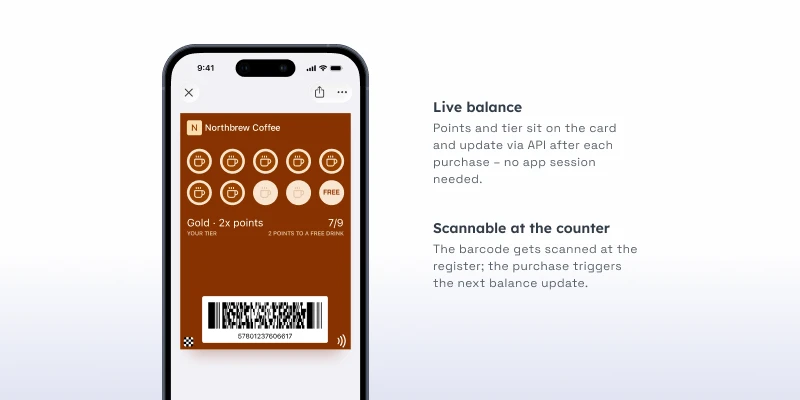
A cafe loyalty card works best when it asks almost nothing of the customer and keeps showing up at the right moment. Three mechanics do most of the work.
Points per visit or per dollar
Pick the earning rule that matches your ticket. High-frequency spots like a coffee shop suit a per-visit stamp: buy nine, get the tenth free. Places with a wider check size suit points per dollar spent, and either way, keep the first reward within a few weeks of normal visiting, not months.
Geofenced reminders near the location
Because the card lives in the wallet, it can surface on the lock screen when a customer is near your door. You set a short line per location (“show this card for a free-coffee stamp”), and the pass appears on its own when the phone is within range, no notification sent and no tracking on your side. It’s a passive nudge a paper card can never match, and it works for the roughly 100-meter radius Wallet uses for loyalty cards.
Birthday and win-back offers
Automate the two moments that reliably bring people back. A birthday reward gives a warm reason to visit, and a win-back offer catches a regular who’s gone quiet: if someone hasn’t visited in a few weeks, a timely “we miss you, here’s a free side this week” pulls them back before the habit breaks for good.
Real-world examples
Two patterns from the wider restaurant market, in a repeatable format. Formats are illustrative; adapt the reward to your margins.
App-less loyalty at scale / Wallet-based program
Source: reported industry results for app-less restaurant loyalty (2026).
The strategy: skip the app entirely and issue a wallet-based loyalty card customers add with one tap, distributed at the counter and on receipts.
Why it works: it removes the download step that kills most sign-ups, so enrollment climbs; one large chain reportedly built over two million members in ten months without asking anyone to download an app.
Simplified rewards structure / Points reset
Source: reported industry results for a simplified digital rewards program (2026).
The strategy: cut a confusing points scheme down to a clear, reachable reward and push it through digital sign-up.
Why it works: a reward customers can actually picture reaching drives enrollment and repeat visits; one fast-casual brand reportedly added around twenty thousand new digital members a week after simplifying its structure.
Launching your program without a custom app
You don’t need to build an app or rebuild your point of sale to launch. With Pushwoosh Wallet passes, you design the loyalty card once in a dashboard, generate an “Add to Wallet” link and QR code, and place them where customers already are: the counter, the receipt, the table tent, your site.
From there, the card updates points over the air, and it surfaces on the lock screen when a member is near your location. Pair that with automated messaging for the moments that bring people back: a birthday reward, or a win-back message when someone lapses.
It’s a working restaurant loyalty program a small team can run alone, on a channel every customer already keeps in their pocket. For the broader picture beyond restaurants, see loyalty cards for business.
Grow repeat visits with Pushwoosh
Turn first-time diners into regulars. Pushwoosh Wallet passes lets you launch a restaurant loyalty card without an app, update it over the air, and bring customers back with location-aware cards and win-back reminders.