Your transactional notifications work. Payment confirmations fire in milliseconds, fraud alerts land before the user sets the phone down, the API is stable.
And that’s usually where the thinking stops. Transactional messages are owned by product and treated as pure service — receipts, not campaigns — so marketing looks right past them. But every one fires off a real financial event: a deposit cleared, a transfer set up, a card used. Handled right, those same transactional messages can move the numbers marketing cares about (activation, cross-sell, retention), firing the moment a user’s behavior calls for it.
This post is about how fintech apps turn the service messages they already rely on into one of their strongest retention channels.
What your app already does (transactional & promotional messaging)
Almost everything a fintech app sends falls into one of 2 kinds:
Transactional. Triggered one-to-one by your backend the instant something happens — payment received, login from a new device, statement ready. Near-zero latency, expected by the user, no marketing consent required. This is the type of messaging most fintech mobile teams already run well.
Promotional messages (marketing). A marketer writes the campaign and sends it to the whole user base or a specific segment. New product, rate change, a push to revive a dormant feature. Useful, but it ships on the marketer’s calendar to a segment, not to one person at the moment who matters to them.
Most fintech apps run one end or the other — transactional or promotional — and leave the middle empty. So let’s look at what that behavioral messaging actually is, what it looks like, and how to build it.
Behavioral messaging that goes in the middle (& boosts retention!)
So what is the behavioral messaging? It’s still marketing (e.g., a cross-sell, an activation nudge) but delivered the way a transactional message is: automatically, to one person, the moment their behavior calls for it.
The highest-value moments are the ones that are already tracked as transactional, but marketers say nothing about them to help users use the app:
| A moment | What happens now | The message that belongs there |
|---|---|---|
| Verification passed | "You're verified ✅" Then nothing. | Push to the first real action — the deposit or transfer that turns a signup into a user. |
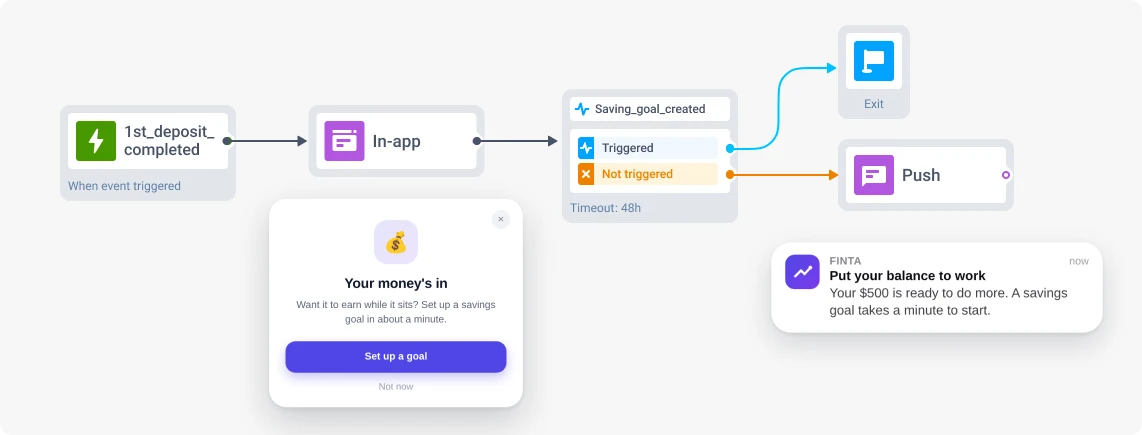
| First deposit completed | "Deposit received," then silence until the next blast. | The money's in. Show how to put it to work while the balance is top of mind. |
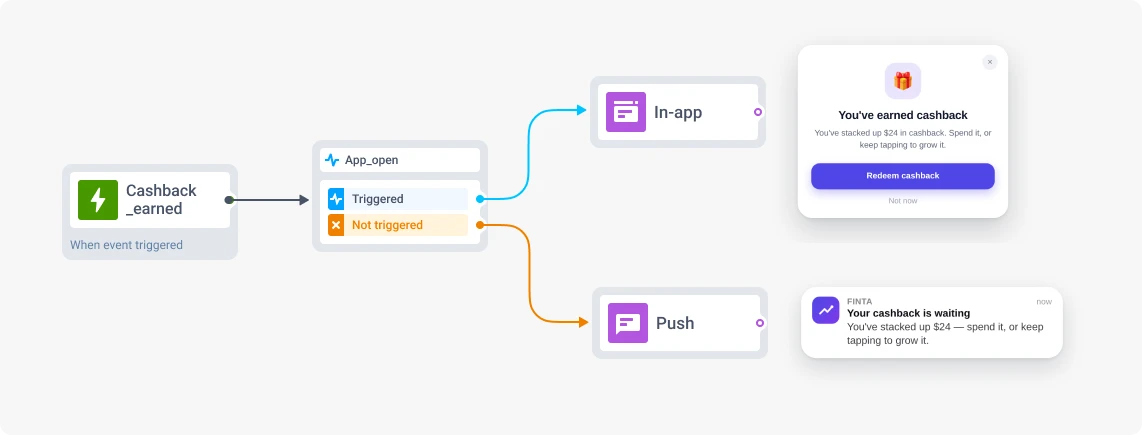
| Cashback earned | "You earned {amount} cashback." A line in the feed. | Let it add up, then show what it's worth, and that using the card more grows it. |
| 30 days without a transaction | Nothing, until they're a churn statistic. | A reason to come back that fits what they used to do, before they close the account. |
What this looks like in practice
Verification passed 👉🏻 first action
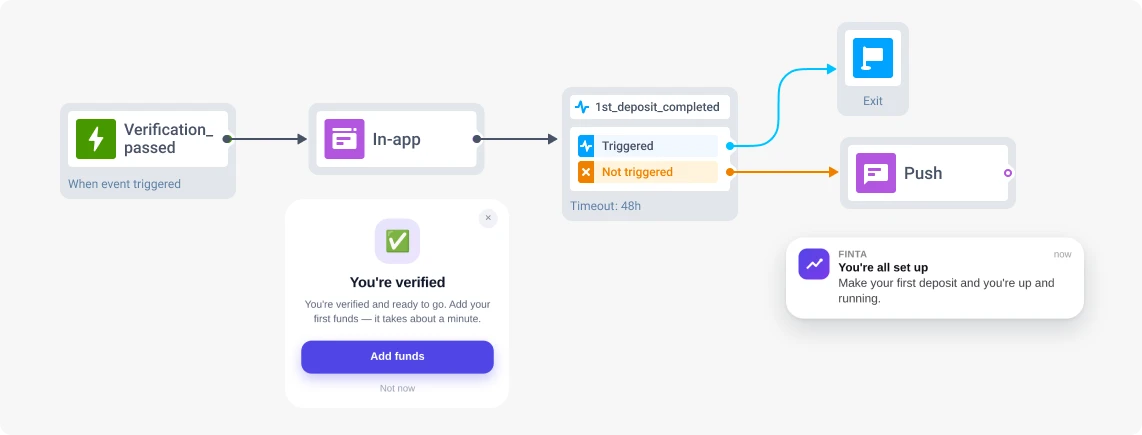
First deposit 👉🏻 the next product
Cashback earned 👉🏻 make the value land
30 days quiet 👉🏻 a reason that fits
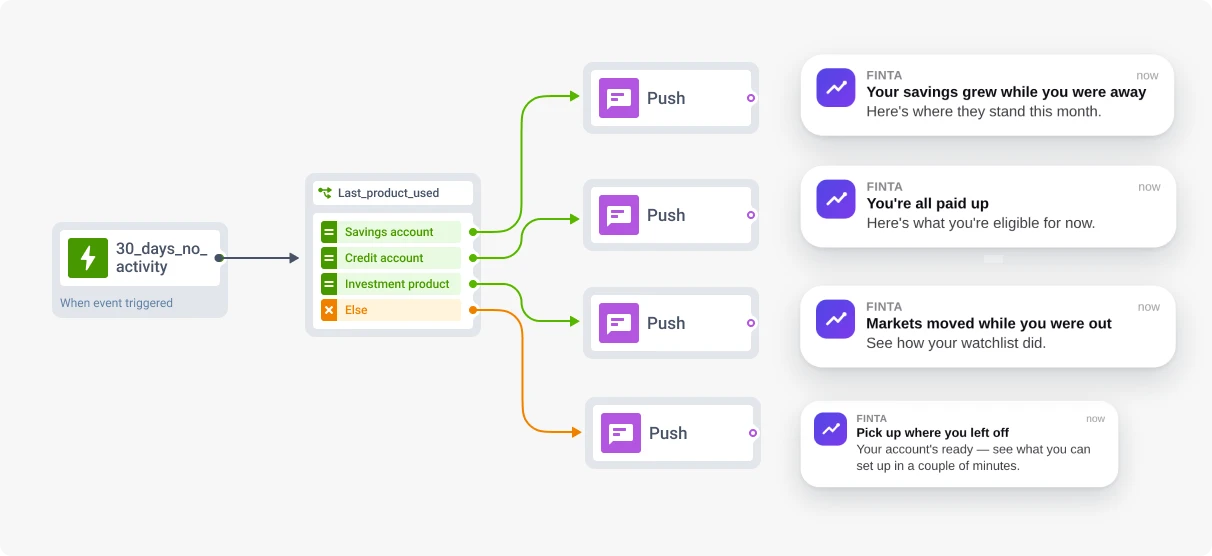
These are the flows strong fintech teams already run. More examples you can explore:
- A first bill paid prompts a nudge to switch on autopay, which lifts recurring transactions.
- A user who crosses a spending threshold gets an offer to enable budget tracking, which drives adoption of a feature they’d otherwise never find.
- A declined payment triggers a quick fix-it message instead of failing silently, which recovers a transaction that would otherwise just be lost.
- A paycheck landing in the account opens the moment to auto-save a slice of it, which turns a one-time inflow into a recurring habit.
Warning! Make it useful, not creepy
Money is sensitive, and behavioral targeting around it tips into surveillance fast. “We noticed you haven’t invested yet” reads very differently from a budgeting tip that lands the week after someone starts tracking their spending. 2 rules keep these messages on the right side of that line.
✅ Anchor on what the user already shared. If someone makes regular transfers, point to no-fee transfers. If they paid with the card at a supermarket, surface cashback. Reference behavior they’d expect you to know, and skip the inferences that feel like you’ve been watching.
✅ Cap by behavior, not by calendar. A user who just got three transactional messages doesn’t need a promotion stacked on top. Frequency caps tied to recent activity keep these sends from reading as noise — which, in fintech, is where opt-outs and “spam from my bank” reviews come from.
How to start without rebuilding your stack
The usual objection is that this means touching the transactional pipeline. Our answer: not necessarily!
It rides on top of what you already have:
-
Set the events once
Make sure the financial actions that matter —
first_deposit_completed,recurring_transfer_set_up,product_activated— are set as events, via the SDK or API. Your transactional confirmations keep firing exactly as they do now. This is the only step that needs developer time, and it's a one-time job. -
Build the journeys
Now it's all marketer-owned. For example, in Pushwoosh Customer Journey Builder, you set a Trigger-based entry on each event, add Time delays, and use the Reachability check element to route to a fallback channel when push won't land. At this stage, no code is needed after the initial event setup.
-
Measure against a holdout
Set the target action as a journey-level conversion goal: for example, a second product activated within 30 days of the first deposit. To prove the layer lifts the number, run an A/B/n split with one empty branch: the same users, no messages, as your control.
With Pushwoosh, our app became a real channel for activation, retention, and revenue growth.

Build fintech behavioral marketing messaging in Pushwoosh
The service messages your product team already ships do more than confirm the app works. Wire marketing to the moments they mark, and that same reliability starts driving activation, cross-sell, and retention.
You already have the infrastructure and the opt-in. The missing piece is the set of journeys that fire on the moments your app can already see.