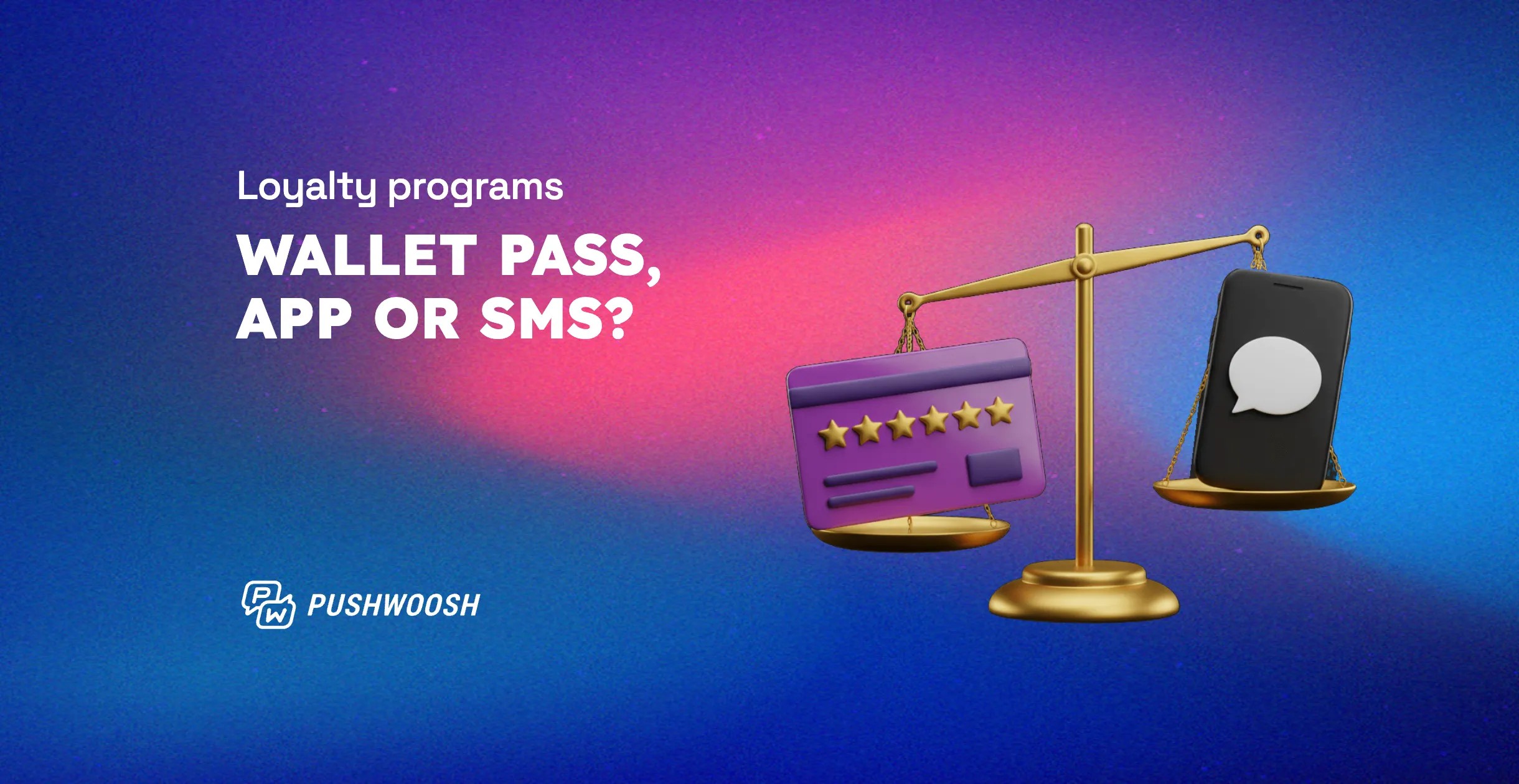
Every mobile team faces the same question sooner or later: should this message be a push notification or an SMS? The answer depends on what you are trying to achieve, who you are reaching, and how much you are willing to spend per message.
This guide covers how push and SMS actually work, where each channel fits, and how to combine them without annoying your users. And along the way, you’ll see how Pushwoosh handles both channels within a single Customer Journey Builder.
What is a push notification?
A push notification is a short, tappable message that appears on a user’s lock screen or notification shade. It comes from an app or website and shows up even when the app is closed.
There are two types:
Mobile push notifications come from a native iOS or Android app. The user has to have the app installed and notification permissions enabled. These messages travel through Apple Push Notification service (APNs) or Firebase Cloud Messaging (FCM), so the device must be online.
Web push notifications are sent from a website via a browser (Chrome, Firefox, Safari). The user opts in via a browser prompt. No app install is needed, but an internet connection is required.
Both types support rich media (images, GIFs, action buttons, deep links), making push a flexible channel for everything from a flash discount alert to a personalised content recommendation.
What is SMS?
SMS (Short Message Service) is a text message sent to a phone number over the cellular network. Each message segment is capped at 160 characters. Longer texts are split into multiple segments, and each one costs money.
MMS extends SMS with images, audio, and video, but it is less universal and more expensive.
The key difference from push: SMS does not require an internet connection or an installed app. A basic feature phone with a cellular signal is enough. That makes SMS the most reliable channel for messages that absolutely must land.
Other characteristics worth noting:
- SMS is natively two-way. Users can reply in free text, which is useful for support flows or appointment confirmations.
- Reach is near-universal. Any active phone number can receive an SMS.
- Consent rules are strict. Most regions need explicit written opt-in (double opt-in under TCPA in the US, similar rules under GDPR).
Push vs. SMS: side-by-side comparison
| Feature | Push notifications | SMS |
|---|---|---|
| Delivery mechanism | Internet (APNs, FCM, browser services) | Cellular network (SMSC) |
| Internet required? | Yes. Queues until device is online | No. Cellular signal only |
| App/website dependency | App installed or browser subscription | Phone number only |
| Content format | Rich media, action buttons, deep links | Plain text (160 chars). MMS for media |
| Cost | Included in platform fee, no per-message cost | Per-message charges, vary by region |
| Two-way communication | Limited (predefined action buttons) | Native free-text replies |
| Audience reach | App/web subscribers only | Any mobile phone globally |
| Personalization depth | High (behavioral data, dynamic content, location) | Basic (name, order number) |
| Analytics | Full funnel: delivery, open rate, CTR, conversions, revenue | Delivery reports, link clicks via shorteners |
| Consent model | App/browser permission prompt | Explicit written consent (double opt-in) |
| Deep linking | Native, links to specific app screen | URL shorteners, less integrated |
Push is richer, cheaper per message, and offers better data. SMS is more reliable and urgent, reaching more users. Both are often necessary.
When push notifications work best
Push is your main channel when the user has your app, and you want to drive an action inside it. Here are the scenarios where push consistently outperforms SMS:
Promotional offers and flash sales. Rich media grabs attention. A deep link takes the user straight to the product page. No per-message cost means you can test aggressively.
Abandoned cart reminders. A well-timed push (30-60 minutes post-abandonment) with a cart link drives high e-commerce ROI.
Feature announcements. Push notifications are ideal for informing active users of new features, with deep links to boost engagement.
Daily engagement nudges. Login bonuses in games, streak reminders in fitness apps, and content digests in news apps. Push keeps the daily habit loop alive.
Personalised recommendations. Combine behavioural segmentation with dynamic content to serve product or content suggestions that feel relevant, not spammy.
Industry examples:
- Mobile games (justDice): reactivation campaigns for lapsed players, daily reward reminders
- E-commerce (FloSports): price drop alerts, back-in-stock notifications
- News and media (wetter.com): breaking news, personalised content digests
- Fintech (AvaTrade, EXMO): feature announcements, transaction summaries
When SMS is the better choice
SMS is worth the per-message cost when delivery is mandatory.
OTPs and two-factor authentication. Security codes need to be delivered instantly to any device. SMS is the standard.
Emergency and service alerts. For system outages or security threats, SMS delivers critical messages without internet.
Appointment confirmations and reminders. SMS replies confirm appointments and reduce no-shows, no app required.
Order and delivery updates. Shipping notifications, driver ETAs, delivery confirmations — users expect these on SMS.
Suspicious login attempts and password resets. SMS adds a layer of urgency and trust.
Industry examples:
- Fintech (Alinma Bank, ONE.co.il): fraud alerts, 2FA for sensitive transactions
- Delivery and transportation: real-time driver updates, delay notifications
- E-commerce: payment reminders, urgent flash sales for non-app users
Combining both channels: the fallback strategy
The strongest mobile communication strategies do not pick one channel. They use push as the primary channel and SMS as a fallback for critical messages or unreachable users.
Here is a typical flow inside Pushwoosh’s Customer Journey Builder:
- Send a push notification with a promotional offer or transactional update.
- Wait 1-2 hours. Check if the user opened it.
- If no engagement, send an SMS with a condensed version of the same message.
This approach keeps costs down (push is free per message) while ensuring important communications still land. The Customer Journey Builder handles the logic visually with drag-and-drop triggers, wait conditions, and channel splits.
Pushwoosh also applies AI to optimize channel selection and timing. For some segments, SMS in the morning outperforms push. For others, the reverse is true. AI learns these patterns from your data and adjusts delivery automatically.
Making messages more relevant: segmentation and personalization
Choosing the right channel is half the job. The other half is making sure the message content matches the recipient.
Behavioral segmentation. Pushwoosh Tags and Events let you group users by what they actually do: purchases, content views, feature usage, app launches. A user who browsed running shoes but did not buy gets a push with a discount on that exact category. A high-value user who has not opened the app in 14 days gets an SMS with a win-back offer.
RFM segmentation. Recency, Frequency, and Monetary value scoring helps you separate loyal customers from at-risk ones. High-RFM users might get exclusive early access via push. Low-recency users get a re-engagement SMS as a last resort before they churn.
Dynamic content. Insert user-level attributes (name, city, last purchase, favorite category) into push and SMS templates. Even a 160-character SMS feels personal when it references the user’s last order by name.
These are not theoretical capabilities. They are available inside Pushwoosh’s segmentation engine and work across both push and SMS channels.
How to choose the right channel for your goal
Use this framework when deciding.
Choose push when:
- The user has your app installed
- You need rich media or deep links
- The message is promotional or engagement-driven
- Budget matters (no per-message cost)
- You want detailed analytics (CTR, conversions, attributed revenue)
Choose SMS when:
- Delivery must be guaranteed regardless of internet access
- The recipient may not have your app
- The message is transactional or security-related
- You need two-way text replies
- Regulatory requirements demand explicit written consent anyway
Use both when:
- The message is important enough to justify a fallback
- You are running a lifecycle campaign (onboarding, win-back, renewal)
- Your audience is split between app users and non-app users
Improve your mobile messaging ROI with Pushwoosh
Choosing between push and SMS is not about picking a favorite. It is about matching each message to the channel where it will perform best, and having the infrastructure to automate that decision at scale.
Pushwoosh gives you both channels in one platform, with behavioral segmentation, RFM scoring, dynamic content, AI-powered timing, and a visual Customer Journey Builder that handles fallback logic without code.