Score every customer by value in one click
Pushwoosh scores your users 1 to 5 on how recently they bought, how often they buy, and how much they spend. One calculation returns the 10 standard RFM segments, from Champions to Hibernating, as tags and audiences you can send to. Use them to start a Customer Journey, or as conditions inside any other segment.
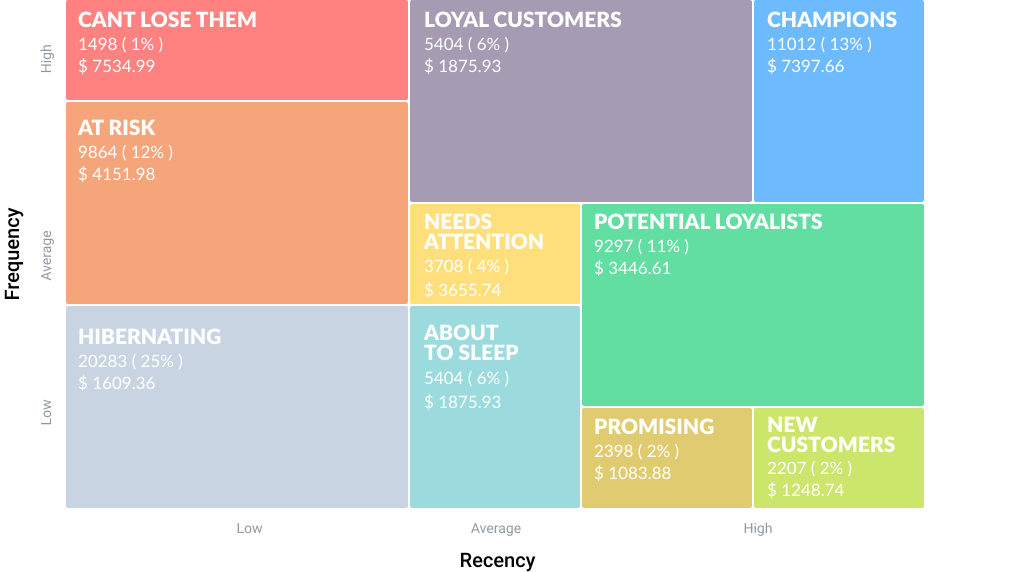
What the RFM tab gives you
One-click calculation
Pick the event, press Calculate.
Scores of 1 to 5
Every user ranked on each axis.
10 named segments
Champions, At risk, Hibernating, and 7 more.
3 reusable tags
Recency, Frequency, and Monetary on the user profile.
RF-only mode
Skip Monetary where there is no revenue event.
Per-segment stats
User count, share of your base, average spend.
How the scores are built
The wizard reads the history of one event you nominate as the valuable action, then turns it into 3 scores per user.
| Axis | What it measures | Score |
|---|---|---|
| Recency | Time since the user last fired the event | 1 to 5 |
| Frequency | How many times the user fired it | 1 to 5 |
| Monetary | Value on the event's Integer or Price attribute | 1 to 5, optional |
Each score sits on the user profile as a custom tag, so the same numbers are available in the segment builder, in journey condition splits, and in message content.
Businesses without a revenue event to point at pick none for the monetary attribute and score on recency and frequency alone. That covers apps where the action worth scoring is a lesson completed, a workout logged, or an episode watched.
The 10 segments you get back
Every user with history on that event ends up in one of these tiers.
| Segment | Who lands here | Where to take them |
|---|---|---|
| Champions | Bought recently, buy often, spend the most | Early access, loyalty tiers, referral asks |
| Loyal customers | Frequent buyers with steady recent activity | Cross-sell, review requests, service messages |
| Potential loyalists | Recent buyers at an average frequency | Event-based prompts to buy again |
| New customers | Bought once, very recently | Onboarding and a reason to return |
| Promising | Recent, low frequency, clear intent | Follow-ups on the category they browsed |
| Needing attention | Above-average history, activity slipping | Offers built on past purchases |
| About to sleep | Below-average recency and frequency | A reminder before they go quiet |
| At risk | Used to buy often, quiet for a while | Win-back with a personal discount |
| Cannot lose them | Former high spenders, now inactive | Your strongest win-back offer |
| Hibernating | Last purchase long ago, low value | Batch win-back at minimal cost |
What RFM segmentation is best for
VIP and loyalty programs
Champions and Loyal customers are your reward audience, ready on the day you calculate.
A graded win-back ladder
About to sleep, At risk, and Cannot lose them come out ordered by urgency, so the offer can grow with the risk.
New-customer nurture
Separate a first-time buyer from one who is already showing promise, and message each differently.
RFM pays off where a minority of customers drives most of the revenue, and where churn shows up as a drop in purchase frequency.
- E-commerce
- Mobile games
- Marketplaces
- Subscription apps
- Food delivery
- Fintech
- Media
- Travel
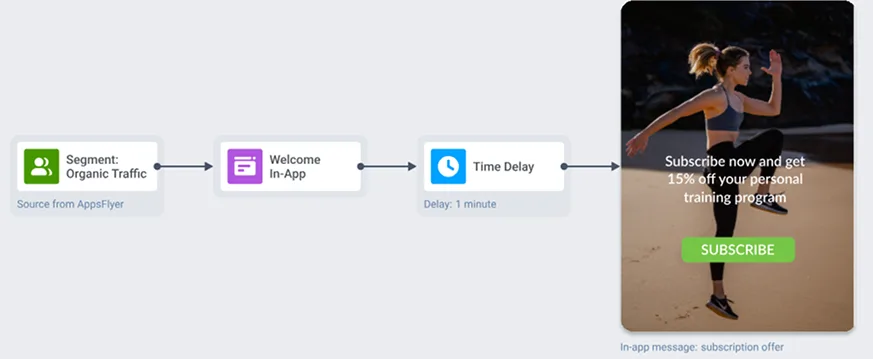
Take a tier straight into a journey
Any of the 10 segments can open a Customer Journey or sit inside a condition split. From there the audience reaches push, in-app, email, SMS, WhatsApp, and your other channels against a single profile, with fallback where a channel does not reach the user.
Reward Champions in one journey and win back At risk in another, both reading the same tag set.
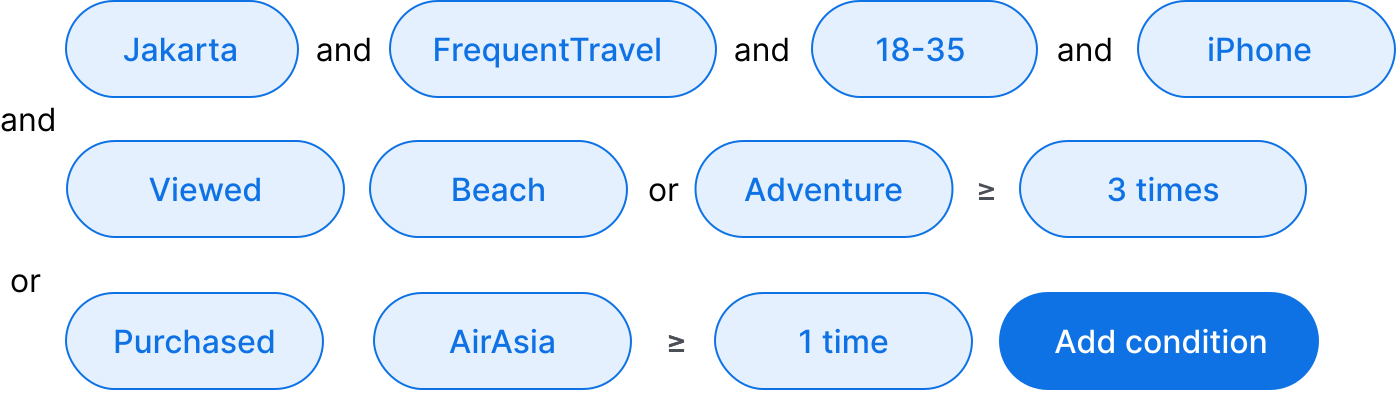
The scores stay yours to reuse
Recency, Frequency, and Monetary behave like every other tag on the profile. Combine them with country, plan, app version, or any behavioral condition in marketing segmentation, and reference a score inside message content.
A frequency score of 5 plus a country filter plus a last-session condition is one segment, built in the same place as the rest of your behavioral segments.
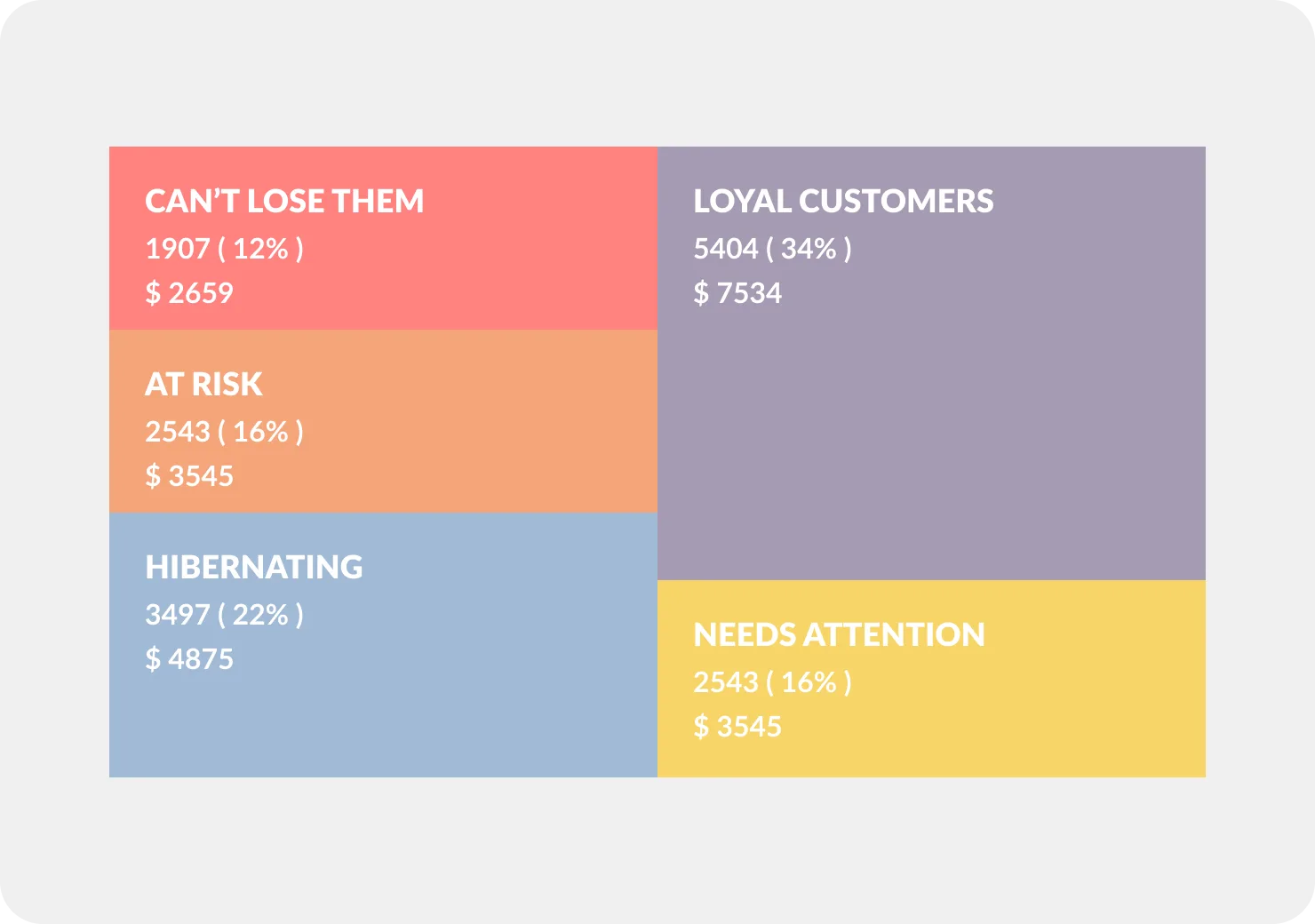
See the size of every tier
Each calculation lists all 10 segments with the number of users in them, their share of your total base, and their average monetary value where you scored one.
Read the grid before you decide what to send. A base weighted toward Loyal customers calls for a different plan than one sitting mostly in Hibernating.
Purchase data stays on our own hardware
RFM scoring runs on purchase history and order value, inside the same platform that already holds your audience data. Pushwoosh runs on its own hardware in the US and Germany, under GDPR and BDSG. Full detail sits on the data safety page.






How it works
-
Pick your purchase event
Open the RFM Segmentation tab and choose the event that stands for a valuable action. It has to carry an Integer or Price attribute the wizard can count.
-
Choose a monetary attribute, or none
Select the attribute holding the amount to score spend as well. Choose none to run recency and frequency only.
-
Press Calculate
Pushwoosh writes the 3 tags, builds the 10 segments, and shows the size of each. Target them from a campaign, or hand them to a journey.
Score every customer by value
Run the calculation on your own data and see how your base splits across the 10 tiers. Our team can help you pick the right event and connect the segments to a journey. Plans are on the pricing page.
Explore related products
Pushwoosh segmentation tools help you reach your users with the most relevant offer based on their unique preferences and behavior.
Advanced segmentation for a friendly budget? Everything is possible with Pushwoosh! Say goodbye to imprecise targeting — achieve higher CTRs, retain your audience, and boost conversions effortlessly.
Drive engagement with real-time segmentation. Create dynamic audiences that update instantly based on behavior, trigger timely campaigns, and maximize conversions.
Win back campaigns for inactive users that work. Re-engage dormant customers with personalized messages, incentives, and experiences that bring them back.
Map out and streamline your campaigns with one visual tool. Communicate, engage, retain, convert, segment, and experiment using Pushwoosh Customer Journey Builder.
Synchronize & activate your customer data with Pushwoosh's actionable CDP for mobile apps.