About Hussle Technology
Hussle Technology builds mobile-first sales enablement platforms for the direct and field sales industry. Their white-label platform gives distributors, field sellers, affiliates, partners, franchisees, and reps the tools they need to share content, track customer engagement, manage contacts, and grow their business, all from their phone.
What makes Hussle unique is its B2B2C model: Hussle sells its platform to brands that have a multi-channel selling strategy, who in turn roll it out to their selling network. Each brand gets a white-labeled version of the app, customized to their products and culture, but powered by the same underlying platform.
With hundreds of brand deployments and hundreds of thousands of sellers across those brands, Hussle needed a communications infrastructure that could scale with them — and flex to serve the very different engagement rhythms of each brand’s distributor base.
The challenge: turning app installs into active distributors
The most critical moment in a seller’s journey isn’t when they sign up — it’s what happens in the first 60 days.
New users who log in, sync their contacts, and share their first piece of content within those early weeks are dramatically more likely to build an active business. Some users never realize the app’s potential. The challenge for Hussle was: how do you systematically move tens of thousands of new users through those first meaningful actions, across different brands, each with its own messaging voice and business rules?
Beyond onboarding, Hussle also needed to tackle re-engagement. Users whose activity drops off are at high risk of abandoning the platform. With a varied feature set, tracking all activity was critical to optimize the onboarding and adoption strategy.
The engineering challenge was significant. Every API event from the Hussle platform — a user’s first login, their first contact sync, their first share, a contact’s first link click, etc. — needed to trigger precisely timed, behaviorally conditioned communication sequences. And those sequences needed to be cloned and deployed across dozens of brand-specific app instances without starting from scratch each time.
The solution: event-driven lifecycle journeys at scale
Hussle integrated Pushwoosh deeply into their platform architecture. The connection works through a bidirectional API integration: when key user actions happen inside the Hussle app, they fire events to Pushwoosh in real time. Pushwoosh then uses those events both as journey entry triggers and as behavioral checkpoints throughout multi-step sequences.
Some of the key events Hussle tracks include:
- User account created / device registered
- First login
- Contact sync
- First share and most recent share
- First contact engagement
- Last login or activity date
All events feed into the user profiles that reside inside Pushwoosh. These are used in three core journey types that Hussle has built, refined, and now deploys as templates across their brand portfolio. Additional custom journeys can be created or customized at any time as these events are all tracked and stored at the user level.
Journey 1: New provisioned user journey
When a new user account is provisioned in the Hussle platform, Pushwoosh is notified immediately via API from the Hussle system. If the user hasn’t logged in within the first few days, an outreach sequence begins: a message inviting them to download the app and log in. The journey then gates every subsequent touchpoint on a real behavioral check to switch them to the First 60 Days Engagement Journey. If not, the sequence continues nudging them at escalating intervals.
This journey is deliberately lightweight by design. It has one job: get the user to log in and access the app for the first time. It is an omnichannel delivery approach to the new provisioned user. Pushwoosh allows for customization so each brand can have a tailored experience for each of their new users.
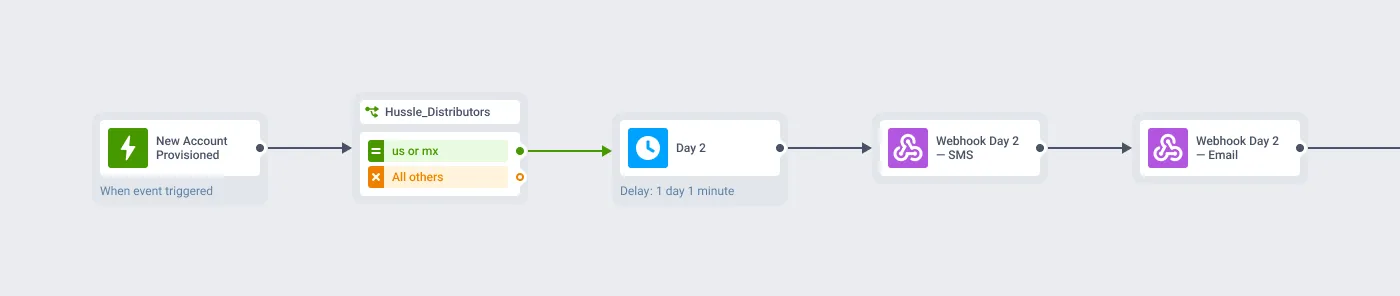
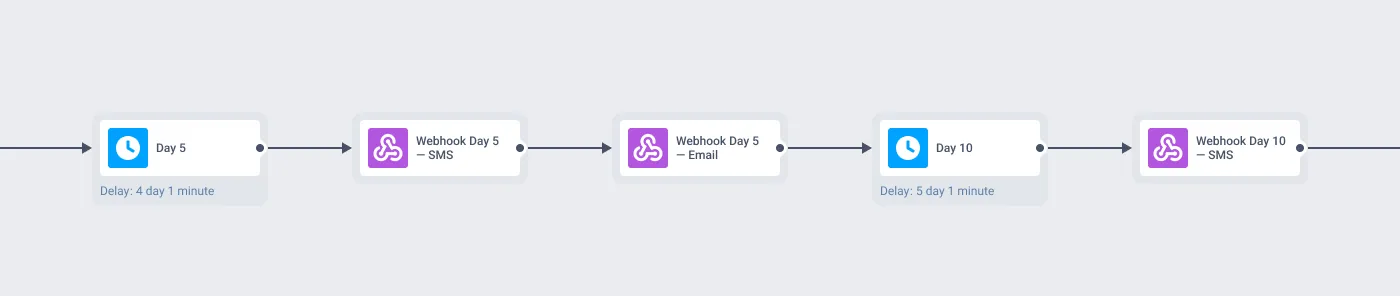
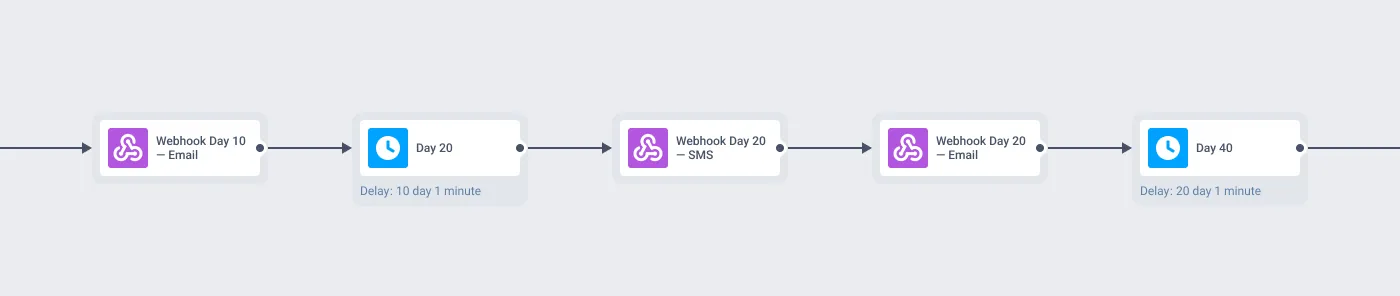
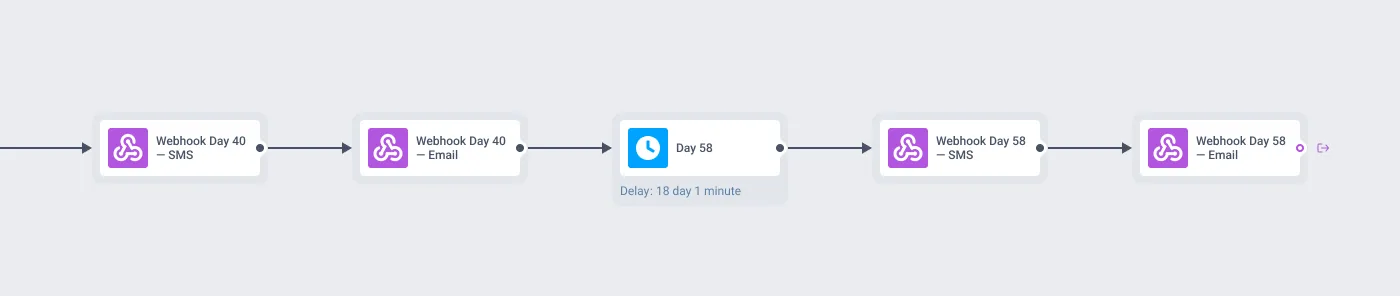
Journey 2: First 60 days engagement journey
This is the most sophisticated of the three journeys, and the heart of Hussle’s user onboarding strategy.
Once a user logs in for the first time, they enter a 60-day sequence designed to walk them through the five behaviors that predict long-term success: turning on notifications, syncing contacts, making their first share, getting their first contact engagement, and maintaining regular login habits.
The journey uses junction points at every key milestone to route users down personalized paths based on what they’ve actually done. A distributor who has already synced their contacts gets a very different nudge than one who hasn’t. Someone whose contact clicked a shared link gets tips on how to follow up; someone whose links haven’t gotten clicks gets content on improving their sharing strategy.
At the end of the 60-day journey, the Pushwoosh platform is able to check the activity and other stats to either celebrate user progress with a personalized summary or pivot to an encouragement message with a fresh call to action or even put them on another journey.
The journey structure in Pushwoosh is quite flexible, from handling dozens to hundreds of delay points, junctions, API, and webhook calls. The Hussle platform and Pushwoosh are fully integrated, with 2 set-tag operations that update the user’s profile in real time as they hit milestones.
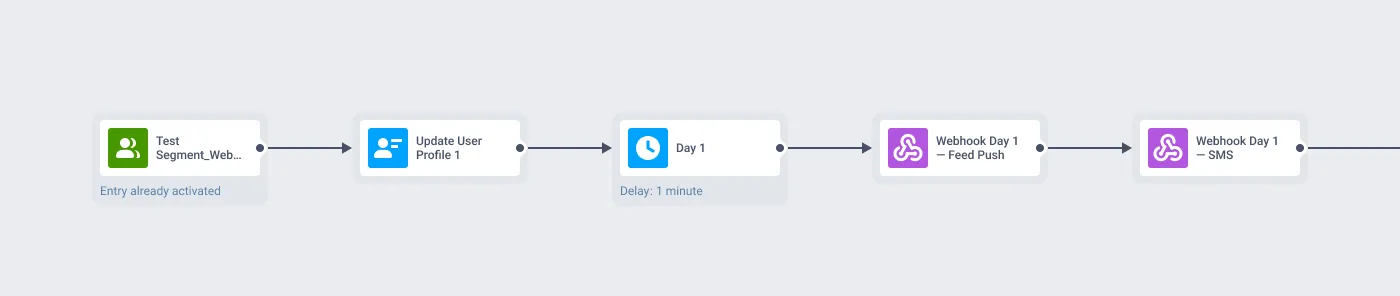
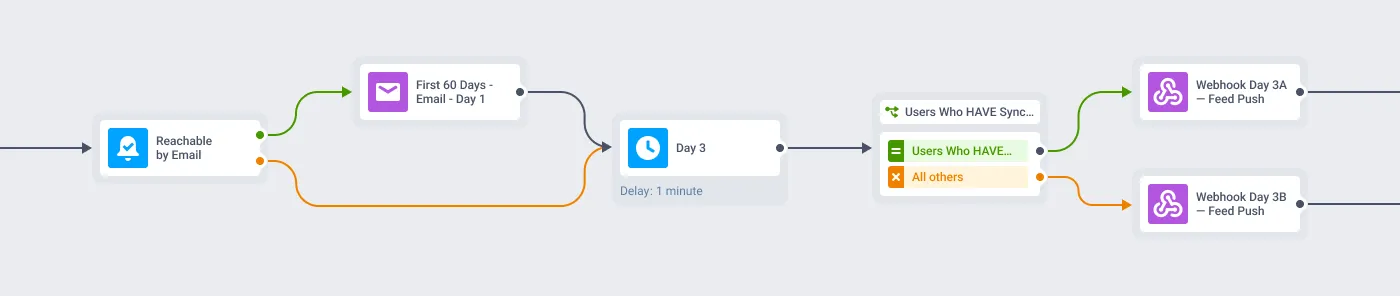
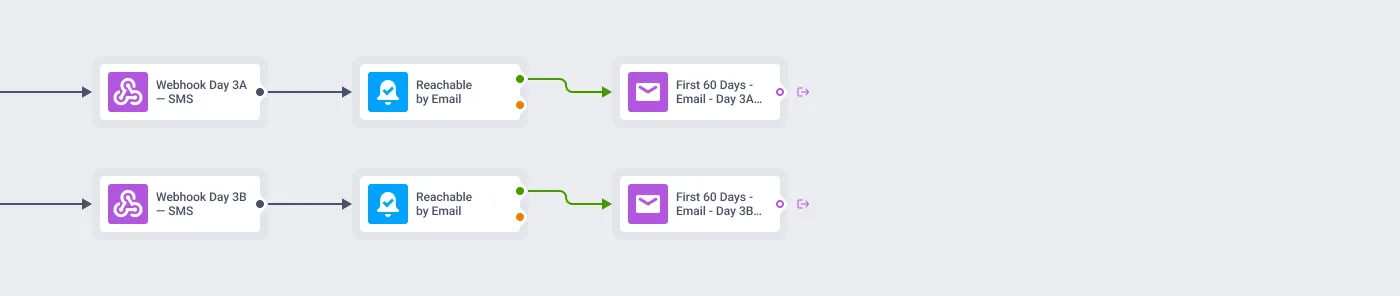
Journey 3: Inactive user journey
Users who have gone dormant on the platform, from either no activities or logins, are triggered to go into a resurrection (or inactive) journey for re-engagement. There is a series of escalating urgency messages and different emotional angles. Early messages emphasize what they’re missing; later ones share peer success stories and solicit feedback. The goal to re-engage is tracked and monitored within Pushwoosh for analysis and adjustments to help meet the needs of Hussle’s customers.
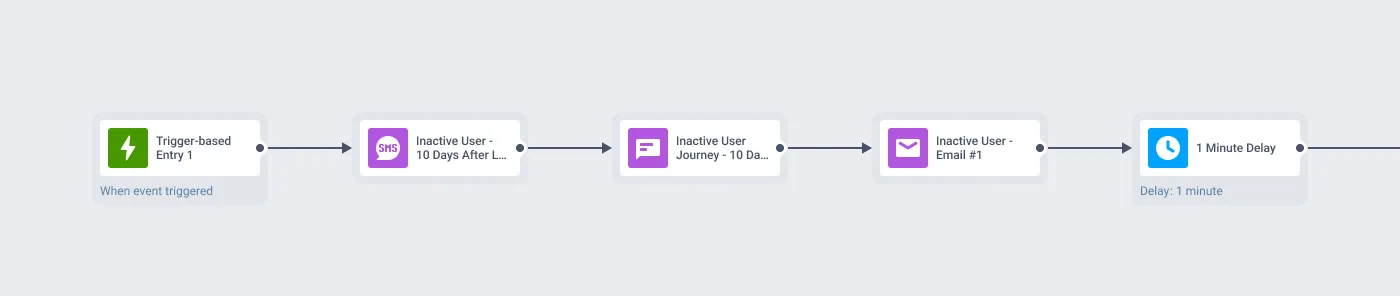
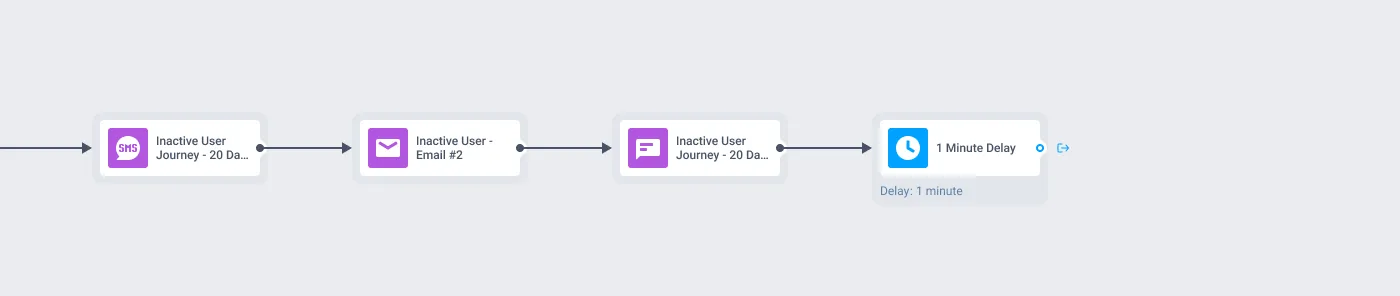
The template architecture: one build, deployed everywhere
One of the most operationally powerful aspects of the Pushwoosh integration is how Hussle manages journey deployment across hundreds of brand instances.
Rather than building separate journeys for each brand, Hussle maintains master template journeys as the source of truth. When a new brand is onboarded or an existing brand needs updated messaging, it is simple and easy for Hussle’s team to create the journeys and customize each journey to match that brand’s voice and business requirements.
The architecture makes this scalable: rather than duplicating business logic into every journey, the integration supports webhook and other API calls back between Hussle and Pushwoosh platforms at key moments, letting Hussle’s backend handle the brand-specific data lookups and personalization. This keeps the journey structures clean and portable.
The Pushwoosh account currently has active journey infrastructure across Hussle’s brand portfolio, including major direct sales companies with tens of thousands of subscribers.
Results
- Hundreds of brand deployments running from a single, yet very customizeable template architecture
- Hundreds of thousands of users across the portfolio receiving engagement nudges.
- Journeys spanning an omni-channel include OS push notifications, email, alerts and SMS — all coordinated through a single Customer Journey Builder setup
- Dramatically reduced time to engagement or first meaningful action for newly provisioned users
- Template-based journey management that allows new brand onboarding without rebuilding communication flows from scratch
Why Pushwoosh
For Hussle, the key capabilities that made Pushwoosh the right partner were:
- Event-driven journey entry.
The ability to start and branch journeys based on real behavioral events from the Hussle API — not just scheduled sends — was fundamental to the product. Pushwoosh’s webhook and custom event infrastructure made this straightforward to implement. - Boolean splitter logic.
The ability to check, mid-journey, whether a user has completed a specific action, and route them to completely different message sequences as a result, is what makes the Day 1–60 journey genuinely personalized rather than one-size-fits-all. - Multi-tenant scalability.
Hussle didn’t need hundreds of different communication platforms — they needed one that could cleanly serve all of their different brand contexts. The combination of Pushwoosh’s multi-app architecture and Journey cloning made that possible. - Omnichannel in one place.
Managing push, email, and SMS from a single journey canvas — with unified timing logic and behavioral conditions across channels — removed the coordination overhead that would have come from running separate tools for each channel.