Most loyalty programs generate high-intent signals every day: a member crosses 70% to Gold, points near expiry, a top-tier customer goes quiet. Most brands still message these moments on a calendar, disconnected from the behavior that should trigger them.
This playbook was built with our loyalty partner NeoDay, whose programs show what a strong loyalty layer can do: Pathé’s All Stars drove more than 300,000 new members and an 18% lift in visit frequency, and Tesco moved over 100,000 users from plastic to digital with ROI inside 3 months.
This guide covers 6 behavioral triggers, ready-to-send copy, and the journey branching for each. And along the way, you’ll see how Pushwoosh, an omnichannel customer engagement platform, turns each loyalty event into a message across push, in-app, email, SMS, and WhatsApp inside a single journey. The program defines the moment; Pushwoosh delivers it.
The 6 loyalty triggers at a glance
| Trigger | Event that fires it | Channel and timing | KPI it moves |
|---|---|---|---|
| Enrollment | Member joins the program | Immediate push, then in-app, then email fallback at 2h | Activation rate |
| Tier progress | Member crosses 70% to next tier | Single push/in-app at the threshold | Repeat purchase rate |
| Points expiring | Expiry window opens (e.g. 14 days out) | Email at 14d, push at 3d, SMS at 24h | Redemption rate, revenue |
| Redemption | Redemption completed | Immediate confirmation plus next-action prompt | Repeat redemption |
| Lapsing / win-back | No program activity in X days | Tier-branched, program data only | Reactivation rate |
| Gamification | Streak or challenge progress | Updates as it builds, final nudge 1 action out | Visit frequency, basket size |
Enrollment: activate in the 1st session
The event is a member joining the program, not a generic signup. Send an immediate push, follow with an in-app message that explains the tier system if they open it, and fall back to email after 2 hours if they do not. Branch on 1st behavior: a purchase within 7 days moves the member to a momentum track, no purchase moves them to an activation nudge.
Copy: “You’re in. [Name], you’ve earned 50 welcome points. Here’s how to use them today.”
📖 Read more: Welcome in-app messages that turn new members into active users
Progress toward the next tier: turn status into behavior
Fire this when a member crosses 70% of the points needed for the next tier, checked as a threshold rather than a scheduled send. 1 clear message is usually enough, and you only escalate if the member sees it and stays inactive.
“You’re 340 points from Gold. 2 more orders this week gets you there.”
The framing shifts by vertical. Retail works with a dollar-discount tied to the tier, travel and hospitality often win with status perks like lounge access instead of points value, and fintech converts on a cashback bump (“2 more transactions gets you 2% cashback”). If the member opens but does not act within 48 hours, branch to a limited-time double-points window.
Points expiring: the highest-intent moment you own
Expiring points are the highest-intent moment in most programs, so they deserve their own journey rather than a footer line in a newsletter. The event is the expiry window opening. Escalate channel intensity as urgency rises: email 14 days out, push at 3 days, and SMS at 24 hours for opted-in members.
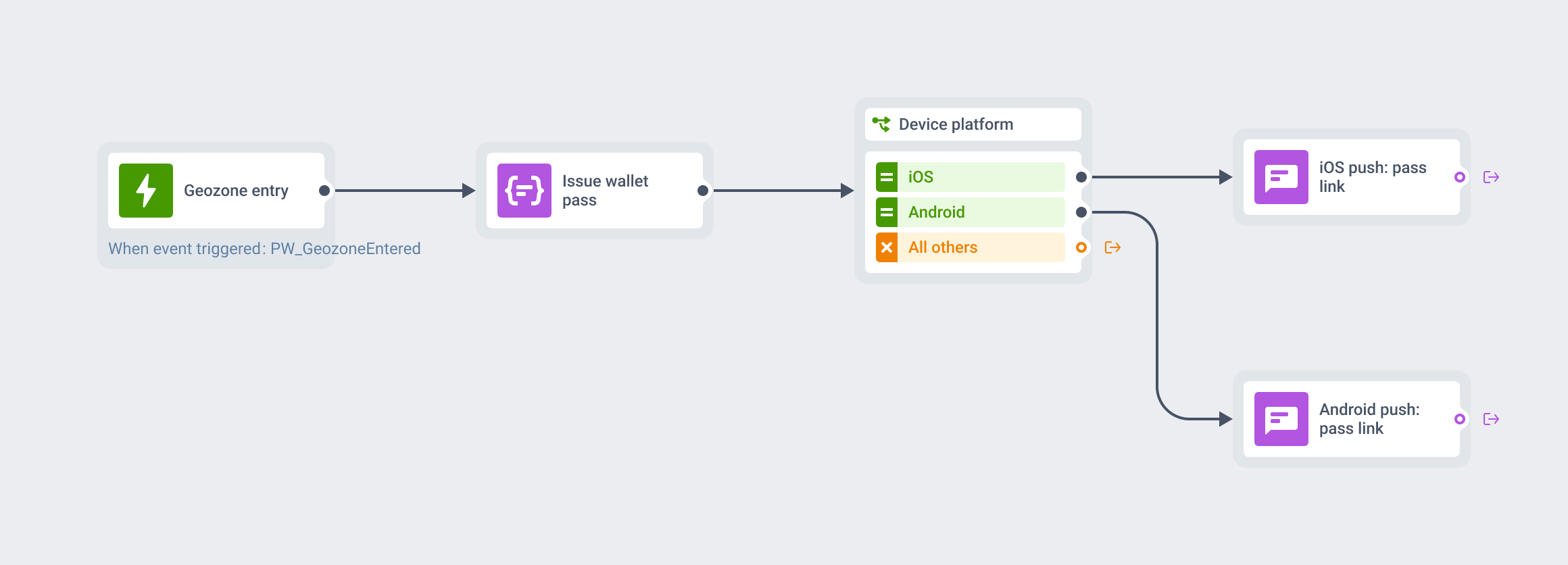
Branch on engagement. No open on the email moves the member to the day-3 push, and no action on the push moves them to the 24-hour SMS. For programs with a physical footprint, add a location layer: a Geozones push can remind a member about an unused voucher as they approach a store.
You orchestrate this escalation and its branches in Customer Journey Builder, where each step waits on the member’s response before firing the next.
Test the framing. Loss-framed copy reads “327 points expire Friday”; gain-framed copy reads “Use 327 points before Friday for $15 off”. Retail leans on dollar value, QSR on a free item (“your free coffee expires Friday”).
📖 Dive deeper: Omnichannel customer engagement: strategy & examples
Redemption: treat the confirmation as a re-engagement moment
Most programs stop at “redeemed”. Treat it instead as the start of the next cycle by bundling the confirmation with a next-action prompt in the same send, so you don’t need a separate journey step.
Copy: “Redeemed. Your next reward is 180 points away, and here’s the fastest way there.”
Lapsing and win-back: tighter than a generic churn flow
Loyalty win-back is not the same as an app win-back, and treating them the same is the mistake most brands make. Trigger it off program engagement specifically, redemptions and points activity, not overall app usage.
A member who still opens the app every day but hasn’t touched their points in 2 months isn’t churned. They’re bored with the program, and that needs a different message than a generic “we miss you”.
Branch by tier. Top-tier lapsers get a higher-touch message and a bigger incentive (“we miss you, here’s 2x points on your next order”), while low-tier lapsers get an automated, low-cost nudge (“your points are still here, come back for a quick win”). Mobile games can swap the discount for social proof (“your guild misses you”).
📖 Read more: Re-engagement email guide: examples, templates & best practices
Gamification: message the streak, not the calendar
Streaks and challenges are behavior-based, for example 3 purchases in 30 days for a bonus multiplier. Send progress updates as the streak builds and a final push when the member is 1 action from finishing, and use an in-app message for mechanics like a spin-the-wheel or a punch-card check-in that belong inside the app.
Copy: “2 more purchases this month gets you 2x points on everything.” If a streak breaks, reset it silently with no punitive messaging; if it completes, roll the member into the redemption flow above.
👉 See it in practice: Pushwoosh Customer Journey Builder in action
Turn loyalty events into revenue with Pushwoosh
Your loyalty program already knows who is about to lapse, who is 1 order from Gold, and whose points expire Friday. Pushwoosh turns those events into sequenced, omnichannel journeys that reach each member on the channel they respond to, built and edited by marketers with no code. Bladestorm boosted revenue by 4.58% using Pushwoosh Customer Journey Builder, and the same event-to-message logic applies to every trigger above.
Improving customer retention isn’t about sending more reminders. It’s about meeting each member at the exact moment their behavior signals intent.