Email open rates stopped meaning much. Since Apple’s Mail Privacy Protection started preloading messages, a large share of your “opens” are machines rather than people, and your non-openers list now mixes users who ignored you with users who read you and slipped through the tracking. Resending to that list is guessing.
The silence itself is the better signal. A user who received your message and stayed quiet is handing you behavioral data: this person exists, got the email, and chose not to act. Read that signal, and you can route them to a channel they’ll actually respond to.
Read the silence, then escalate
An ignored email tells you something specific: the channel might not fit, the timing might be off, or the offer missed. The catch is that silence comes in 2 flavors, and each one calls for a different move.
Unreachable via email. The message never had a chance. The user has a dead token or an unverified email. No amount of resending opens a closed door; you need a channel that’s actually open.
Reachable but silent. The message arrived, and the user passed on it. That points to fit, and a sharper context or a higher-urgency channel can flip the outcome.
From resend to escalation: a real flow
Instead of resending on 1 channel, escalate across 3. Each step fires only when the previous one produces no real signal, so most users never travel the full ladder.
- Email — for depth and context. Send the full info: details, a comparison, a clear link. It’s where most re-engagement starts.
- Push notification — timing and urgency. If 48 hours pass with no click or conversion, a short, time-sensitive nudge reaches users who skim faster than they read.
- SMS — high-stakes moments only. Still silent after push, and the user is high-value or unreachable elsewhere? Now a text earns its cost. For everyone else, the ladder simply ends.
Here’s that ladder as a real flow.
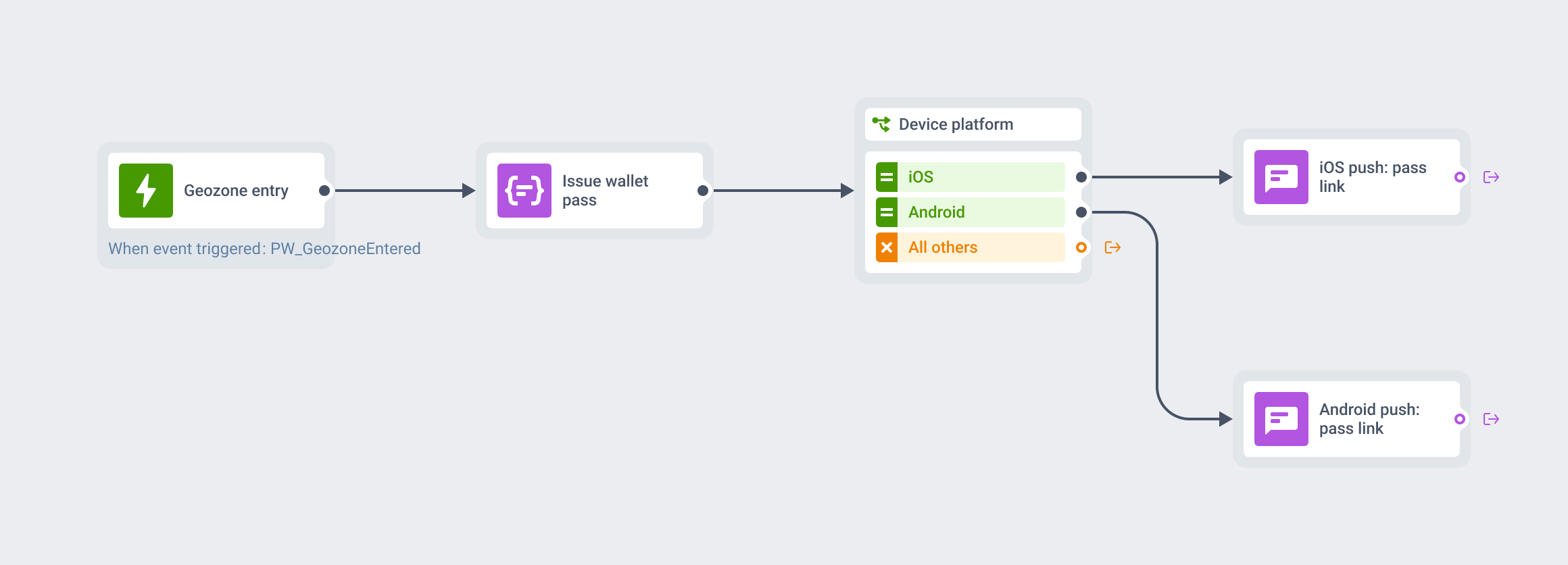
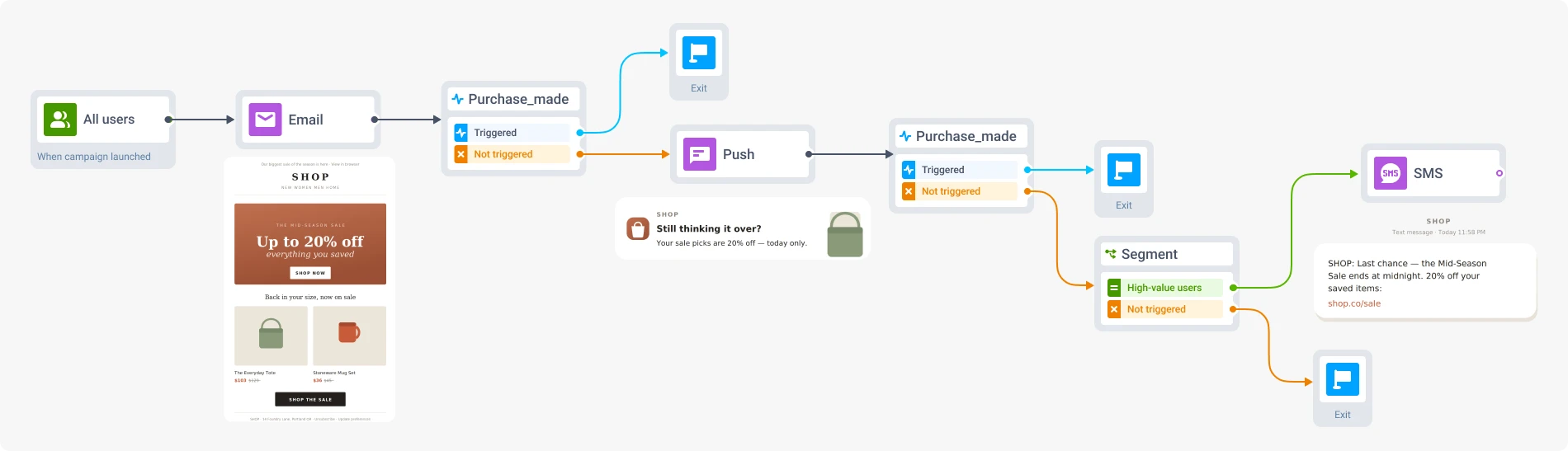
Take a standard e-commerce promo: a seasonal sale email to your active base, rebuilt as a signal-driven escalation in Pushwoosh Customer Journey Builder:
-
Send the email.
The full promo: hero image, offer, deep link to the collection. This is the channel with room for context, so it does the heavy lifting.
-
Wait 48h, then check for a click or conversion
A
link_clickedorpurchase_madeevent. Fired? The user exits. Still silent? Continue. -
Send a push notification.
Short and timed: "Your sale picks are still waiting — 20% off ends tonight. Tap to shop." This catches the segment that ignores email but responds to notifications.
-
Wait 24h, then check again.
Same logic, same events. Converted? Exit. No signal and the user is in a high-value segment? One step left.
-
SMS — only for the few who earn it.
Stripped to essentials plus a link: "Last chance: 20% off ends at midnight → [link]" Everyone else stays out of the SMS branch entirely.
Measure what reading the silence earns you
The cleanest way to prove it is to test it. Put an A/B/n split at the entry: 1 branch gets the email and nothing else, the other runs the full escalation. Same audience, same offer, same window — the only variable is whether silence triggers a next step.
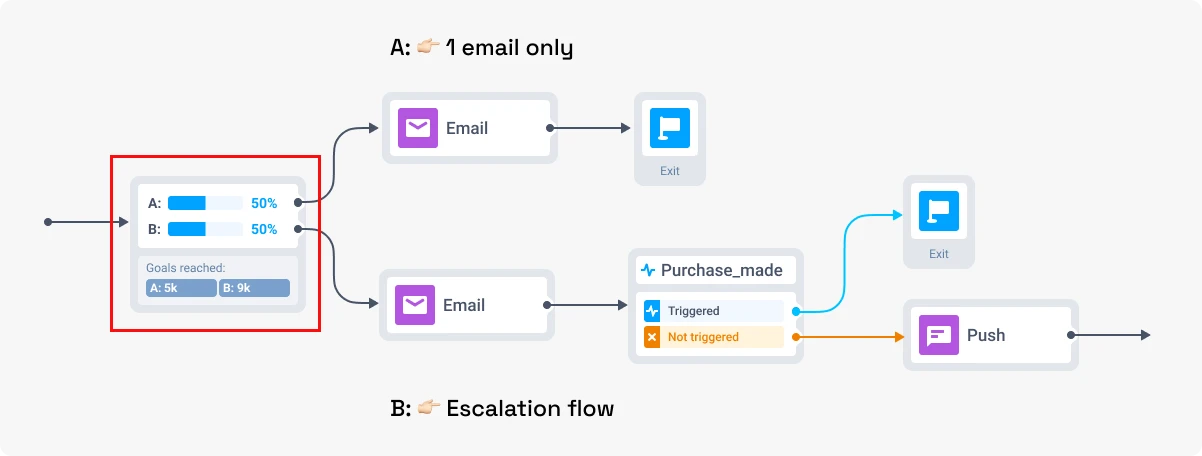
Then compare conversions across the two branches. Say the email-only branch converts at 2% and the escalation branch at 5%. That lift is everything push and SMS pulled back from users you’d have written off as silent.
Build signal-driven escalation flow in Pushwoosh
The whole system runs on 1 idea: a non-response is an event, not a blank. Read it, route on the click and the conversion, and let each channel handle only what it’s best at — email for context, push notification for timing, SMS for the moments that justify the cost. Same reach, far less waste, and no user buried under 3 messages about 1 sale.
Every element here — Trigger-based entry, Wait for trigger, Reachability check, time delays, and the channel nodes — lives in Pushwoosh Customer Journey Builder. No custom orchestration or no separate tools are needed.