The harsh truth is that you may lose 77% of your app users within the first 3 days after the install. Within 30 days, this figure can reach 90%. A well-known marketing ‘leaky bucket’ analogy suggests that you have to constantly increase the water flow (=user acquisition) to replace the customers you are losing.
But what if you try plugging some of the holes in the bucket instead (=boosting customer retention)? Read this post to define what user acquisition and user retention are for app growth and what strategies you can implement to get them in sync.
What is user acquisition?
In the mobile world, customer or user acquisition is the process of driving app installs and gaining new customers. For user acquisition, apps use such methods as App Store Optimization (ASO), paid advertising, influencer marketing, and content marketing.
How is customer acquisition measured?
When it comes to user acquisition, by far the key metric you’ll have to focus on is Customer Acquisition Cost (CAC). It can be calculated by dividing all the marketing costs by the number of new users acquired in the billing period:

Reducing CAC means that the business is spending money wisely. However, effective user acquisition is not just about paying less to get a customer. For sustainable app growth, it is crucial that CAC is in line with your ability to monetize acquired customers.
The size of the company, its structure, and the founder’s background highly influence how acquisition converges with retention & monetization inside teams. The siloed thinking about user acquisition is most often seen in companies that aren’t mobile-first or by marketing managers who don’t understand other disciplines like product design, growth hacking, or marketing analytics.

We could not agree more on this. While user acquisition strategy for apps mainly depends on your ability to attract new users, customer retention relies on your ability to provide value with your product, build relationships and personalize user experience.
The ‘leaky bucket’ problem is something that we have to regularly explain to our clients — and help them to fix. It happens because advertisers tend to overlook the underlying problem behind the flat, or even declining, curve of their mobile app’s user base which, in most cases, is caused by the product, not acquisition.
In an ideal world, UA and product managers hold hands all the time, share everything, and plan together. Their insights inspire each other, they create campaigns. The mutual understanding of roles helps to get the most of both.
Customer acquisition sost, a well-known startup killer, is a metric that growth marketers relentlessly try to optimize for, as you can reach huge audiences and the number of installs can compound rapidly.
However, given the ever-increasing costs to acquire users and the rise of the subscription economy, we’ve been observing a shift leaning toward retention over the past few years.
Keeping your user base active and engaged will increase their likelihood to convert, and with subscription models becoming more popular, a purchase can ultimately become recurring revenue.

What is customer retention?
In the mobile context, “customer retention” refers to the app’s ability to keep users after the initial download. Retention is one of the most important metrics of the app’s performance.
How is user retention measured?
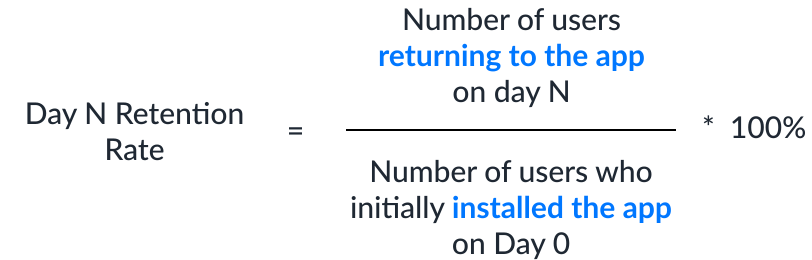
Retention Rate is the rate at which you retain users over a certain period of time. The most commonly taken metrics for mobile apps are Day 1, Day 7, and Day 30 retention.
For example, Day 30 retention would be the percentage of users returning to the app within 30 days. However, you can measure user retention for any time period:
The opposite of the Customer Retention Rate is the Churn Rate. It is measured as the percentage of users who uninstall or stop using an app over time.
Having a high retention rate and a low churn rate means that you are doing a good job engaging with your users, educating them about the app, and offering the most aligned features and incentives.
Customer acquisition cost vs. customer retention cost
In the post-IDFA world, user acquisition has become more expensive. Due to Apple’s App Tracking Transparency (ATT) framework, iOS users are harder to track and hence, more costly to acquire. For example, in e-commerce, the average CPA has increased by 155%.
The biggest challenge in user acquisition (UA) right now is working with SKAdNetwork (SKAN) for attribution on iOS 14.5+. Marketers need to balance a robust ATT opt-in strategy with a SKAN approach that leverages both aggregated and opted-in data to create a conversion value configuration that optimizes insights.

To keep your app viable in the changing landscape of mobile advertising, it is crucial to keep CPA lower than a typical user’s lifetime value (LTV). The possible solution here is a “product-first” approach to user experience.
If you invest in user acquisition before you have retention, you are not buying users, you are renting them. People too often overrate what marketing can do for their business. The acquisition is too often considered an isolated tactic fueling revenue growth. The hard truth is that user acquisition is a business model competition. You either have strong retention and monetization and can afford to buy users or you are left to organic traffic and less scalable marketing tactics such as influencer marketing.
Frequently we refocus with new clients from planned growth to a “product-first” approach to be even able to sustainably acquire users once the product performance improves.
User acquisition is largely automated on the side of ad networks and therefore doesn’t offer the leverage as years ago. Our role as an agency naturally changes toward where we can have the biggest impact — on the product.
Should you be focusing more on user acquisition or retention?
Enhancing your app retention rate can prove to be a cost-effective long-term strategy. A classic Bain & Company study suggests that for an average market, a 5% increase in retention rate leads to a profit increase of 25% to 95%. For your app’s growth, simply pushing tons of traffic and mobile app installs to your app every day won’t help if people jump the fence soon after.
If anything should come first, it’s the activation. Without getting people to see the value of your product, they won’t come back which will make retention and app monetization near impossible.
Activation is where the most leverage is. If you could increase the conversion rates during the activation stage of the customer lifecycle, it would be much easier to decrease the cost per acquisition and provide an experience that makes the user likely to return.
Once you have had rock-solid activation, your focus should go toward retention. People have to see long-term value to stick and to pay.
And only then it makes sense to start scaling user acquisition. If you don’t follow priorities in the correct order, you will deal with the ‘leaky bucket’ problem and your business will sooner or later die.
It’s crucial for apps at any stage to consistently seek to retain and monetize users, as even incremental gains can drive a massive impact on revenue metrics. Improving your trial to paid rate or reducing subscription churn can generate a meaningful impact on ROI, depending on the app’s scale. Users get closer to converting into revenue as they move down the funnel, so keeping them moving is essential to any mobile app.
Generating sustainable growth is all about balancing acquisition and retention. It’s key to ensure that your acquisition channels keep bringing new users to the top of your funnel while improving your product and lifecycle to monetize retained users at the bottom.
Best strategy for app growth: align user acquisition and retention
In the same way as an acquired user base is strengthened by customer retention, a well-planned acquisition can help optimize future retention. A smart marketing strategy doesn’t rely on just acquiring anyone. They look for the best users who engage, retain, and eventually, monetize.
Customer acquisition and retention are inherently linked. For example, we see apps whose user acquisition efforts are successfully driving conversion to purchase up, but simultaneously driving the lifetime value (and therefore retention) of users down.
It’s a balancing act, and app growth can’t be achieved sustainably without alignment between functions in terms of metrics, knowledge sharing, and the experience for users.

A key to successful acquisition/retention strategies for mobile apps is to apply user segmentation throughout the funnel so that your value proposition hits the target at every stage of the customer journey — from installation and adoption to in-app purchases and upgrades.
In order to maximize user LTV, it’s also essential to align UA and retention efforts to achieve your desired marketing results.
UA costs are on the rise, which makes retention more important than ever. Instead of viewing UA and retention as two separate topics, think of them holistically and ensure that teams are working together to map a segmented user journey that correlates with the campaign that drove the install.
By identifying churn points in the user journey, you can also better understand your segments and can make adjustments at acquisition level.
It’s all about finding the balance that delivers you the highest ROI.
The most successful apps understand that the person who is clicking on your advert is the same user who is subscribing to your app down the line.
Placing yourself in the user’s shoes helps you to, for example, set up user acquisition campaigns so that different audiences have different key messages, based on the core reasons they may be interested in using the app. This drives their motivation through the funnel, which can be further personalized above the base product through CRM campaigns that add value to specific user types.
Considering the user’s decision-making process at every stage of the funnel allows you to ensure you’re providing value to them, and hitting them with the right messaging and education at each point, to drive effective and holistic app growth.
Map and automate customer journeys
Mapping customer journeys will show all the interactions your clients have with your app. Automated user journeys can perform 3 main functions:
▪︎ Identify churn points;
▪︎ Segment users according to their behavior and characteristics;
▪︎Send event-triggered messages with instructions, product tips, and feature promotions.
In Pushwoosh Customer Journey Builder, you can easily set up cross-channel campaigns and target your app’s users with the right messages at the right time.
Use activation to balance acquisition and retention
The bridge between user acquisition and retention is user activation — a metric that shows how many customers have started using the app and already performed a valuable action. Without user activation, you can’t take newcomers down the sales funnel as they haven’t found reasons to use your app. It’s no wonder user activation can impact D1 Retention, as it determines the very first impression users get from the app. But did you know that successful activation can even increase customer LTV by up to 300%?
If anything should come first, it’s the activation. Without getting people to see the value of your product, they won’t come back which will make retention and app monetization near impossible.
Activation is where the most leverage is. If you could increase the conversion rates during the activation stage of the customer lifecycle, it would be much easier to decrease the cost per acquisition and provide an experience that makes the user likely to return.
Once you have had rock-solid activation, your focus should go toward retention. People have to see long-term value to stick and to pay.
And only then it makes sense to start scaling user acquisition. If you don’t follow priorities in the correct order, you will deal with the ‘leaky bucket’ problem and your business will sooner or later die.
In successful user activation, automated mobile messaging plays a paramount role. Think about the action that a user should take to be considered activated, for example, making their first photo collage or tracking their first run. Send a message motivating users to take action:
- In-app messages for effective user onboarding;
- Emails to encourage users to actually make an activation event;
- Push notifications to engage customers from Day 1 and take them towards activation action in a single tap.
- Retargeting ads that work in tandem with push and email, nudging users who’ve gone quiet, across channels they still scroll.
Apply personalization in messaging
Another way to improve a user’s retention is by sending them personalized messages. This will help you build long-lasting loyalty at each stage of the customer journey. With Customer Journey Builder, you can segment users by the target action they took (or didn’t take) and tag user segments for A/B/N testing. Set User-specific Tags and update information about a specific user no matter how many devices they have assigned.
Key takeaways
We’ve talked to top industry experts and learned that for the app’s long-term growth strategy, it is crucial to align user acquisition and retention. While acquisition allows you to expand your audience, retention maximizes the value of customers you have already captured.
After acquiring users with a good potential for monetization, you should focus on converting their motivation into sales. This can be done by communicating your app’s value at all stages of the customer journey. Talk to our team to learn how compelling and timely mobile messaging—push notifications, emails, and in-apps—makes part of this holistic approach.