An effective communication strategy starts with knowing who you’re talking to. Customer segmentation is how you find that out: you split a broad audience into smaller groups that actually behave alike, then message each group on its own terms.
This guide covers what customer segmentation is, the main models and strategies, the data you need, where AI fits, and how to run it in Pushwoosh. If you’re new to it, start at the top; if you’re refining an existing setup, jump to strategies or best practices.
What is customer segmentation?
Customer segmentation is the practice of dividing your customers into groups that share meaningful characteristics, so you can target each group with relevant messaging instead of one broadcast to everyone. Those characteristics can be anything that predicts how a person responds: age and location, interests and values, or the actions they take in your app.
The point isn’t to sort people for its own sake. A segment earns its place only when the group behaves differently enough that you’d message it differently. If two groups want the same thing and respond the same way, they’re one segment, not two.
Done well, segmentation improves nearly every downstream metric: conversion, retention, and customer lifetime value all move when the right message reaches the right person at the right moment. The rest of this guide shows how to build that.
Why customer segmentation matters for your business
Segmentation shapes who you target and how you talk to them. Here’s what changes when you get it right.
Better-tailored offers. Grouping customers by shared traits lets you send personalized messages that match real preferences and behavior, rather than a generic promo everyone ignores.
More effective communication. Targeted messaging beats broadcast, and segments open the door to real experimentation. You can run split and A/B/n tests to learn which channels and messages work for which type of customer.
Improved customer retention. Customers who feel understood stay longer. Messages tied to a customer’s interests give them a reason to come back, and consistent re-engagement lifts retention, loyalty, and customer lifetime value.
Reduced churn. When you focus on giving each group what it needs, satisfied customers are less likely to leave. Precise product recommendations and need-based communication are among the more reliable ways to prevent churn before it starts.
A stronger customer experience. Segmentation lets you meet your audience in their micro-moments, the small windows when they’re ready to act. Being there with the right thing raises the quality of every interaction.
Insight for product and positioning. Treat segmentation as an analytics exercise. Compare segment sizes and conversion rates, find the group that responds most, and ask whether it’s underserved. The gaps you spot can shape your next feature or offer.
Types of customer segmentation
Most segmentation models fall into a handful of categories. You’ll rarely use just one; strong segments usually combine several. Here are the main types.
| Type | Groups customers by | Example |
|---|---|---|
| Demographic | Age, gender, income, occupation, family status | A retailer targets a discount range by income bracket |
| Geographic | Country, city, climate, urban vs rural | A media app sends local news by city |
| Psychographic | Lifestyle, values, interests, attitudes | A fitness app groups users by health goals |
| Behavioral | Actions taken: purchases, app opens, feature use, engagement | An app re-engages users who lapsed after one session |
Demographic and geographic segments are the easiest to build because the data is stable and often collected by default. Psychographic segments are richer but harder to source, since they depend on stated preferences and inferred interests. Behavioral segmentation tends to be the most predictive for mobile apps, because what a user does says more about what they’ll do next than who they are on paper.
One behavioral model worth calling out is RFM, which scores customers on Recency, Frequency, and Monetary value. It’s especially useful for e-commerce and gaming, where it separates high-value buyers from occasional ones. We cover it in depth in the RFM segmentation guide, including how to run it without the monetary component when your conversions aren’t purchases.
When you’re ready to compare platforms that build these segments for you, the customer segmentation tools guide walks through the options.
4 customer segmentation strategies that boost marketing effectiveness
Knowing the types is one thing; choosing an approach is another. The goal underneath all four strategies below is the same: send relevant messages at the right time. Here’s how to get there.
1. Segmentation by attributes
Start with the data your audience has allowed you to collect. The more zero- and first-party data you gather, the more focused your segments become. Attributes like location, subscription type, and stated interests give you a stable foundation to build on.
2. Segmentation by behavior
Track what users actually do and react to it with content that moves them along their journey. A user who just finished onboarding needs something different from one who’s abandoned a cart, and behavior tells you which is which.
3. Combined attribute and behavior segmentation
Users with similar behavior but different attributes, or the reverse, often respond differently to the same message. Combining both criteria is where segmentation gets sharp. Two people who both abandoned a cart might need different nudges if one is a first-time visitor and the other a loyal repeat buyer.
4. RFM segmentation
RFM (Recency, Frequency, Monetary) analysis sorts customers by how recently and how often they act, and how much they spend. It’s a fast way to find your most valuable customers and the ones slipping away. Even without monetary data, recency and frequency alone are enough to build useful segments. The full method is in the RFM segmentation guide.
What data should you collect to build customer segments?
The more you track, the more precise your segments. That said, your first steps don’t have to be complex, and behavioral data is the best place to begin.
For effective mobile app user segmentation, my main tip would be to start simple and focus on the basics to create a foundation. Even with limited user data, you can leverage behavioral insights from how users interact with your app to create meaningful segments. Behavioral data provides a view into user engagement, their preferences, and any pain points, making it a useful foundation for segmentation.

Behavioral data
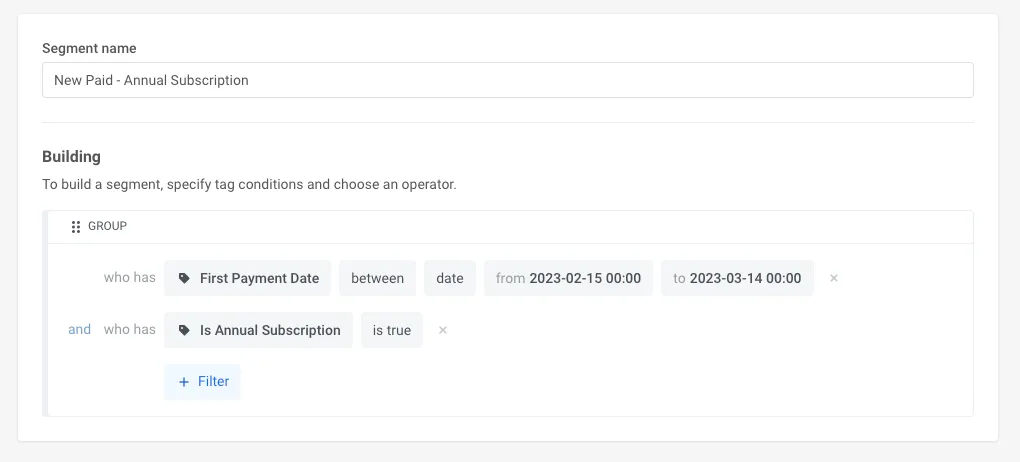
In Pushwoosh, Default Events work from day one, and Predefined Events cover common needs by industry. Your dev team activates them by dropping the required code into your app. Custom Events let you track any action that matters to you, so you can, for example, segment users who bought their first annual subscription in a given period and watch how they adopt premium features.
Purchase and payment history
RFM segmentation is a special case of behavioral data that needs purchase events. To set it up, see the Pushwoosh documentation on RFM segmentation, or walk through it with the team on a demo call.
User properties
Pushwoosh collects key attribute data by default, including city and country, device model, and install and last-open dates. Location lets you differentiate geographically, so a media app can lift CTR by sending local news instead of general updates. Install and last-open dates power onboarding and re-engagement timing.
You can layer on more, such as user interests, subscription type, and names for personalization. This data is anonymized but detailed enough for effective segmentation, and it’s all accessible through Tags.
Combining behavior and properties
As you gather more data over time, refine your segments by incorporating additional variables such as demographic information, device types, and geographic location. By starting with behavioral data and progressively refining your approach, you can create a robust segmentation framework that drives meaningful user engagement and business growth, even with limited initial data.
Targeting focused segments defined by both attributes and behavior is what raises the effectiveness of your messaging and lifts conversions.
Where AI fits in customer segmentation
Traditional segmentation is rules-based: you pick the attributes and events, and define the groups by hand. AI segmentation works the other way around. Machine learning models, usually clustering algorithms like K-means, group customers by shared patterns in the data without you predefining the categories, and they surface groupings a human analyst might never think to look for.
Two things make the AI approach useful in practice. First, it works across many signals at once, blending behavioral, transactional, and contextual data into hybrid micro-segments that a manual rule wouldn’t capture. Second, segments update continuously as new data arrives, so a customer showing churn signals today moves into the at-risk group immediately, not at the next quarterly review.
The catch is that AI doesn’t replace judgment. Models find the patterns; you still decide which segments are worth acting on and what message each one gets. Used that way, AI is a way to scale segmentation, not to outsource the strategy behind it.
Best practices for customer segmentation
A few habits separate segmentation that moves metrics from segmentation that just looks organized.
Plan data gathering with your dev team. The parameters you can segment on later depend on the events you capture now. Line up default parameters and custom events early.
Make segments discernibly different. If two groups have nearly identical needs and behavior, treating them as separate segments wastes effort. Split only where the difference changes what you’d say.
Build on up-to-date parameters. Base segments on recent data and on attributes and events that are still relevant to your business. Stale criteria produce stale segments.
Watch for shifts in category demand. Economic changes bring new people into your category and push others out. Revisit who your customers are periodically, and adjust how you win back the ones who churned.
Track the right KPIs, ignore the vanity ones. A higher click-through rate on a paid acquisition campaign looks good but doesn’t always convert to sales. Pick the KPIs that reflect real outcomes and don’t chase vanity metrics.
What the numbers look like
Segmentation’s impact shows up in engagement rates. Pushwoosh internal data and media benchmarks give a sense of the range:
| Scenario | Before segmentation | After segmentation |
|---|---|---|
| E-commerce push CTR (segmented by favorite product category) | 0.5% (broadcast) | over 10% |
| Media & entertainment push CTR (segmented by preferred content) | — | 7-9% average |
Sources: Pushwoosh internal research on push CTR and news & media push benchmarks. Your results will vary with audience, category, and channel.
Segmented marketing communications: 5 key scenarios
Here are five ways to put segments to work with the Pushwoosh Customer Journey Builder, our drag-and-drop tool for automating cross-channel campaigns.
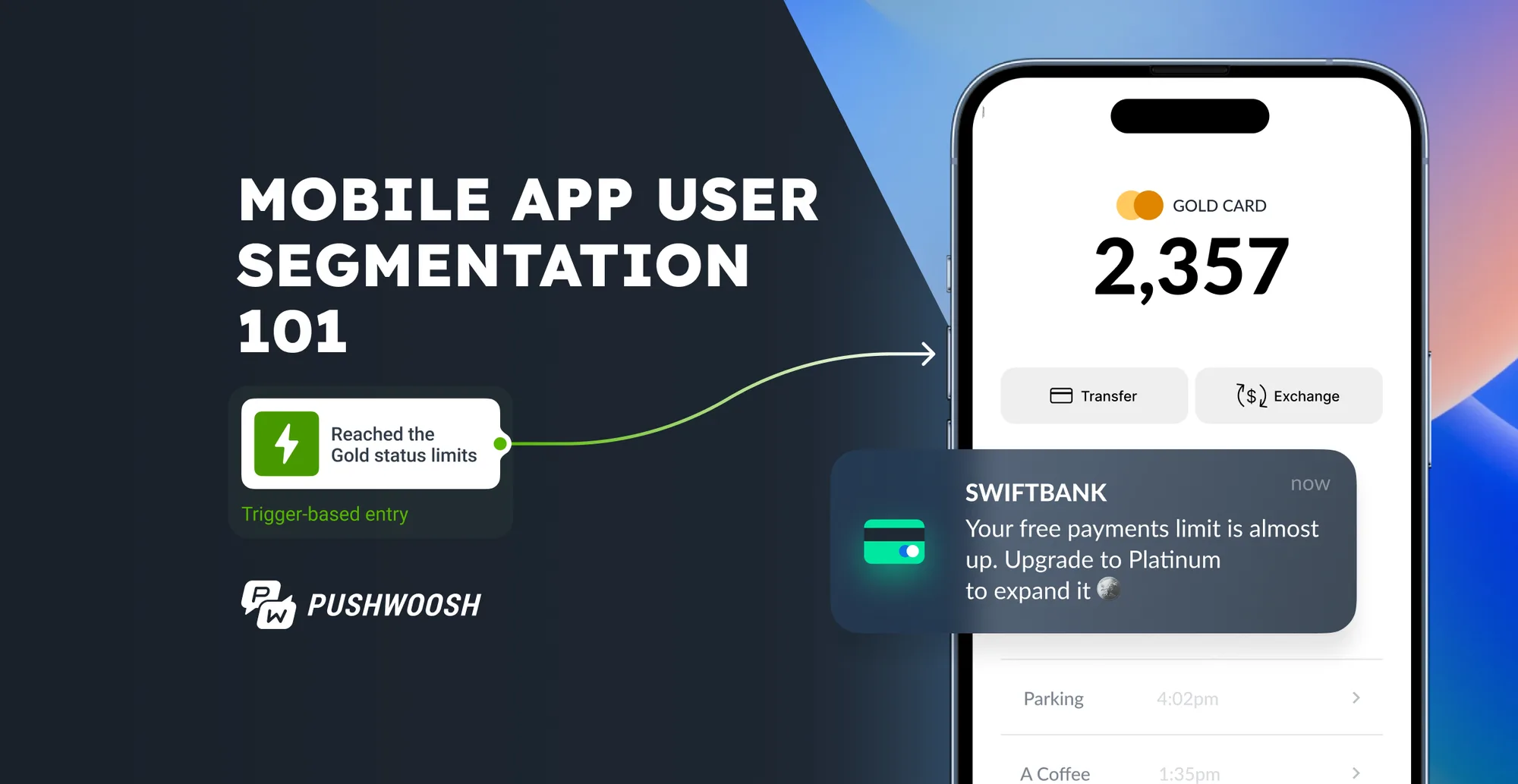
1. User onboarding. Start a journey with a Trigger-based Entry (say, “Application open”) and filter to a “New” segment, so only newcomers enter the flow. Walk them through your product’s value with an in-app messaging sequence. More on building a strong onboarding flow.
2. Selling and upselling. Begin with an event, then split the audience by whether they’ve purchased. Send discount vouchers to buyers to drive repeat purchases, or to non-buyers to convert them. More ways to increase e-commerce sales.
3. Testing messages across segments. Use Tags to mark users inside your segments, then compare how each tagged group responded to see which message and which segment performed best.
4. Exporting A/B/n test data. Run an A/B/n test, tag each group with its own value, send the messages, and export the statistics for deeper analysis in an external system. Here’s how to run A/B/n tests that boost ROI.
5. Combined segmentation for relevance. Pair behavioral and attribute-based segmentation for a sharper picture of your audience. Start a journey with a Trigger-based Entry, set a Tag the moment a user completes a target action (like “ProductAdd”), then build a segment from that Tag and message those users directly.
Tips by industry
How you segment depends on your app type, goals, and above all your industry. A few starting points.
🛒 E-commerce
E-commerce tends to run the most advanced segmentation, using gender, age, location, browsing habits, and interests. The payoff is real: segmenting by favorite product category is what took one business from 0.5% broadcast CTR to over 10% (see the table above).
Recommended next steps: prompt users to add items from their preferred category to the cart, promote goods to the users most likely to buy them, and win back churned customers with abandoned-cart emails.
🍿 Media & entertainment
Here the goal is understanding content preferences and spotting the highest-lifetime-value users. Segmentation by preferred content drives strong engagement (7-9% CTR on average) and audience growth.
Recommended next steps: collect topic preferences from views history, send weekly digests of relevant content, and localize news by geography.
👍 Subscription-based apps
Subscription apps use segmentation to focus messaging on paying customers and active users.
Recommended next steps: keep your just-installed segment current and welcome newcomers with onboarding, launch re-engagement campaigns on specific segments, and test pricing options across segments.
Segment smarter and lift retention with Pushwoosh
Customer segmentation stops being guesswork when the right data and tools are in one place. Pushwoosh gives you the events, tags, and journey automation to build precise segments and act on them across push, in-app, email, SMS, and WhatsApp.
Schedule a demo and we’ll show you how Pushwoosh supports your segmentation and personalized messaging.