Black Friday is probably the busiest time for e-commerce marketers who make great efforts to engage more customers, increase sales and profits. However, the question is, does all this marketing activity bring the desired results?
To give you an informed answer, Pushwoosh Team has studied the data from 57 e-commerce apps and analyzed almost 3 million push notifications. How did brands approach their campaigns and how did consumers react to Black Friday marketing offers? See it clearly by the apps’ CTRs, numbers of DAU, and other important metrics.
This article will help you:
- Get an overview of the key statistics for this Black Friday season and compare it to last year’s one.
- Find out if Singles’ Day was as popular as Black Friday.
- Prepare for Black Friday 2022 backed by the real data and insights.
A quick reminder before we start:
- Black Friday 2020 — November 27
- Black Friday 2021 — November 26
- Singles’ Day 2020 and 2021 — November 11
E-Commerce Apps Have Got Pretty More Active Around Black Friday
Is It Still Black Friday or, Rather, Black Friday Week?
What Is the Most Common Discount That E-Commerce Apps Offered?
Is Singles’ Day a Black Friday Competitor?
E-Commerce Customers In-App Activity Increased on Black Friday
E-Commerce Customers React More Actively to Black Friday Offers
Two Ways to Ensure High Push Notification CTRs on Black Friday
E-Commerce Apps Have Got Pretty More Active Around Black Friday
On Black Friday 2021, e-commerce apps sent out a pretty higher number of push messages per daythan usual. Almost half of the analyzed apps started sending out up to five push messages a day to each device instead of the usual number of two during the non-holiday period.
In more detail, on November 26, most of the apps followed one of the two strategies:
- About 54% of the apps kept sending 1–2 pushes per device
- About 42% of the apps sent 3–5 pushes per device
The rest 4% of the apps mostly sent 6–10 pushes. There is also a minor number of apps that sent up to 50 pushes per device or even more.
These were the pushes that a single user could see on their device. But what about the number of notifications that a single app had to create and distribute?
Let’s look at the average number of pushes sent by a single app — on Black Friday, it also increased from 2 in 2020 to 5 in 2021.Consider this data to predict your staff and customer engagement platform workload for the next year and get ready for it in advance.
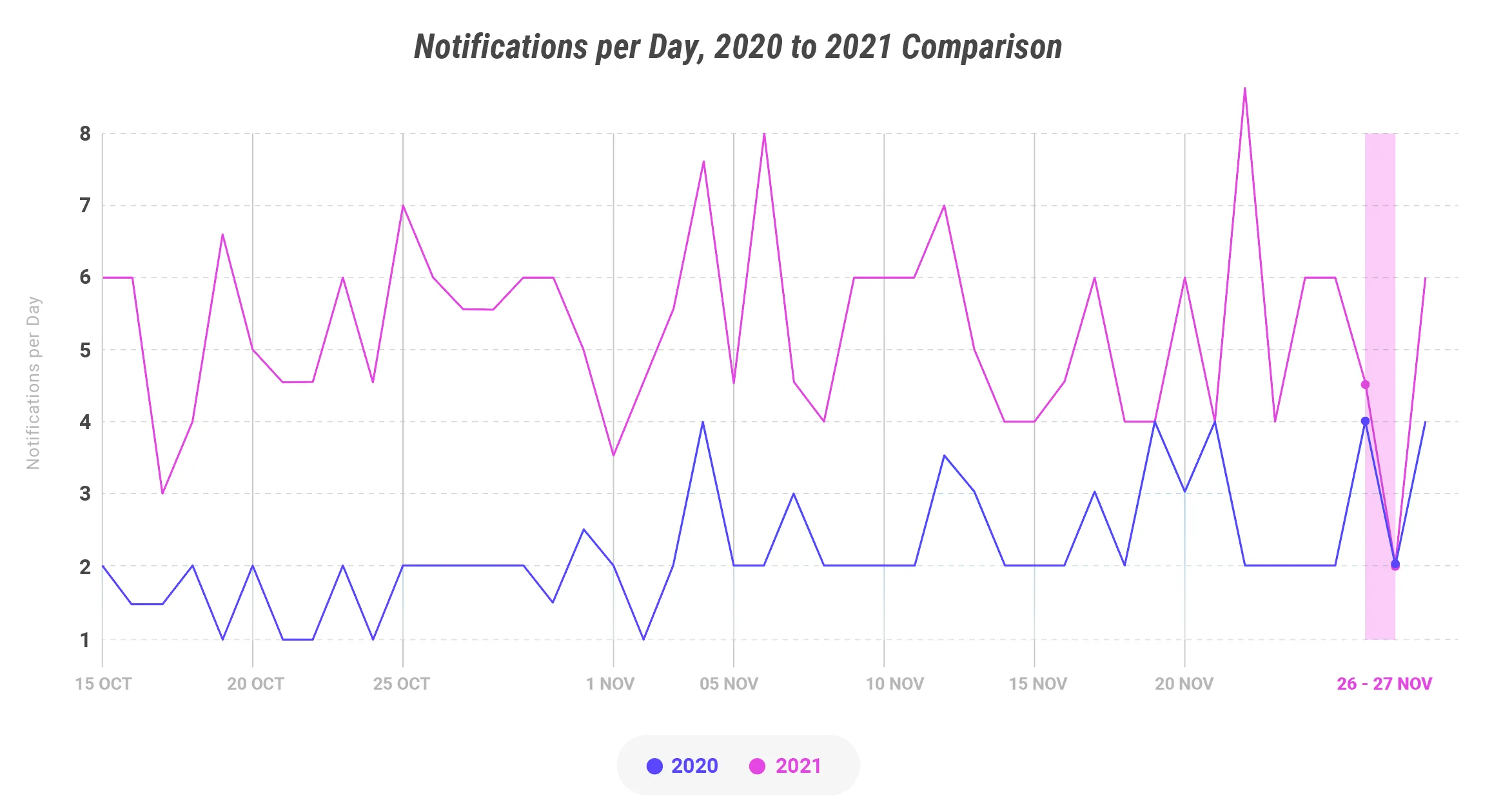
Notifications per Day, 2020 and 2021 Comparison
A spike in the number of push messages sent around Black Friday may indicate both an increase in marketing activity and the fact that marketers started to send more segmented messaging sequences. This is a great move that a marketer can do as behavioral segmentation helps to achieve 7X higher engagement with push notifications, 25X higher conversion into target action, and 30X higher in-app activity, according to the Pushwoosh data study.
Is It Still Black Friday or, Rather, Black Friday Week?
In a nutshell, it’s more correct to call it Black Friday week.
The analyzed apps started to send special ‘Black Friday’ offers on November 19. Over the next week, the number of pushes with such offers was about 1.5% on average. On November 26, 2021, this number reached its maximum — 5.83% of all push messages included the ‘Black Friday’ phrase in English or any of the 10 other languages: German, Swedish, Norwegian, French, Dutch, Russian, Polish, Finnish, Arabic, and Portuguese.
Moreover, a surge in the number of pushes sent per device and pushes sent by an app per day started a week prior to Black Friday. This also indicates that it’s rather a Black Friday week than only one day.
What Is the Most Common Discount That E-Commerce Apps Offered?
Around 15% of the push notifications sent on November 26 contained discount offers, with almost 10% stating the discount percentage. All the discounts can be combined into three main groups in terms of frequency: most common (25%), average (70%), and rare (~50%).
It is noteworthy that the number of 50% discounts was pretty higher on Black Friday than in the prior two-month period.
One more interesting thing is that during the non-holiday period, about 10% of pushes sent by e-commerce apps contained multiple discounts. During the two weeks before Black Friday, this number increased to almost 14%. The likely reason is that marketers try to engage customers with more special offers and promotions on various products at once.
On Black Friday, the number of pushes with multiple discounts fell drastically — to less than half of a percent. It seems that all the pushes were thoroughly segmented to deliver an offer with the most relevant discount to each customer.
Are you interested in how effective this marketing strategy is? Move to the paragraph covering customer engagement around Black Friday.
Is Singles’ Day a Black Friday Competitor?
Black Friday isn’t the only time when e-commerces’ marketing activity increases and so does the number of push notifications they send. On Singles’ Day, we observe the same trends.
Two weeks before Singles’ Day, around 90% of the apps sent 1–2 push messages a day.
On November 11, the situation changed:
- A smaller share — about 67% — of the apps sent 1–2 pushes per device
- Almost 31% of the apps increase the volume of their messaging to 3–5 pushes per device
Compared to Black Friday, the number of apps that sent over 5 pushes per device is twice smaller — less than 2%.
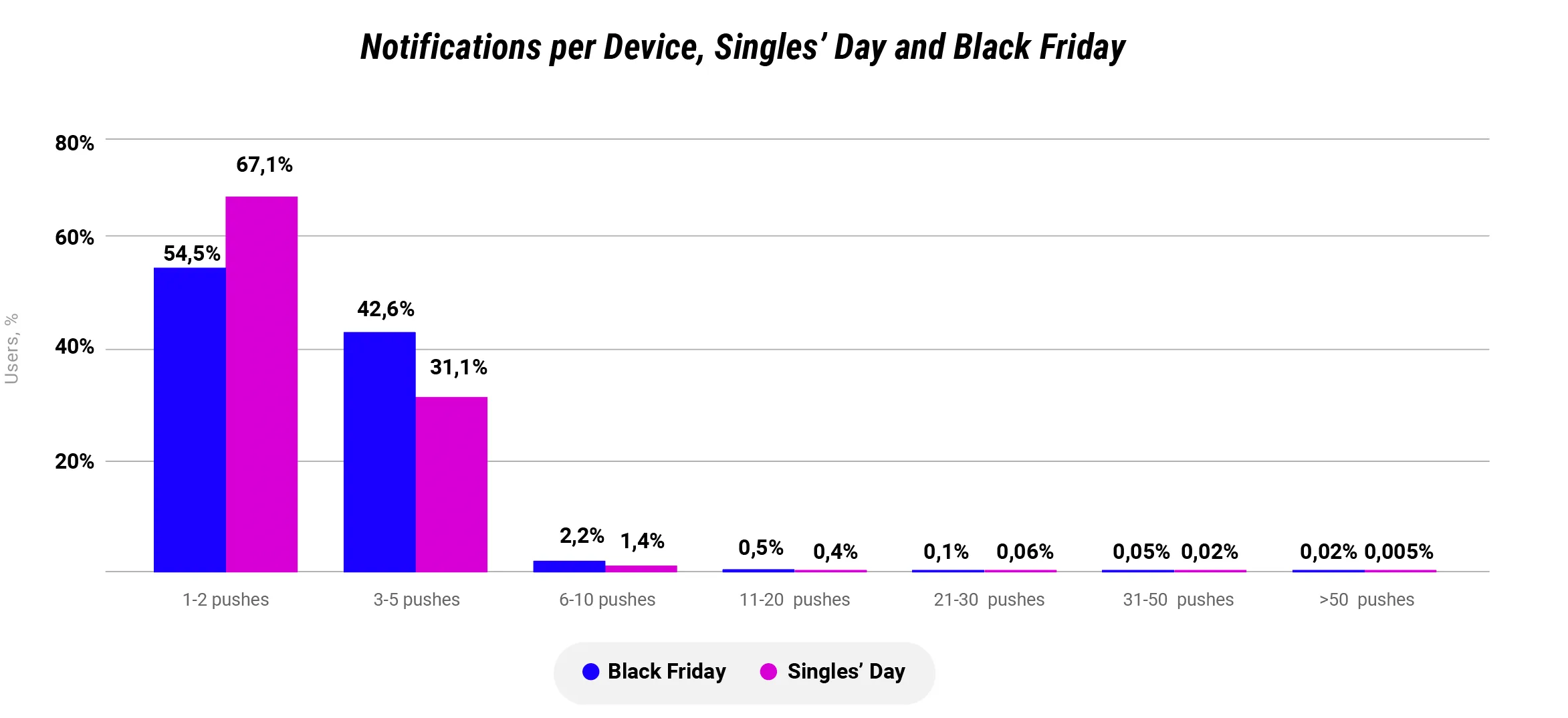
Pushes per Device, Singles’ Day and Black Friday Comparison
The closer we got to Black Friday, the more the situation changed. From Singles’ Day to Black Friday, some of the apps started sending 3–5 push messages a day, and some even more — 6–10 pushes a day.
E-Commerce Customers In-App Activity Increased on Black Friday
Pushwoosh Team analyzed the activity of the e-commerce app audience by DAUs and app open rates.
In total, DAU increased by 15% in all apps and by 30% in those that were growing initially.
🤔How does your number of DAU compare to the industry medians? What kind of campaigns can help you boost your DAU? Get your questions answered in our blog post.
In terms of app open rates, there wasn’t any noticeably higher activity around Black Friday than usual. Of all the 35 apps analyzed by Pushwoosh Team, 25 had an increase in app opens while the other 10 had a decrease.
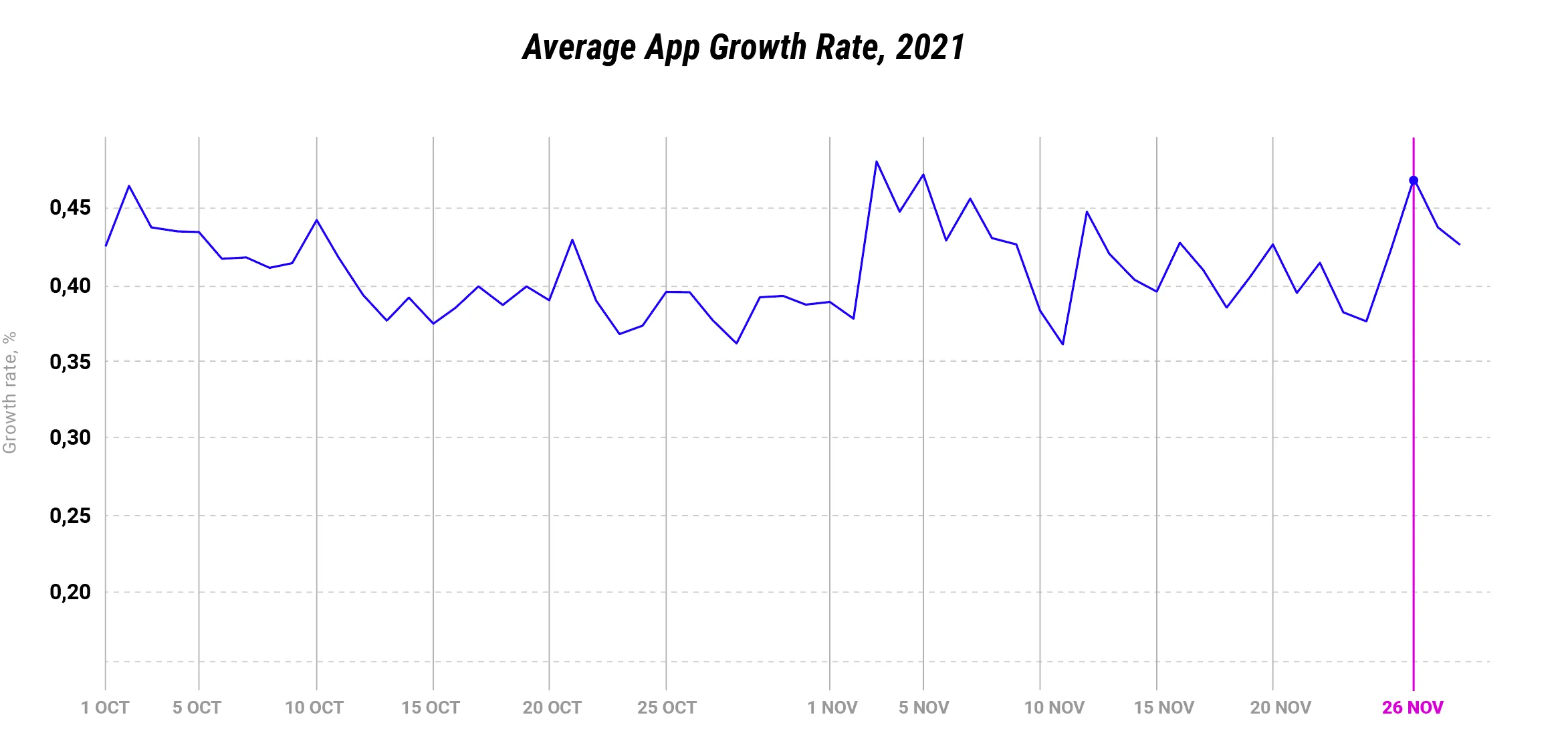
Average App Growth Rate, 2021
The number of app installs didn’t show any marked increase around Black Friday 2021. There are some fluctuations, but they are not significant. On November 26, the growth rate was slightly higher than on other days.
However, this doesn’t mean that e-commerce businesses shouldn’t expect an increase in their in-app activity next year. It’s rather good that the number of app installs remains unchanged, which means communication with the current audience may provide a basis for app growth.
If apps engage their audience during the Black Friday period, they may increase sales by making offers to more loyal customers. Moreover, this effect can remain far beyond Black Friday and the entire holiday season, bringing more conversions and sales on regular dates.
Furthermore, if we get back to the 2020 stats, we’ll see there was growth if you average all the apps’ metrics. On November 11, 2020, the in-app activity increased to 11–20% on average. Around Black Friday, the activity also slightly increased in some apps.
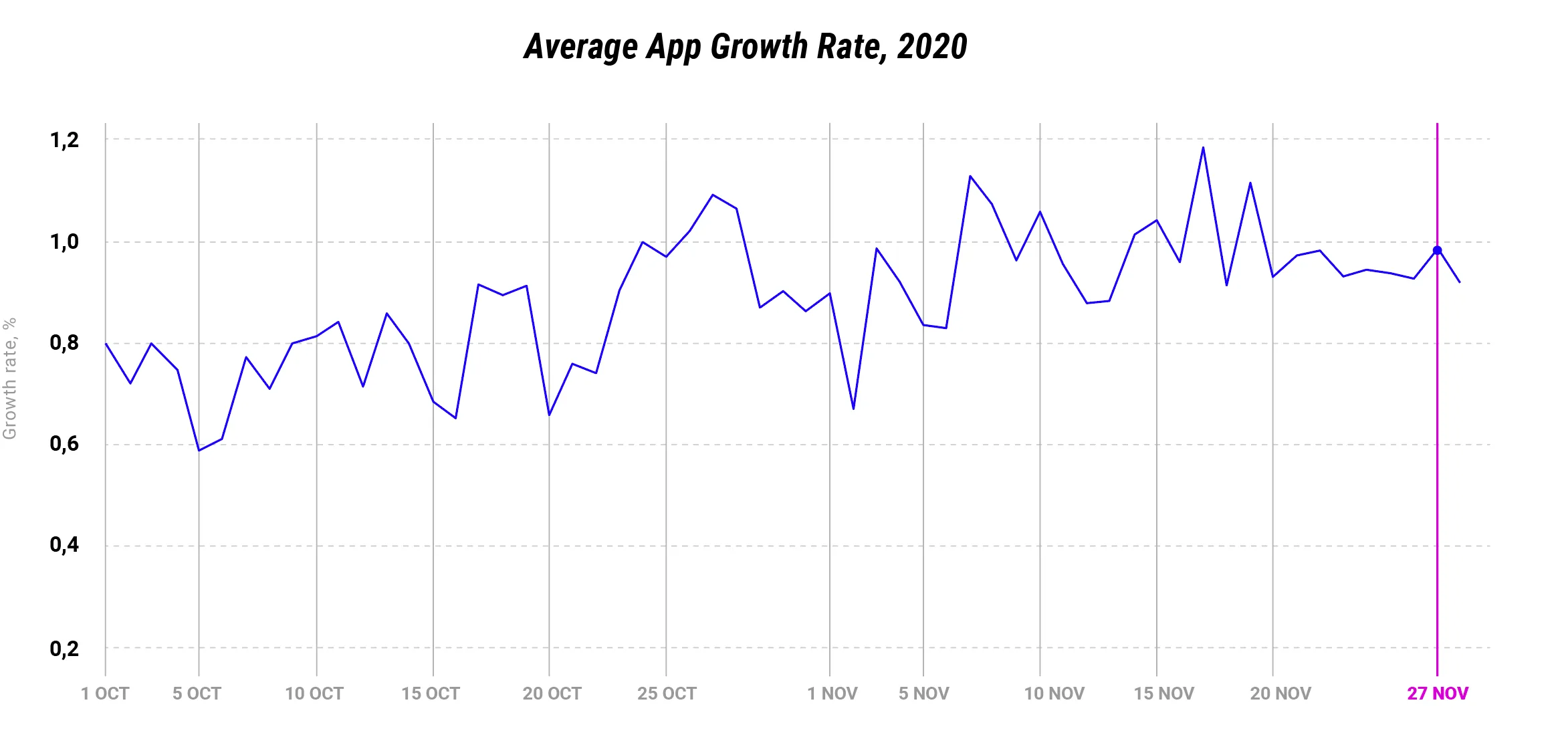
Average App Growth Rate, 2020
After Black Friday, we observe no surge in the number of app uninstalls compared to the previous period. This means users who installed apps before Black Friday are likely to keep using them afterwards.
E-Commerce Customers React More Actively to Black Friday Offers
In general, e-commerce apps had higher push notification CTRs on Black Friday than throughout the rest of the year. Messages with discounts are no exclusion:
- The average CTR of pushes with a discount prior to the Black Friday week — 3.68%
- The average CTR of all pushes sent on the Black Friday week — 4.96%
However, on the very day of November 26, CTRs of pushes with discounts were even lower than during the prior non-holiday period.
- The average CTR of all pushes analyzed in this study — 4.34%
- The average CTR of pushes on Black Friday 2021 — 3.91%
The reason could be, most customers choose what to buy during the week before Black Friday and then wait for the biggest discounts. And on Black Friday, they open only the pushes with the best discounts on the chosen categories.
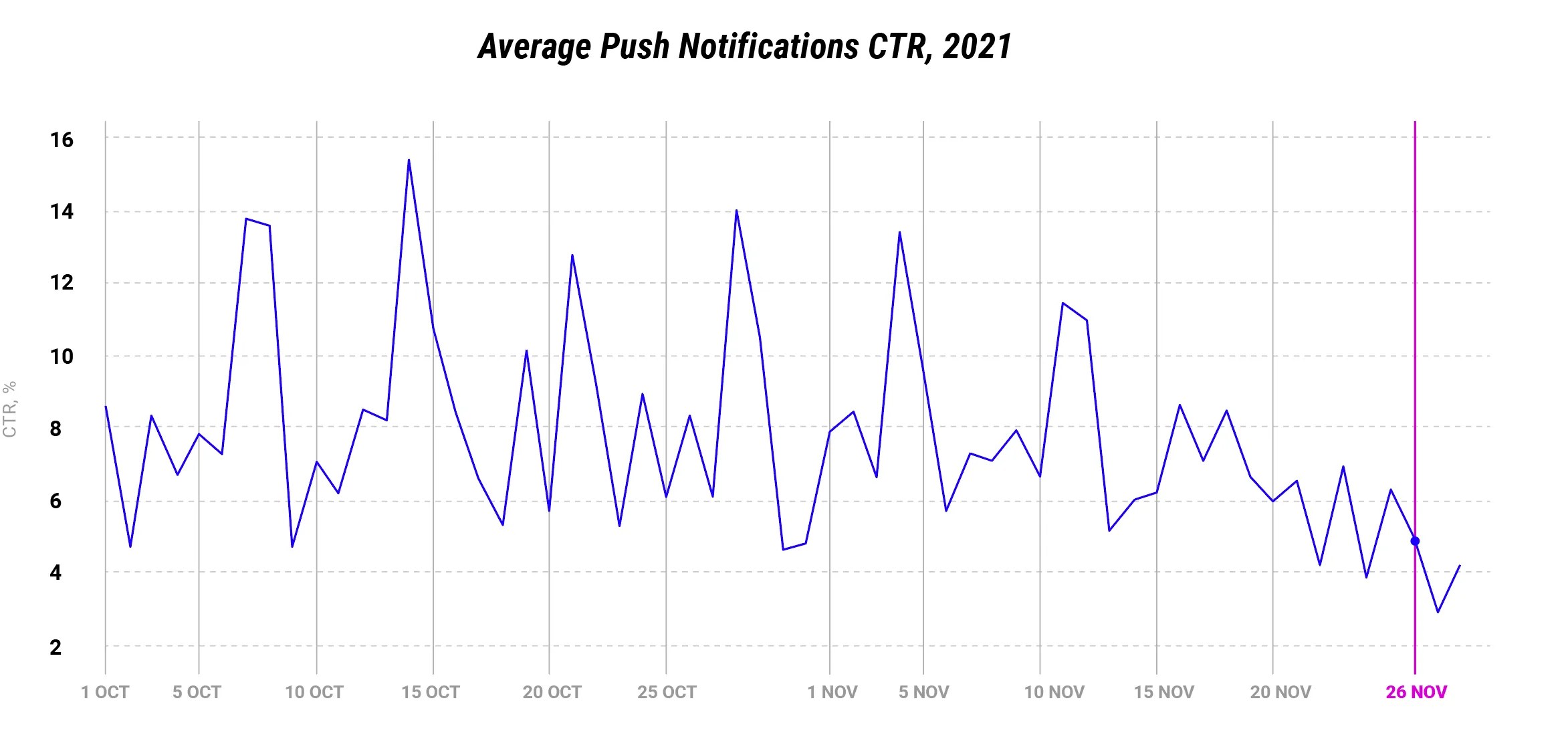
Push Notification CTRs, Before and During the Black Friday Period 2021
The Pushwoosh data states that low CTRs around Black Friday are not typical at all: last year, CTRs of pushes with discounts reached their monthly maximum around Singles’ Day and a week before Black Friday.
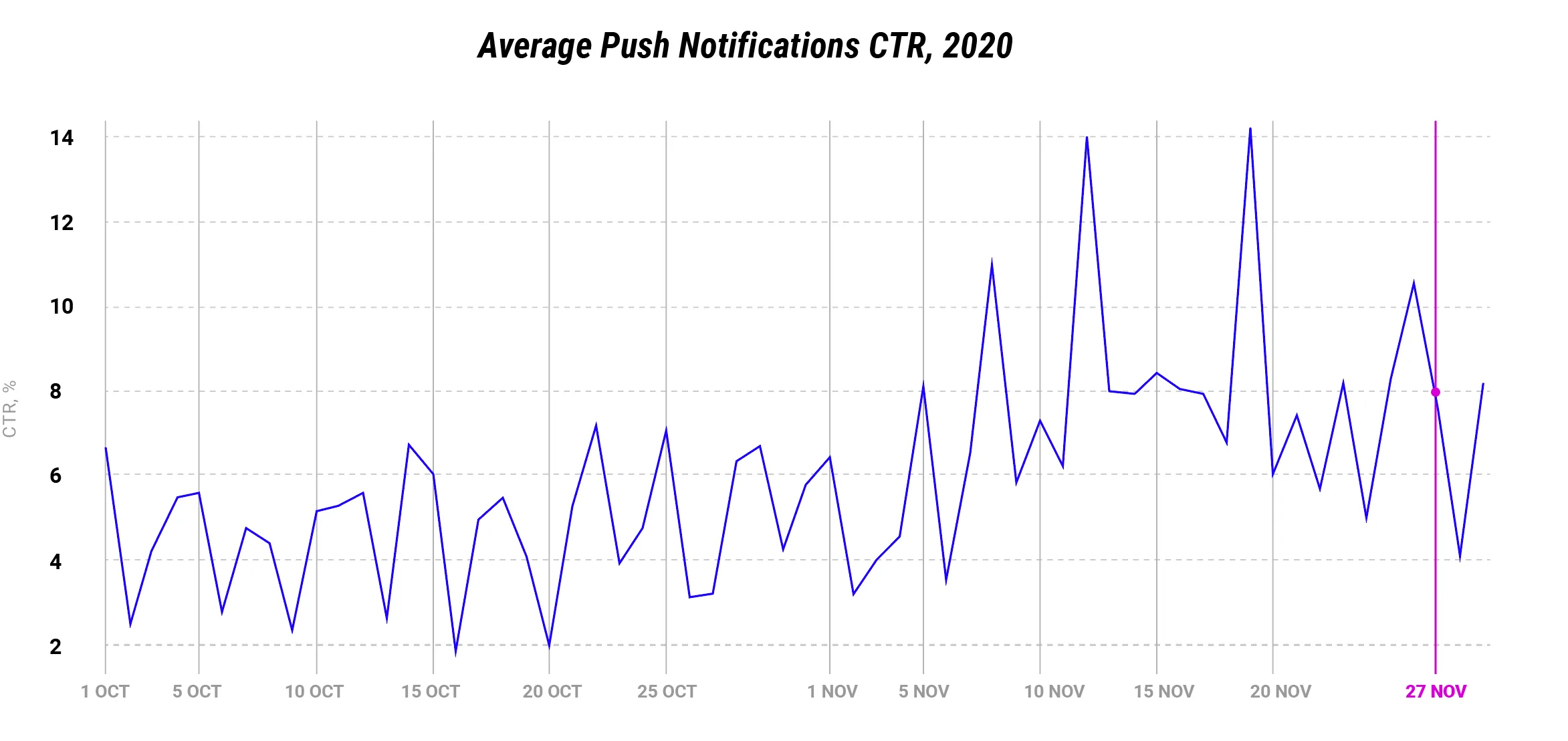
Push Notification CTRs, Before and During the Black Friday Period 2020
Two Ways to Ensure High Push Notification CTRs on Black Friday
Based on the Pushwoosh data analysis, here’s what you can do to increase your push notification CTRs in your next Black Friday and holiday season campaigns:
- **A higher discount leads to a higher push notification CTR******
According to Pushwoosh data, these are the most popular discounts offered by e-commerce businesses:
- From October 1 to November 29 — 25%, then 50% and 30%
- From November 15 to November 25 — 30%, then 50% and 40%
- On November 26 — 25%, then 70% and 50%
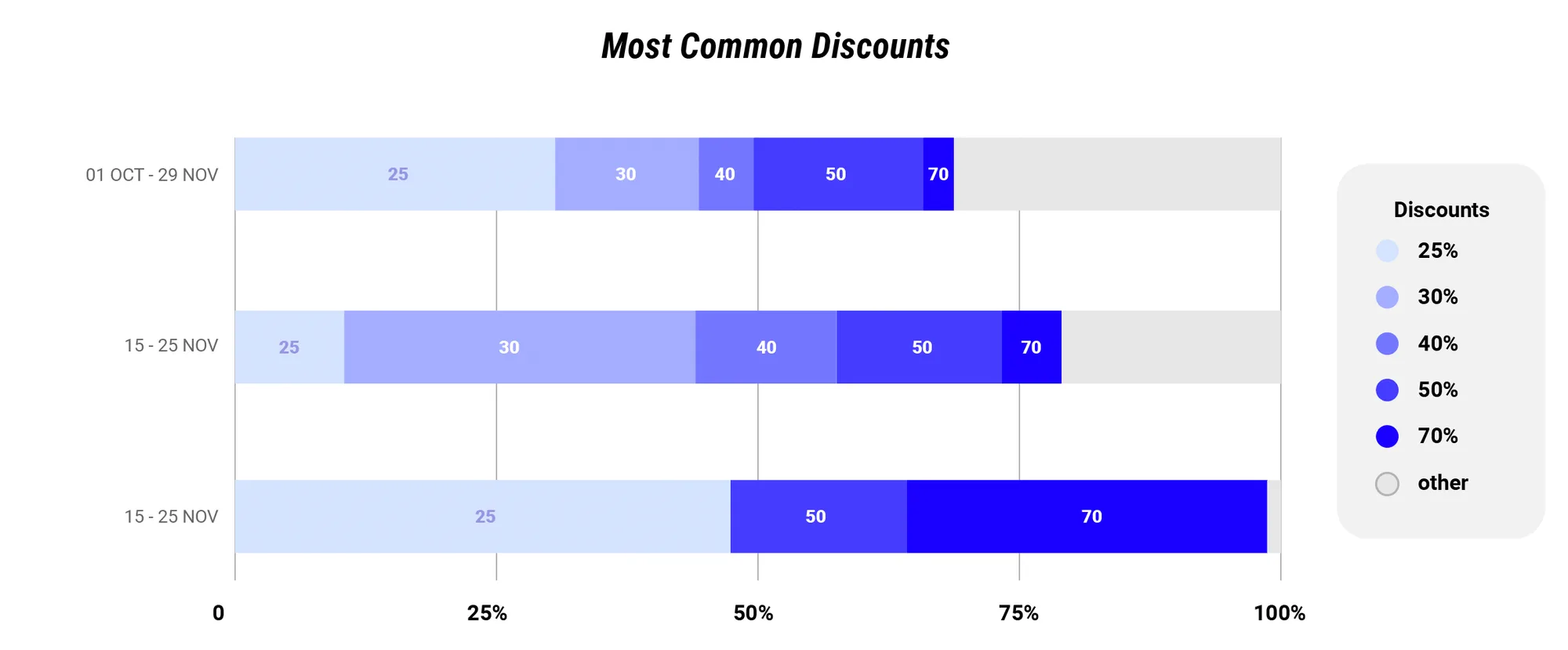
Discounts’ Popularity, 2021
Which discounts resulted in the highest CTRs? Little surprise here. On Black Friday 2021, offers with a 50% discount got a CTR of over 4%. And there is a case when offers with a 70% discount got a CTR of over 6%.
To compare, have a look at the correlation between a discount and a push notification CTR over the three time periods of 2021:
From October 1 to November 29,
- 15% discount — 4.8% CTR, 90% discount — 3.99% CTR, 50% — 3.41% CTR
From November 15 to November 25,
- 25% discount — 4.59% CTR, 70% discount — 4.17% CTR
On November 26,
- 50% discount — 4.28% CTR, 25% discount — 1.87% CTR
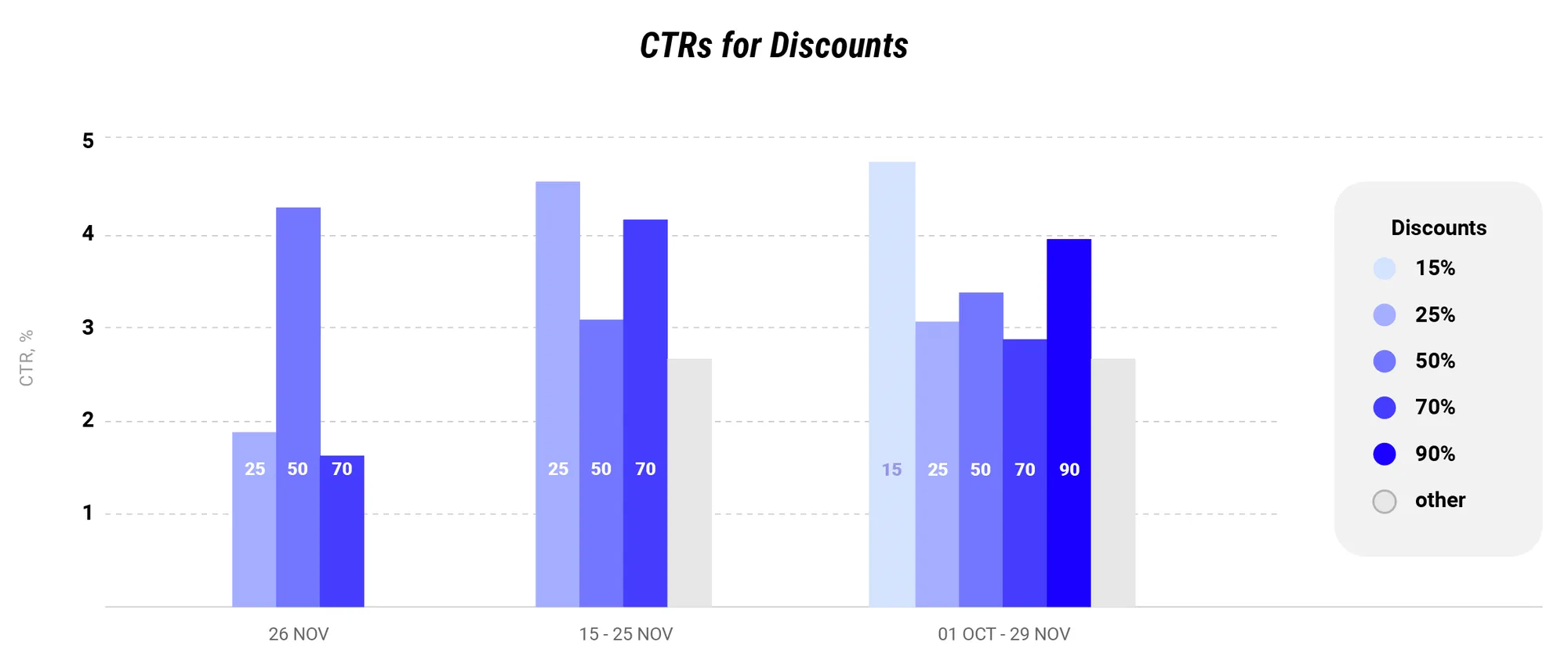
CTRs for Discounts, 2021
- Special promo expressions
There is one more thing that can affect the CTR besides the discounts. You can draw extra attention to your special offers with popular call-to-action phrases:
Straightforward sales offers
- Shop Now, Buy Now, Shop Today, Shop Online, Order Today
Engaging offers
- Enjoy Free, Save Now, Today Free, Book Now
Promotions
- Coupon, Promotion, Promo Code
Brand credibility
- Official Website, Top Brand
Extra benefits
- Lowest Price, Free Delivery, Huge Selection, Fast Shipping, Great Deal
Time limits
- Right Now, Limited Time, Online Today
All the special promo expressions above are equally common — and effective — to the similar phrases in the ten other languages we have in the data study: German, Swedish, Norwegian, French, Dutch, Russian, Polish, Finnish, Arabic, and Portuguese.
In our extended e-commerce apps research, you can find the data on which of these phrases result in the highest possible CTRs. Download the report to learn this year’s trends in high-converting copies — and a lot more!
Download the Pushwoosh Data Study
Get Prepared for Black Friday 2022
As you can see, marketing activity around Black Friday is ramping up, even compared to the previous year. And there are certainly some tricks e-commerce businesses can use to succeed in the next year’s Black Friday competition.
The Pushwoosh data study has shown that users react positively to high discounts and special offers — increased DAU and CTRs prove it. So instead of bringing users to your home screen, make sure they land on a special page with segmented discounts. How can you enable this in your e-commerce app? With the help of Pushwoosh!
Pushwoosh offers an all-in-one tool for omnichannel messaging, audience segmentation, and users’ activity analysis. Make yourself familiar with our solution and all the ways it can benefit your e-commerce business.