Customer relationship management has become more critical in recent years for many businesses in the mobile sector. With the rising cost of app user acquisition, retention methods have become increasingly vital in engaging the current audience and improving return on ad spend (ROAS).
Therefore, in such a competitive app market, it’s essential for app marketers to have a strong customer retention strategy to keep users engaged and using their app. We will cover the basics of CRM, key points and steps every app marketer should keep in mind, and some of the best examples of customer retention strategies using CRM.
Customer retention strategy: Importance of CRM
Customer relationship management (CRM) is the process of managing interactions and relationships with customers. CRM plays a crucial role in building and maintaining a solid user base (aka customer retention) in the context of apps.
CRM for apps enables us as marketers to interact with our target group at any time and from any location, maximizing real-time interaction. We no longer have to wait until our customers are in front of their computers to connect with them, but we may do so whenever and wherever we think suitable for our business.
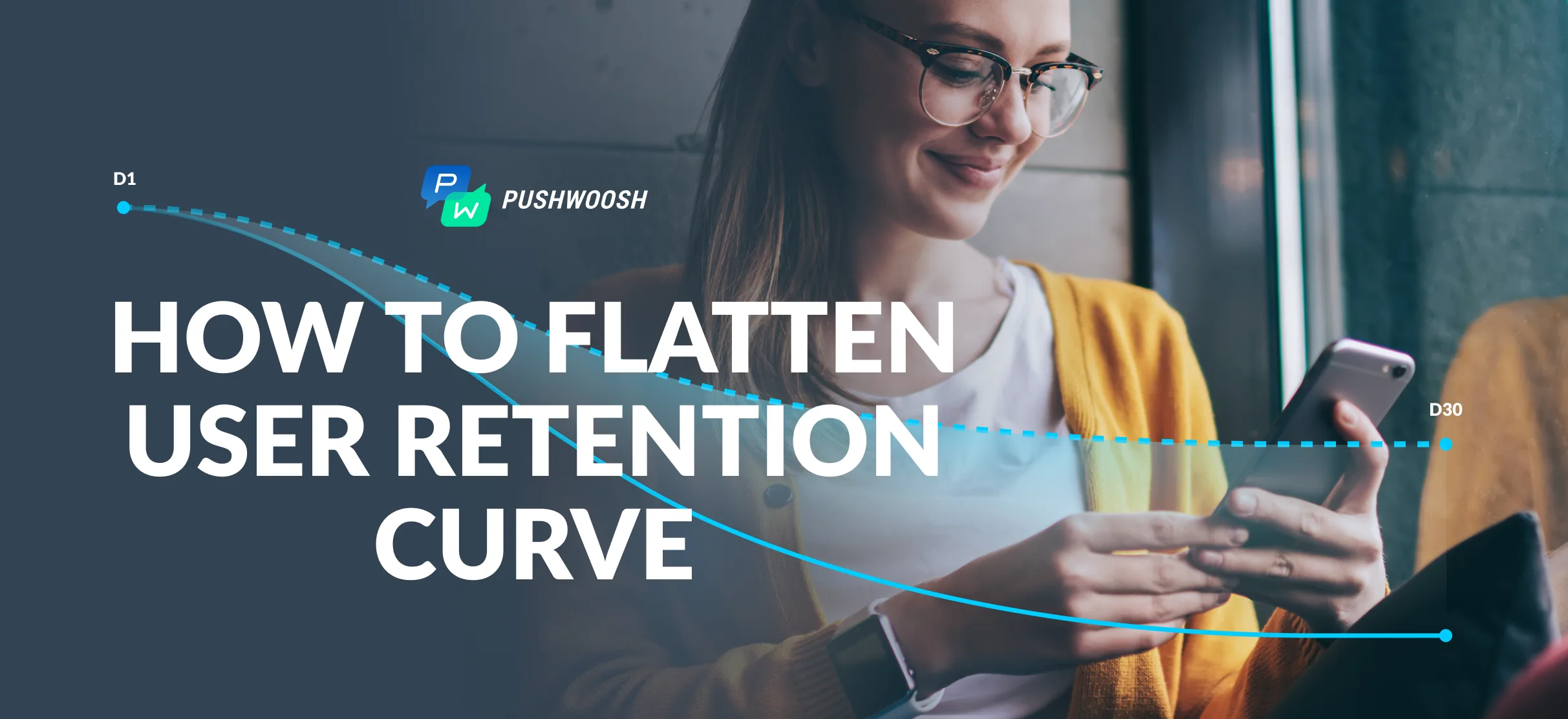
As a result, customer retention techniques should play an essential role in any company’s growth efforts since they may increase user engagement while lowering churn rates and improving conversion rates at each stage of the funnel.
By improving such metrics, we will raise our user base’s LTV and, consequently, maximize our marketing budget and ROI.
Basic tips to keep in mind when developing a customer retention strategy
First, we will start with some essentials that app marketers can always incorporate to build a strong customer retention strategy for their apps. Below you can see some of the most important ones.
- Personalize the user experience: personalization is key to building a solid customer retention strategy. By personalizing the user experience, app marketers can make users feel the app is tailored to their needs and preferences. This can be achieved through targeted notifications, personalized recommendations, and customized content.
- Offer incentives: incentives such as discounts, free trials, or exclusive content can be used to keep users engaged and coming back to the app. App marketers can incentivize users who refer friends, complete certain actions within the app or reach specific milestones.
- Keep users engaged with regular updates: regular updates can keep users engaged and interested in the app. App marketers can provide updates that add new features, fix bugs, or improve the overall user experience. This can help users feel like the app is continually evolving and improving.
- Monitor user feedback and make improvements: user feedback can provide valuable insights into what users like and dislike about the app. App marketers can use this feedback to make improvements to the app, which can lead to increased user satisfaction and retention.
- Utilize omnichannel communications: for example, if we wish to communicate a special weekend deal, we can send an informational email at the start of the week, a push notification as a reminder closer to the weekend, and ultimately an in-app message each time the user accesses the app.
By incorporating these first steps into their customer retention strategy, app marketers can build a strong relationship with users and increase retention rates. Moving on, let’s see how a detailed approach can help you master CRM efforts.
🤑Optimize your customer retention cost and emerge from the crisis as a winner: we’re sharing a strategy in a dedicated blog post
5 Steps to excel at CRM efforts
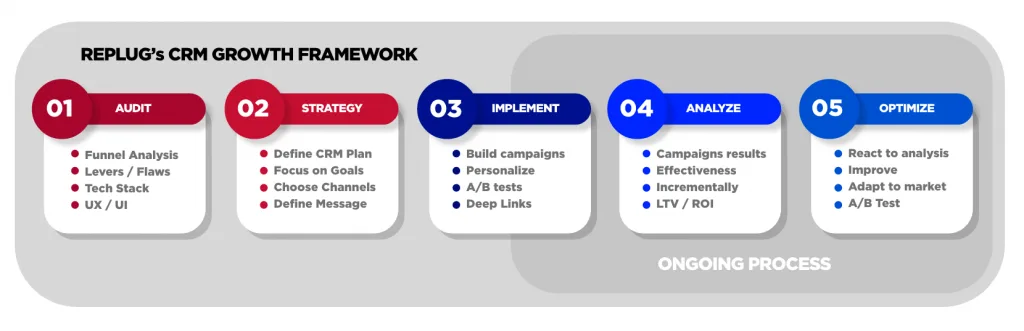
Often, an effective CRM strategy does not rely solely on a single channel. Instead, it is a synchronized blend of all of them. As a result, mastering CRM tasks for mobile apps is neither easy nor quick. Let’s now look at how to accomplish success through systematic approaches.
REPLUG has outlined five steps that can assist any organization in developing an efficient and successful mobile CRM strategy based on its aims and priorities.
Identifying the conversion funnel via audit
Prior to initiating CRM activities, we must thoroughly understand our conversion funnel. It includes recognizing the most significant events for our mobile app and when and at what rate people leave at each stage of the funnel. That phase is critical for planning tasks and instantly defining an effective approach to improve essential metrics.
Our example of this step: The PhotoSì strategy
When PhotoSì asked us to build a new communication plan for their referral program, the first step was to thoroughly assess the conversion funnel and all touchpoints the customers had with the present communication. The audit specifically included the following:
- Post-order funnel review: what are the touchpoints with users once they’ve made a purchase? Are we utilizing them all correctly?
- Assessment of the existing referral program campaigns: how do we interact now? What are the key figures?
- Discovery of levers: what are we missing according to the previous steps? What are the drawbacks of the present structure? What are the most promising possibilities?
- Tech stack analysis: do we have all the required technologies to execute (and monitor) effective campaigns?
- UX / UI evaluation: is the app’s user experience enough for a strong referral program? Are there any app features that we have overlooked?
- KPIs: what are the most important KPIs to consider when defining success? Are we currently monitoring them? Do we need to reassess them?
In this case, we developed a CRM strategy in conjunction with introducing a new feature, resulting in up to +85% of new users originating via the referral program.
Creating a multichannel and attentive plan for a CRM Strategy
After we clearly grasp the obstacles and the goals we want to accomplish, we can develop a detailed approach. Of course, no universal formula applies to all apps – rather, it is determined by the various products/services provided and the company’s aims.
Nonetheless, at REPLUG, we discovered eight pieces of advice for developing an effective CRM strategy that may have an immediate positive impact.
In summary, the best recommendation for developing a successful CRM strategy for apps is to concentrate on one goal at a time, using all available communication channels (pushes, in-app, emails, app inbox).
In the scenario of Winelivery, for instance, one of our partners contacted us with an explicit desire to boost their conversion rates at each funnel stage. Following the first assessment, we were prepared to develop a plan that included unique campaigns for every activity that needed to be done by the consumers.
Furthermore, we were able to increase conversions by up to 150% owing to a tailored multichannel approach.
Implementing the strategy: Personalization and A/B testing matter
A plan alone will not suffice to retain consumers and increase LTV. That is why we must carefully execute all campaigns. The most crucial things to remember throughout this time are the following:
- A/B testing: it is critical to begin testing alternative communication tactics from the start of the campaigns to get insights and enhance each phase of the automated communications.
- Deep links: by using them, we can be more efficient in directing people to the precise page of the app we want them to visit.
- Personalization: personalize messages with users’ names and all the available data. Use the name of the product they viewed in your e-commerce app or the meal they got on your delivery app last time. Be mindful of gender, location, and time zone to make every consumer feel like you’re talking to them.
Discovering what works and enhancing it: It’s time for analysis!
As with any app marketing activity, evaluation is required to determine whether our approach is effective and how to strengthen it. It is critical, especially for mCRM, to set the KPIs from the start and then analyze the campaigns against them. The indications to monitor are many and can be classified into three types:
- Campaign success: often, such KPIs are directly represented by the conversion rates we aim to improve through our efforts. Is there a gain to the registration rate? Are customers buying more? Is the retention rate improved following a particular campaign?
- Campaign performance: you want to keep track of how emails, push notifications, and other communications perform. If nobody checks your emails, how will they know about our great discount?
- Incremental value: we must finally determine the value that our CRM activities provide. Is there an overall gradual increase in LTV, revenue, and ROI?
In principle, it is a great practice to set up a “control group” for every campaign, and even a general one, to have a group of people who do not receive notifications. We will be able to comprehend the consequences of our actions in this way entirely.
Reacting to the analysis and making changes for optimization
As previously said, CRM for apps is a continual process of analysis and improvement rather than a one-time event. Consequently, each assessment should be accompanied by an action plan to enhance present communications (even when the results are good, there is always something to improve).
For another partner, for instance, we evaluated how to effectively communicate a discount through push notifications by separating the audience into two equal sections.
REPLUG’s test on push Notifications: The Winelivery example
Below, you can see the two groups we had while doing the test.
Group A: received a push including the word “discount” in the title and in the push text.
Group B: received a push including the word “discount” only in the push text.
Here are the results after we have separated the audience:
- Group A (title discount) produced 6% more transactions than Group B
- Group A made 4% less income overall (which can be substantial with a large number of orders)
- Yet, Group A’s average revenue per transaction was 10% lower than Group B’s
According to the findings, we decided to change the communication strategy—we would still communicate the discount, but not as the main component of the push, because while it was excellent for the conversion rate (more orders), it wasn’t so great for the LTV.
Still, optimization actions should take into account not just the outcomes but also the particular environment in which we operate. We must, especially, adjust our tactics to the market or unique events occurring in a specific geographic location and always take the chance to communicate around special events.
Conclusion
How do you accomplish the most effective customer retention strategy using CRM? There is no one-size-fits-all answer to this question, as it will depend on a number of factors, including the app’s specific target audience, the goals of the app, and the competition in the marketplace.
That being said, several strategies can be effective in retaining customers for apps using CRM. But we want you to remember the following especially:
- Collect as much data as possible to personalize the messages
- Segment your audience
- Work in frameworks
- Don’t stress your users
- Don’t mix your goals—tackle one at a time
Only via ongoing analysis will we be capable of optimizing our campaigns and responding quickly to changes in the environment in which the mobile app runs.
Need help implementing a CRM strategy for your mobile app or improving communication with your mobile users? Get in touch with REPLUG.
Looking for a solution to engage & retain your customers effectively? Discover how Pushwoosh can be of use – request a personal product tour.