Wallet pass platforms come in 3 classes: standalone pass tools, loyalty platforms with wallet built in, and customer engagement platforms with native wallet. A standalone tool is enough when the pass is the whole program. When the pass has to work with push, email, segments and journeys, the platform that already holds the customer profile usually wins.
First, a naming problem. Apple PassKit is Apple’s framework for Wallet passes, and every pass vendor builds on it. PassKit Inc. is a company that sells a pass platform. When people search “PassKit alternative”, they mean the company, and that’s what this comparison covers, along with where Pushwoosh Wallet passes fits.
3 classes of wallet pass tools
Standalone pass tools. PassKit, Passcreator, PassSlot and Pass2U focus on the pass itself. PassKit pairs a no-code builder with an API for Apple and Google Wallet, PassSlot is a niche builder for Apple Wallet, mostly for retail and events, and Pass2U is a no-code builder for both platforms aimed at small businesses.
Loyalty platforms with wallet. Loyalty vendors such as Antavo and Yotpo run the program logic (points, tiers, rewards) and offer wallet as 1 way to show the card.
Engagement platforms with native wallet. Customer engagement platforms such as Pushwoosh and Airship issue passes natively, on the same profile as push, in-app, email and SMS. Other engagement platforms add wallet through partners. Braze, for example, works with pass vendors such as PassKit.
Comparison table
| Criteria | Standalone pass tool | Loyalty platform with wallet | CEP with wallet via partner | CEP with native wallet |
|---|---|---|---|---|
| Apple and Google passes | Native, some tools Apple only | Varies | Through partner tool | Native |
| Visual builder | Yes | Varies | In partner tool | Yes |
| API | Varies | Yes | 2 APIs | Yes |
| Live updates | Yes | Yes | Yes, via sync | Yes |
| Segments from customer data | Limited to pass data | Loyalty data | Via sync | Same profile |
| Journeys across channels | No | Limited | 2 tools | 1 journey |
| Push, email, SMS in the same tool | No | Varies | Yes, wallet separate | Yes |
Read the table by row, not by column. The rows that matter most for retention teams are segments, journeys and channels. That’s where the classes differ. On issuing passes, they’re close.
How the standalone tools price
Prices change, so check each vendor’s current pricing page before deciding and note the date you checked it. Ask whether the vendor counts passes issued or passes active on phones: the same program can cost very different amounts under the 2 models.
For the full set of models and hidden costs, see the pricing guide.
When a standalone tool is enough
A standalone pass tool is a good fit when wallet is the program, not 1 channel within it. Typical cases:
- An event organizer issuing tickets, with no app and no ongoing messaging.
- A small business running a stamp card with no other CRM.
- A one-off campaign: a coupon, a conference badge, a seasonal pass.
Here the vendor’s designer and API cover the job. Adding a full engagement platform would be more tool than you need, and we’d say so to anyone asking.
When you need an engagement platform
The picture changes once the pass has to react to customer data and work with other channels. You’ve outgrown a standalone tool when:
- You want to issue passes from app or website events, like a sign-up or a first order.
- You segment pass holders by behavior that lives in your CDP or engagement platform.
- 1 moment, like points about to expire, needs a pass update and a push and an email.
- You’re syncing 2 databases and building the same journey twice.
At that point the question becomes whether to connect a pass tool to your current platform or move to one with native wallet.
Where Pushwoosh fits
Pushwoosh is an omnichannel customer engagement platform that issues Apple and Google Wallet passes natively, with no partner in the middle. Passes are issued by User ID and live in the same CDP, segments and Customer Journey as push, in-app, email, SMS and WhatsApp. Journeys have a dedicated Issue Wallet Pass step.
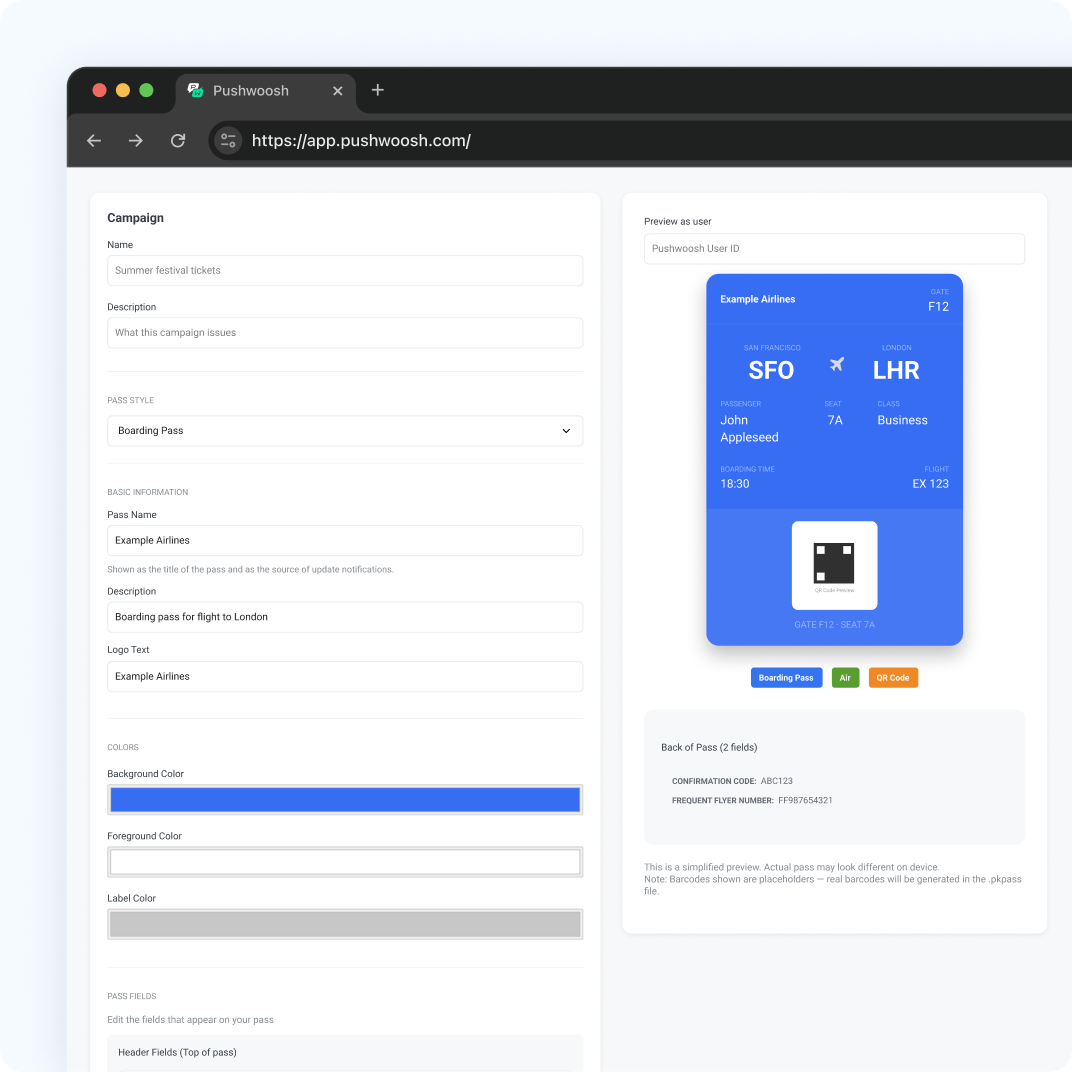
You get a visual builder for both platforms, a REST API and live updates. On Apple, updates are silent unless a field has a change message, in which case the customer sees a lock-screen alert. On Google, changes sync to every saved device. Data is hosted on Pushwoosh’s own infrastructure in Germany and the US, with GDPR compliance and SOC 2 Type 2.
To be clear about the limits: Pushwoosh doesn’t offer NFC passes such as tap-to-ride transit or hotel room keys. And on any platform, Apple and Google allow only pass-related notifications.
Reduce tool sprawl with Pushwoosh
If wallet is 1 channel in a bigger retention program, Pushwoosh puts it next to push, in-app, email, SMS and WhatsApp on 1 customer profile. 1 builder, 1 API, 1 journey for every channel.
The right wallet platform isn’t the one with the most pass templates. It’s the one closest to where your customer data already lives.