To unleash the potential of a subscription monetization model, you should entice users with offers tailored to their behavior and subscription lifecycle stage. Keep reading to uncover how you can target high-value customers at the right time to increase app revenue.
Subscription-based apps: when value drives monetization
It is not only crucial to launch an app that users fall in love with but to choose a monetization strategy that better fits the type of your app. Gaming apps stimulate in-app purchases and implement pay-per-click (PPC) and cost-per-impression (CPI/CPM) advertising, while mobile commerces drive repeat purchases and special-occasion sales.
The subscription-based model generates money through recurring fees. To increase subscription revenue, it is crucial to detect the right moments when the user is willing to pay to enhance their experience. At these hotspots, you have the most chances to convert users into loyal, long-term-customers by offering:
- Free trial;
- Basic or short-term subscription;
- Premium or long-term subscription.
This is basically your subscription funnel, where you should track users and encourage their transition to the next stage with timely automated messages. The most common scenarios include onboarding newcomers, offering subscription tiers upgrades when users see the additional value in the app, stimulating purchases with special discounts, winning back churned users, and more.
Here is an example of a customer journey for new users of a health app, from a free trial prompt to a premium subscription upgrade:

This example is made with Pushwoosh Customer Journey Builder, a campaign mapping tool that helps you send relevant event-triggered messages to customers at every stage of their lifecycle. Open in a new tab to zoom in.
Let your audience know there is a paid subscription
According to Sylvain Gauchet, Director of Revenue Strategy at Babbel, there are a number of ways to make the most of the subscription-based monetization model:
You can’t overestimate the role of paywalls in a successful conversion. An effective paywall should demonstrate your subscription value proposition. Tell your users why they should purchase your subscription and give them information on how it will improve their experience instead of just providing the list of features that they’re buying.

What are the best ways to do this?
Inside the app — by showing in-app messages
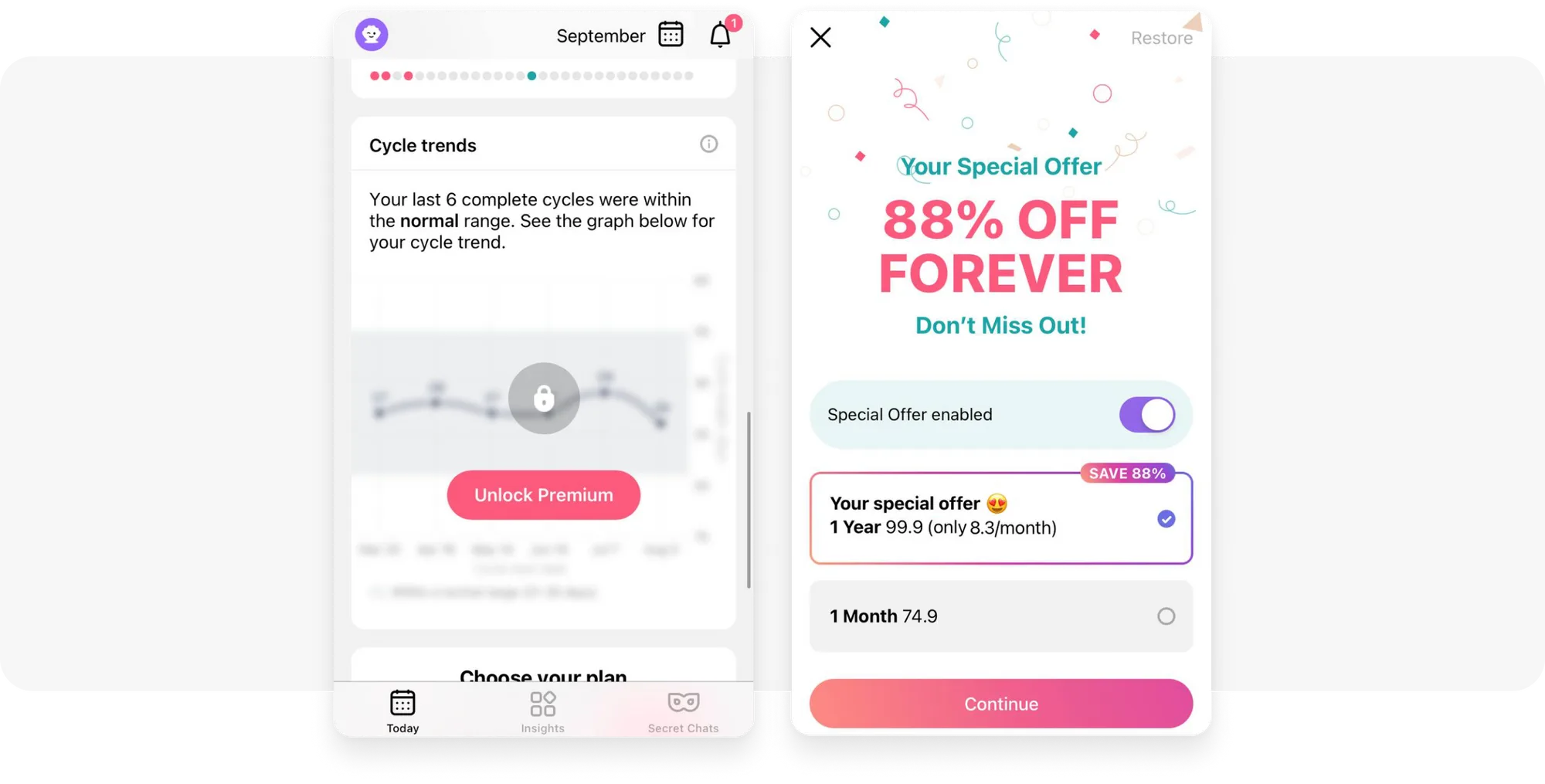
In this example, Flo, a female health app, delivers a paywall in-app message with a special offer to a long-term free user. The paywall comes into play after the teaser has garnered the user’s interest. The teaser tells about the additional value a woman can get from a paid subscription — analyzing their cycle graph to get more health insights:
Outside the app — by showing push notifications
Check out two examples of push notifications in the health app Lifesum. The second one urges users to complete the registration by promoting a special diet that is available only to premium subscribers. The message is not only in line with a user’s goal inside the app (becoming fit) but also with their life values, such as environmental awareness. By hitting the push, users get into the app, where they see an in-app message with more details on the special content and a call to action:
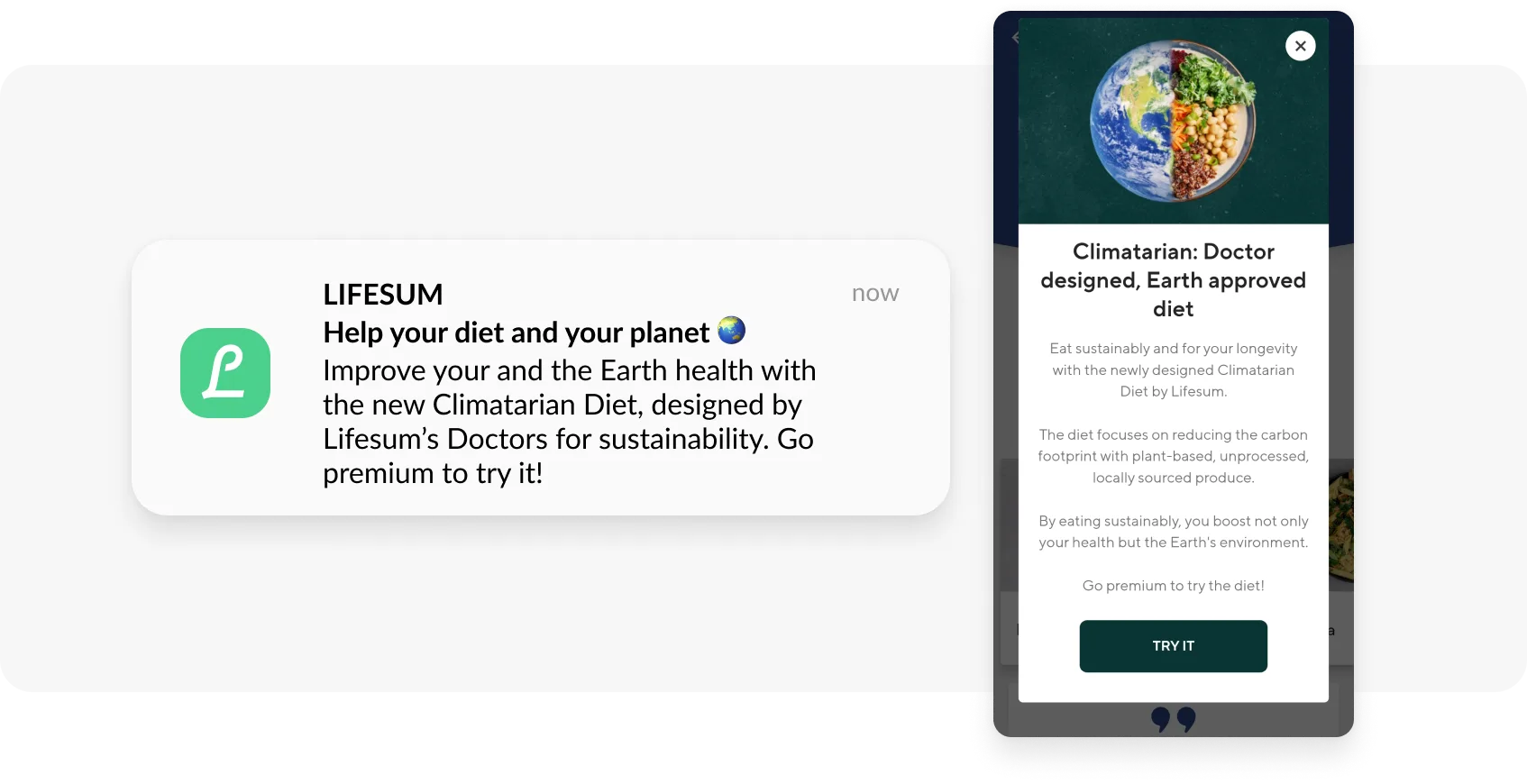
To effectively convert users, it’s always a good idea to use the combination “a push plus an in-app message”, where the push works as a hook while the in-app completes the conversion.
Outside the app — by sending emails
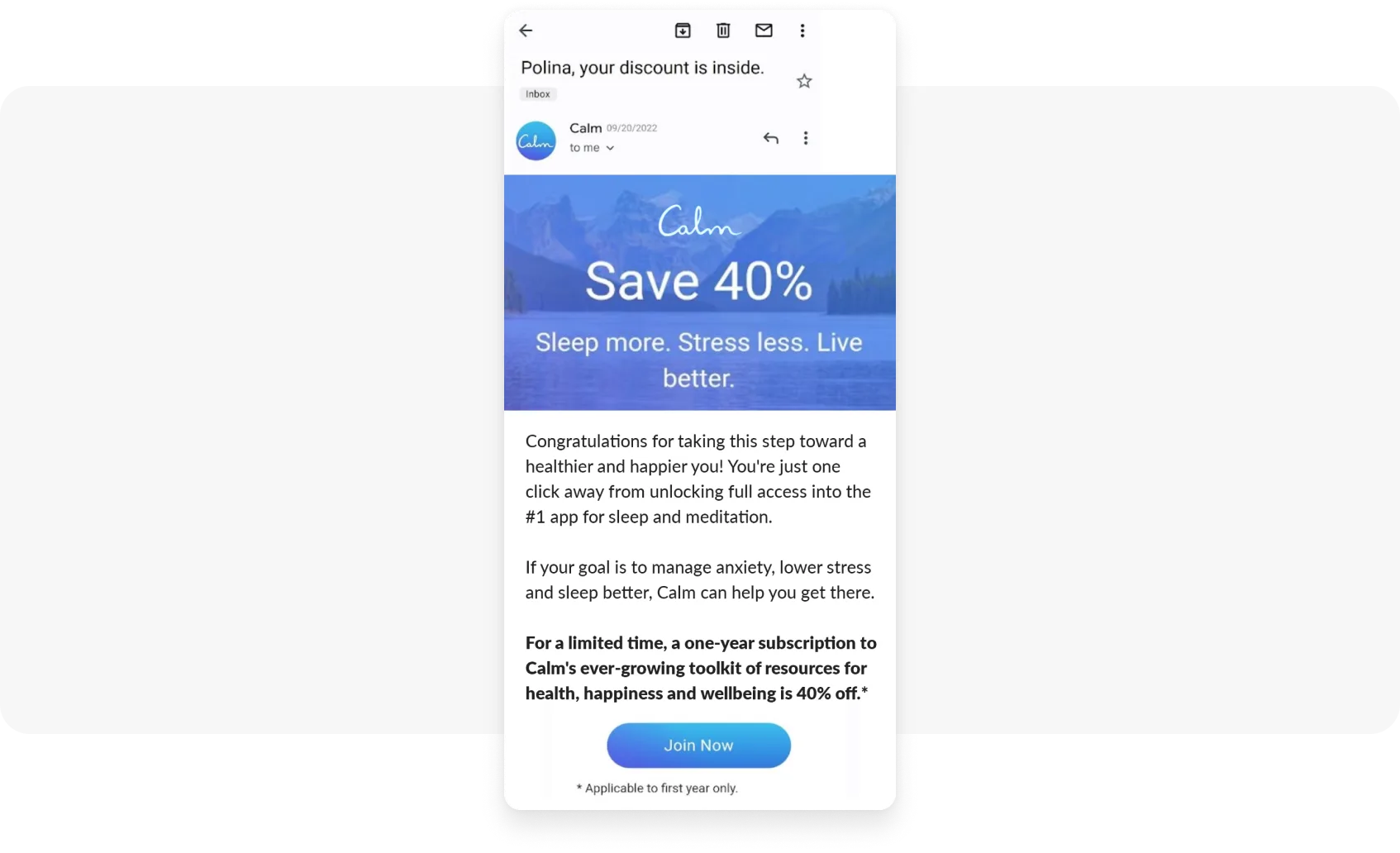
In this example, the meditation app Calm uses email as a supporting channel to promote its full-access subscription with a 40% discount. The message highlights that the offer is limited to better motivate users to convert. To increase mobile app subscriptions, we encourage you to go multichannel in your messaging and value delivery:
All of these channels are available in Pushwoosh Customer Journey Builder. There, you can set event-triggered omnichannel communication flows, sending messages to the highest-value users in the highest-conversion moments. Wonder how to detect such users and such moments? We’ll tell you further.
Define a segment of users that are most likely to convert into paid subscribers
For subscription-based apps, the average purchase conversion rate is about 5 %. It means that, while acquisition is still important, converting users who are able to pay for long-term subscriptions is a core.
To boost the number, we suggest you start by segmenting your audience into groups according to their characteristics, user preferences, behavior, and level of engagement. The second step is to present each group with an adapted customer journey that’s most likely to convert or upgrade them.
Use in-app events and user journey data to identify patterns and clusters. This approach can reveal deeper insights into user behavior, such as which features are most popular among different user groups, or common pathways that lead to high-value actions like purchases or subscriptions. In-app analytics tools can help you track these events and analyze user journeys without requiring an extensive setup.

Upgrade your currently paying users
Your paying users are a highly engaged cohort. There are always possibilities to transfer their engagement into upgrade revenue. For example, you can increase your users’ LTV by offering a 6-month or 12-month subscription to those who have been continuously using a monthly plan.
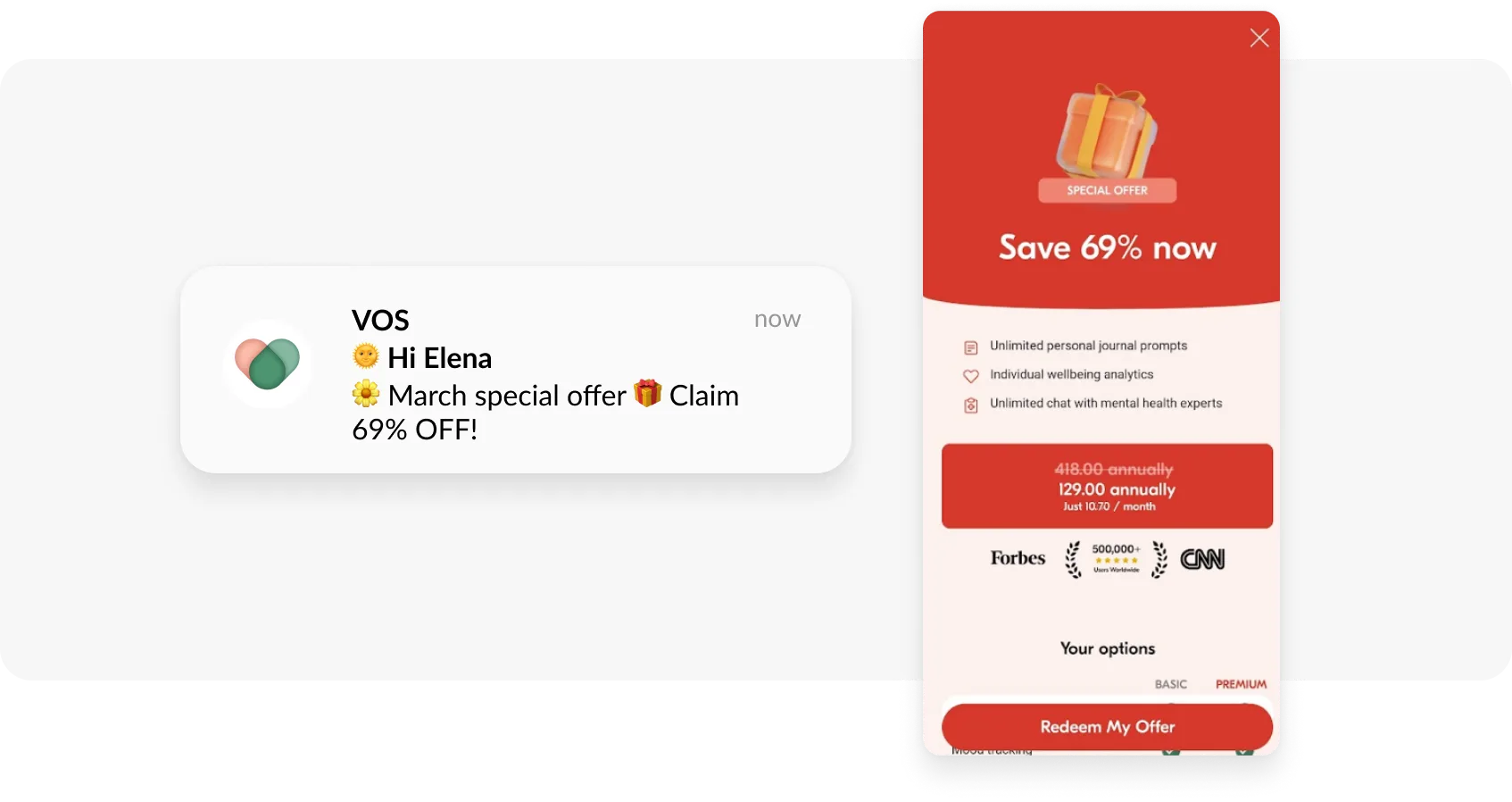
Have a look at the example of VOS, a well-being app. Its push notifications and in-app messages incentivize short-term subscribers to make larger purchases:
Here are a few more ideas you can use to encourage your paid users to upgrade:
- Offering exclusive value. Highlight your app improvements, latest features or content and offer your paid customers an exclusive trial. You can either send individual codes by email or embed a deep link to the push and take a user to the exact screen or in-app message with more details.
- Providing customization. Give your customers the ability to change the app’s appearance through the use of colors or decorations without changing the app’s functionality.
Target the most engaged customers
Another strategy to increase app revenue is nudging your free users to their first-time subscription. This strategy may require more resources, but in the end, all efforts will pay off. After one purchase, customers are 27% likely to pay again, and for the second and third purchases, the chances double.
Here are some categories of highly engaged users you can segment out and target:
- Users who have taken a trial version of your app (or, even, whose trial is about to expire);
- Users who open the app daily;
- Regular users of a specific feature.
Timely behavior-based communications can explain the extra value users will enjoy with a premium subscription or appeal to their fear of missing out. As a result, users may feel motivated to upgrade.
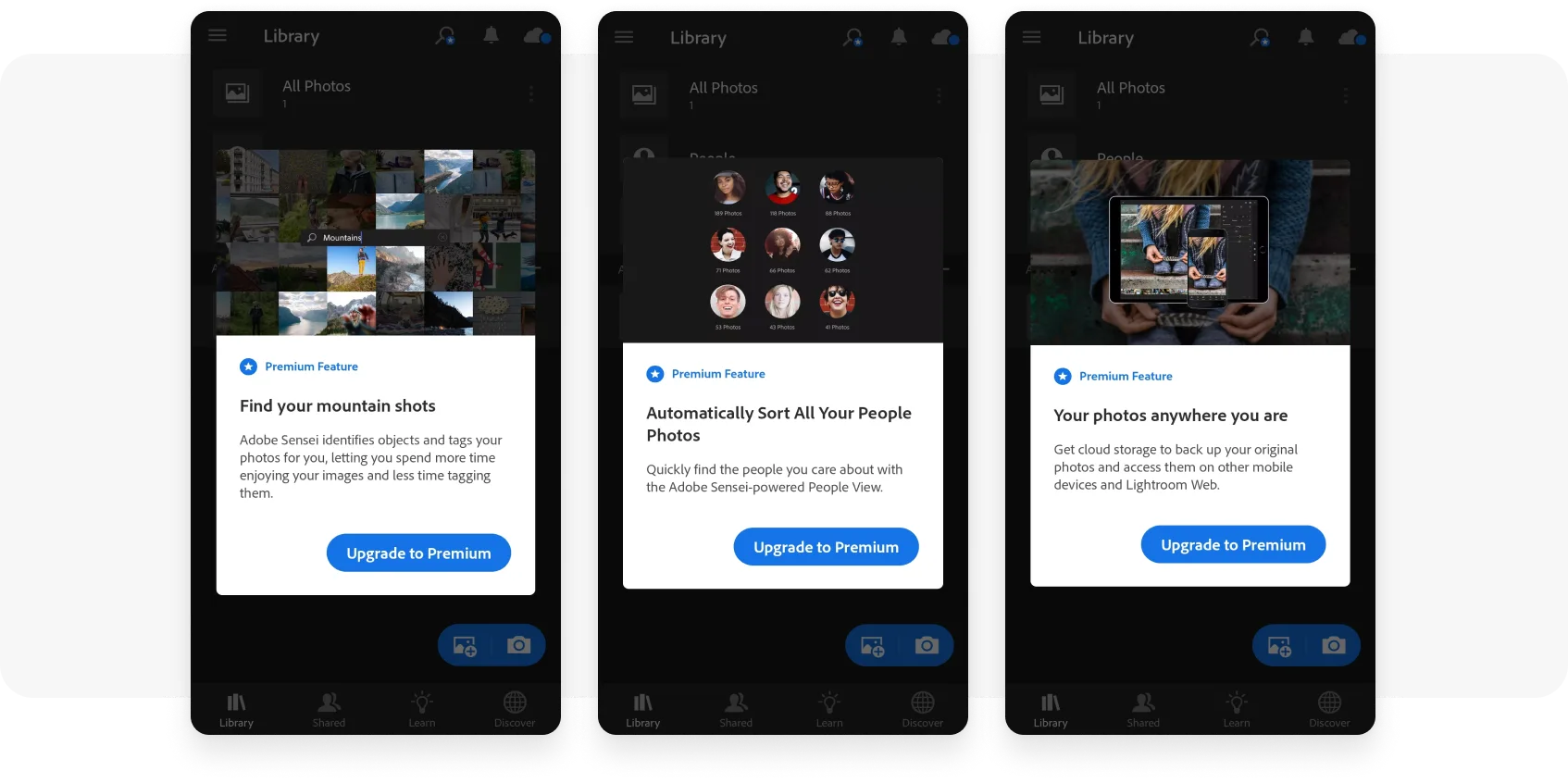
In this example, Lightroom prompts upgrading in a series of in-app messages highlighting the app’s premium features:
 💡Read
more about converting free app users into paid subscribers
in our ultimate guide.
💡Read
more about converting free app users into paid subscribers
in our ultimate guide.
Detect a point when users are most likely to upgrade
Know your hotspots
In gaming apps, there are hotspots — the moments when a player’s excitement peaks and they are prone to go in the direction where you lead. This is when you can influence user decisions, including their decision to pay.
Such moments (potentially) exist in any type of app; you may detect hotspots by analyzing your user behavior data. Some examples include:
- When a user sees value in additional benefits;
- When there is friction in experience (when a user can’t skip an ad or export a file).
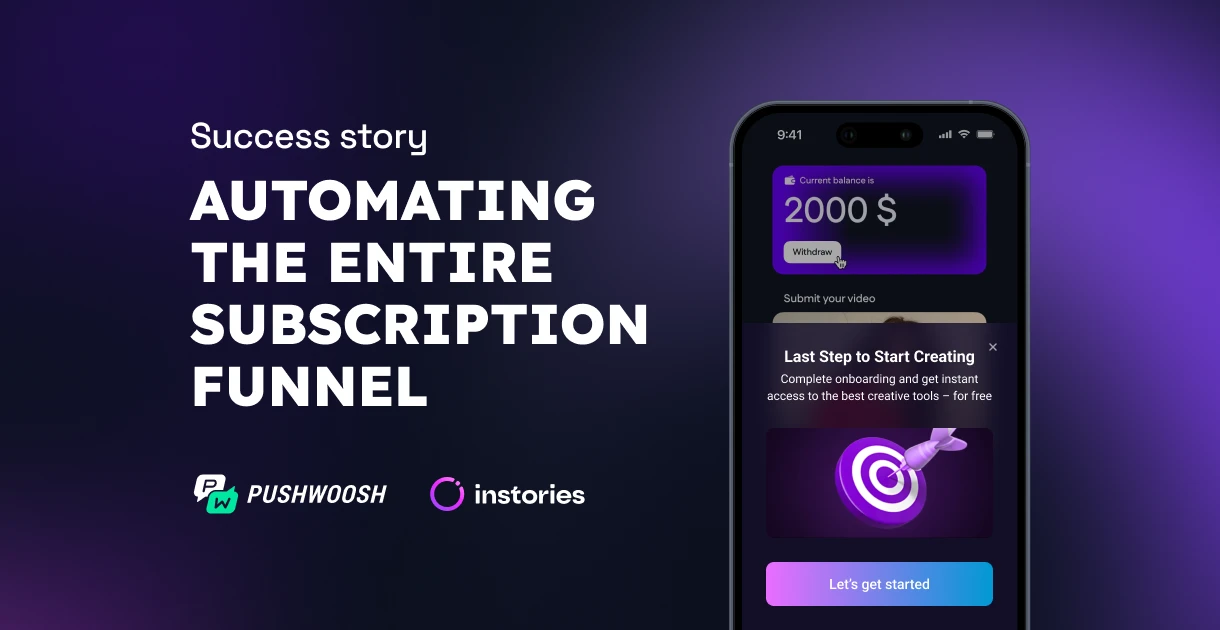
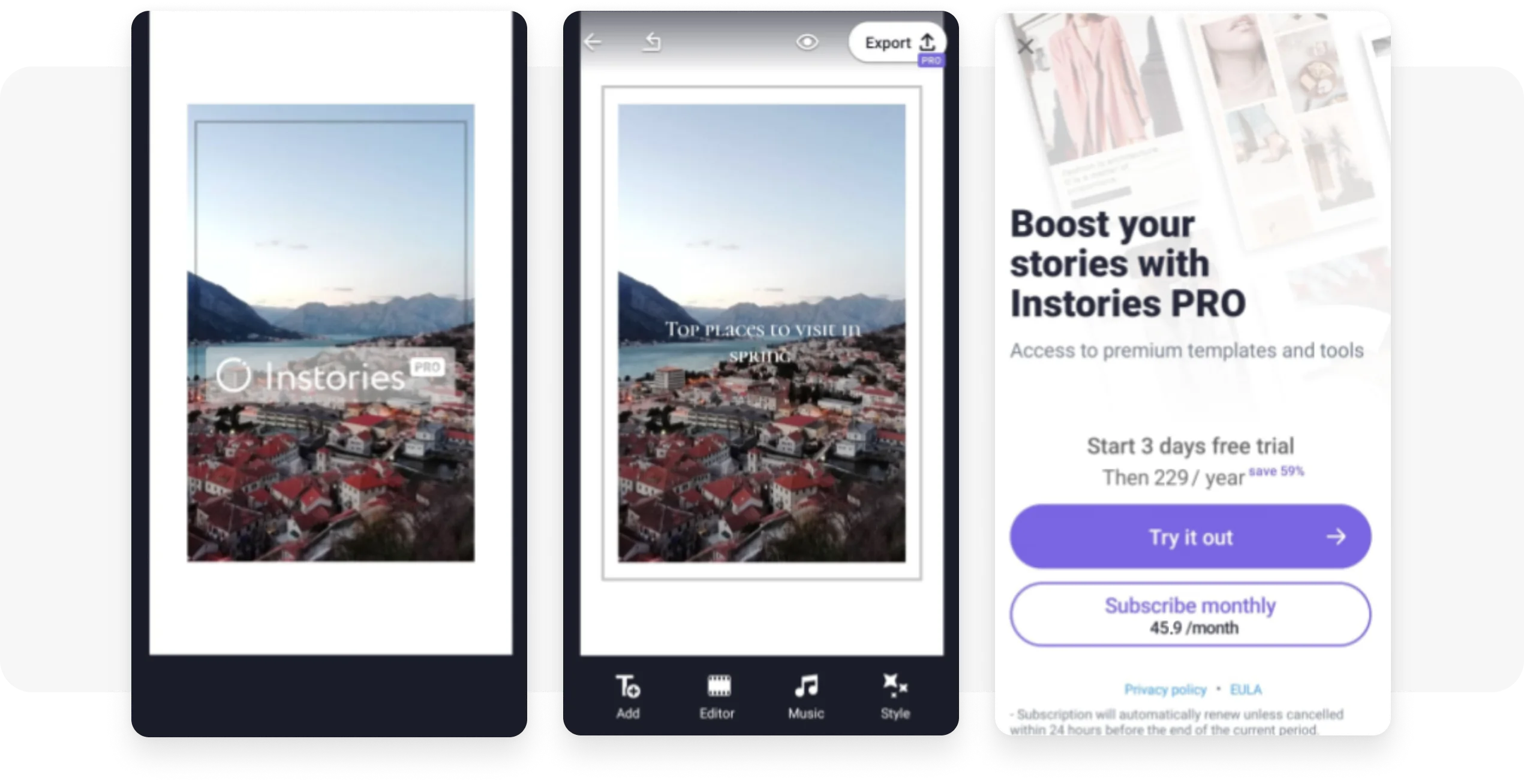
Here is an example from the Instories app that allows free users to try a collage feature but not to export the final picture:
Work with hesitations
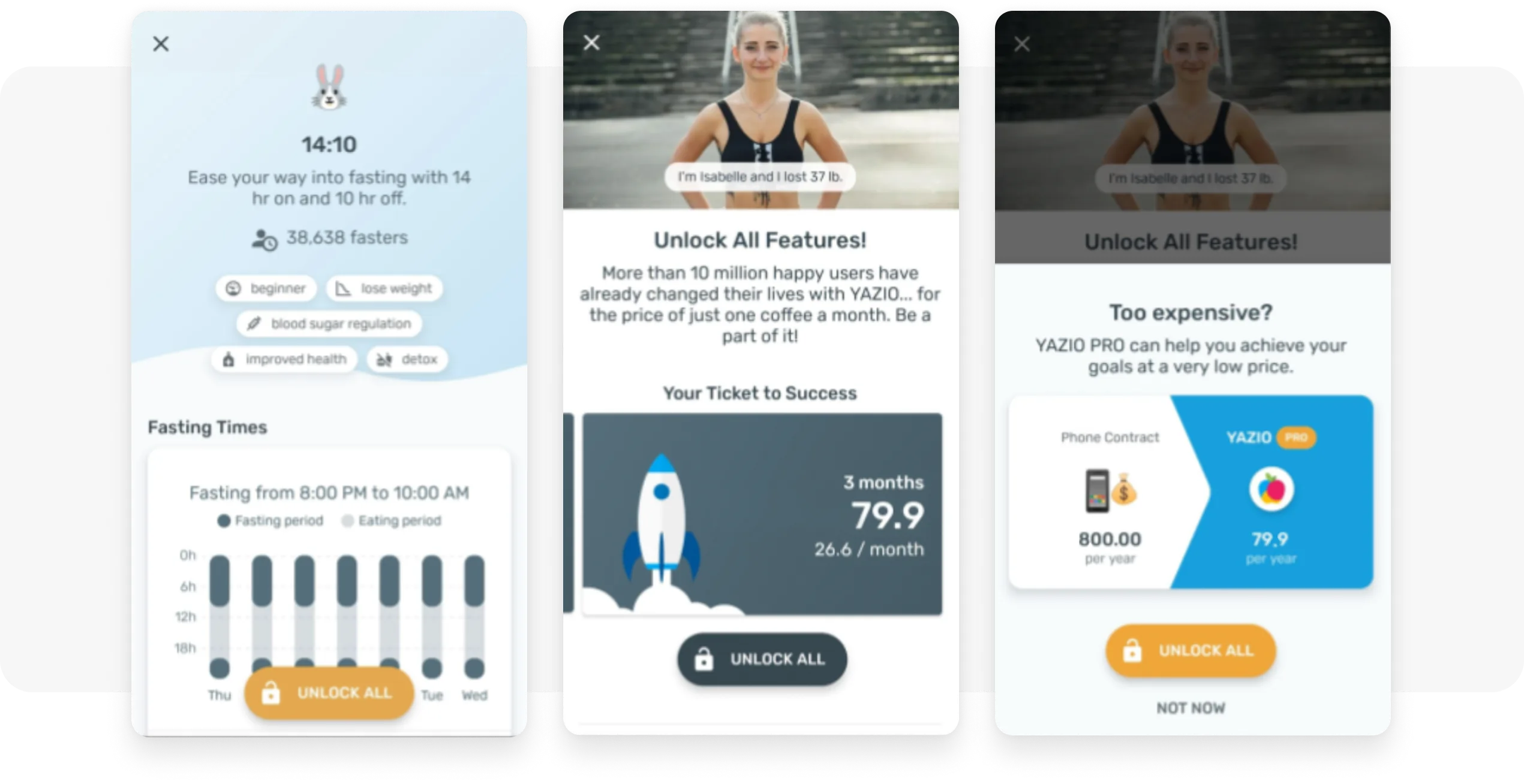
Have a look at a Yazio example: the nutrition tracking app targets users who got stuck on a paid feature page. Yazio tries to motivate these users by dissolving their doubts: the subscription is not as expensive as it seems. Then, a call to action follows:
Capitalize on the seasonality for instant revenue growth
These are not only e-commerce apps that can strike it rich during the holiday season. Subscription-based apps can seize this moment to raise their subscription revenues too! Indulge your audience’s appetite: tease them with a holiday discount and ensure the majority of your app users (=everyone who has opted in for notifications receives your message.
At the same time, seasonal acquisition should be backed up by the users’ potential for retention.
Here is how Charles Boes, CEO at Foodvisor, sees it:
Pushing users to a yearly subscription with a big discount is great for cashflow, but for “motivation” apps (e.g. nutrition), it can also lead to a high seasonality and low retention rates (e.g. lots of subscriptions in January but users leaving before August).

Make subscription offers that users can’t refuse
Use your killer (or any new) features as a bait
Even without a glance at your internal statistics, we can assume that your subscription-based app has a good share of users who have never paid. But what if your most recent feature will finally motivate them to convert?
Try sending a notification announcing new functionality to a broader audience. You may send a broadcast message, but we recommend using the Start Segment element in your customer journey. Target those who have added their payment methods or visited a specific page recently. This way, you will concentrate on the most motivated users.
Speak personally to your future paid subscribers
Be careful with the copy: you don’t want it to be too pushy. Remember to apply personalization and choose the best timing for your notification delivery. Also, apply Deep Linking to make your message hit the target.
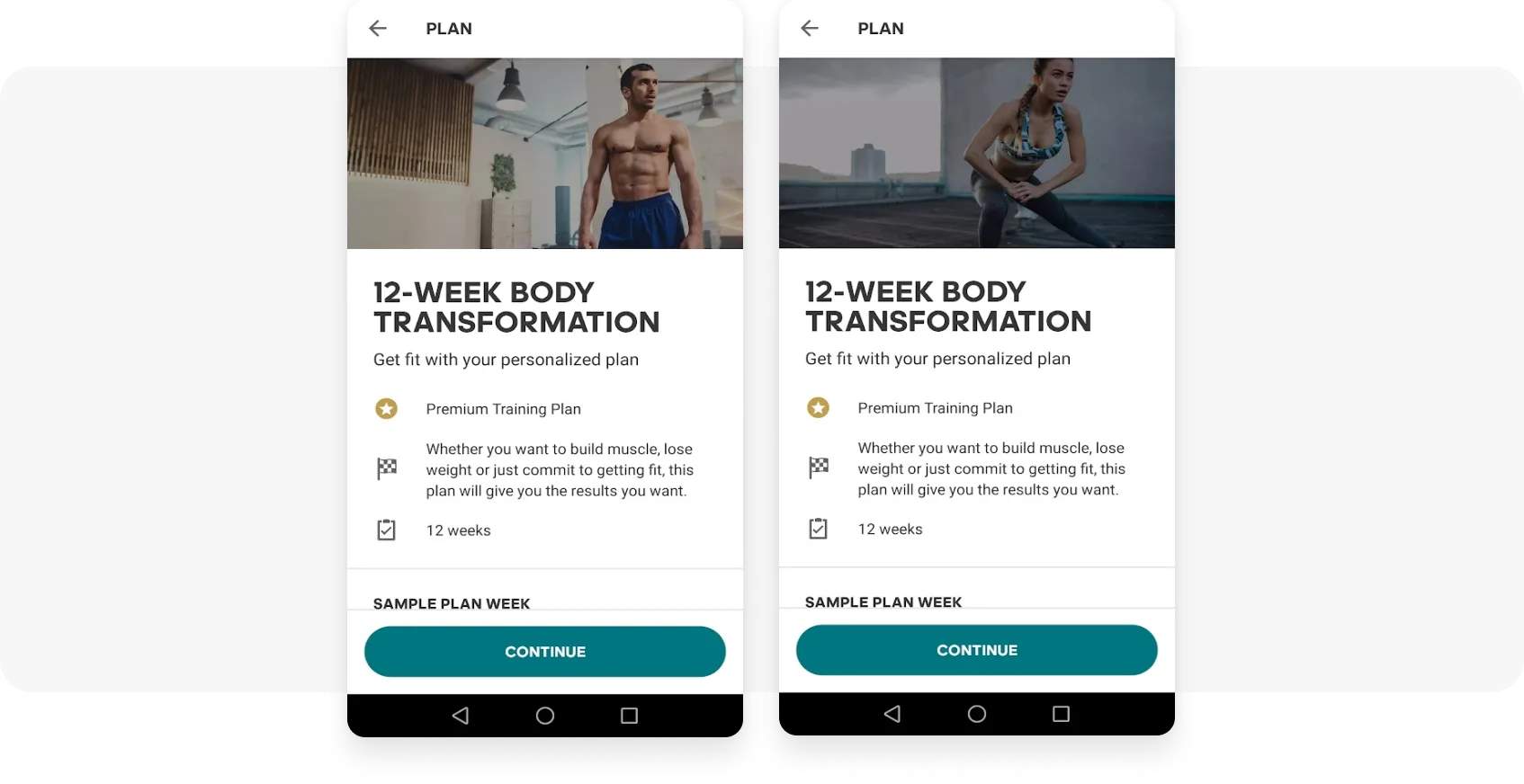
Look at the example of the Adidas Runtastic fitness app. In its premium plan promotion, customers see personalized in-app messages depending on their user attributes (in this case, the gender selected during onboarding stage):
Optimize your tiered pricing
Segmented and personalized communication is essential, but it’ll only be effective if your pricing structure actually appeals to users. So, how can you make it work better? The key is offering flexible subscription options. Here’s how you can make tiered pricing work to your advantage:
Offer exclusive value at each tier
Develop each pricing level with real value based on your users’ needs.
For example, you can give higher-paying subscribers early access to new features or unlimited access to premium content. This makes each tier feel like an essential upgrade.
Experiment with payment terms
Provide a variety of payment plans —monthly, quarterly, or annual— to match users’ different subscription journeys.
For example, users who prefer a longer commitment might be more likely to choose a long-term subscription in exchange for a discount.
A/B test your paywalls to find the optimal offer.
Adapt your subscription strategy to your retention curve
Track how your subscription plans influence churn rates by analyzing your retention curve. (💡If your analytics dashboard doesn’t include this graph, it might be time to add it) This will help you pinpoint the right moments to send targeted subscription offers and reduce churn.
The outcome? A predictable revenue stream and an increase in customer lifetime value (LTV).
Play a long-term strategy and gain more revenue with thoughtful user onboarding
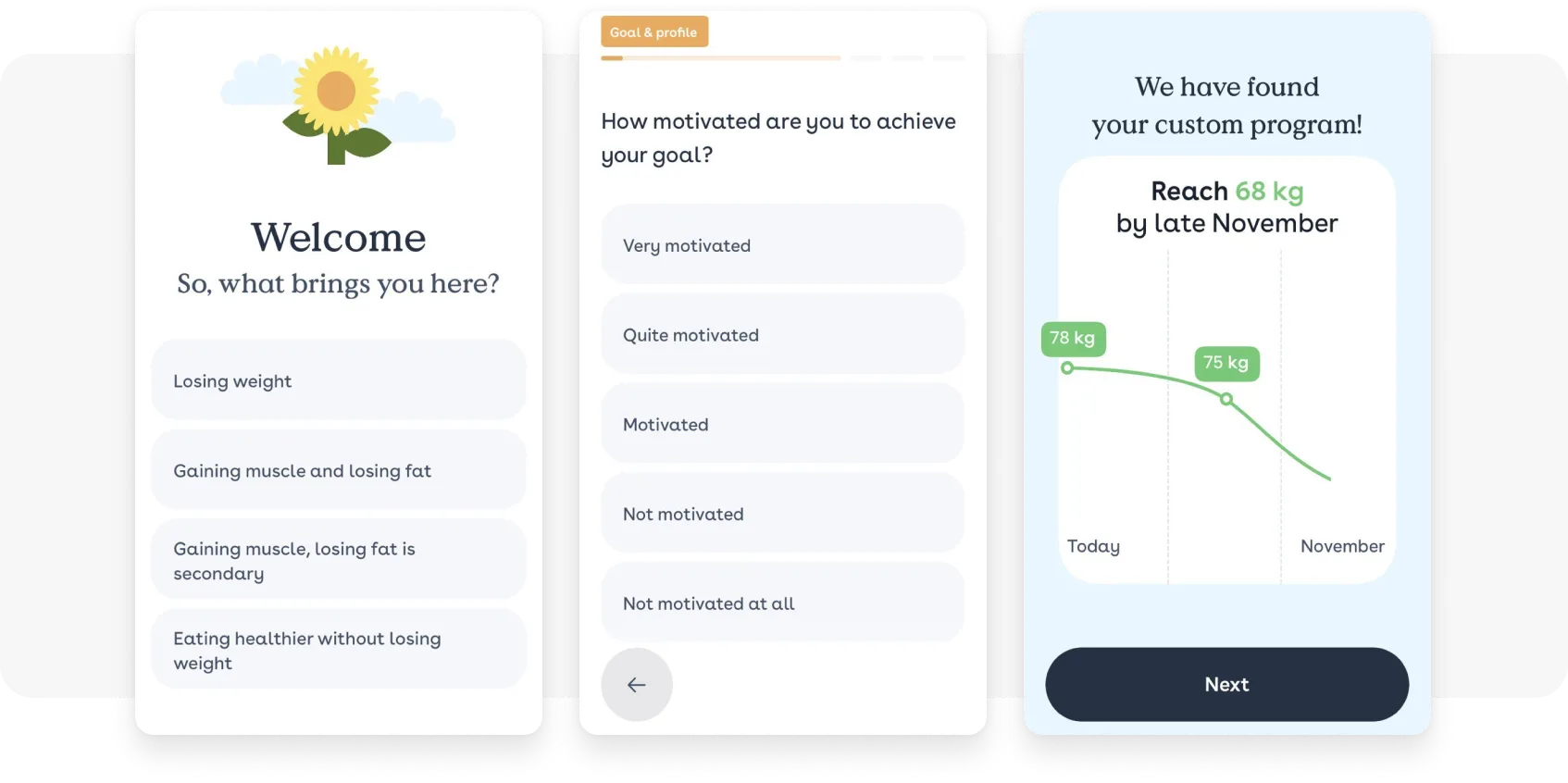
Apps may earn 18% of their monthly revenue on the first day after installment. And for some types of apps, this number may be even higher. According to Charles Boes (CEO at Foodvisor), the moment when people have the highest purchase intent for a nutrition app is the very beginning — Foodvisor has 60–75% of users that purchase during onboarding. Have a look at the Foodvisor’s welcome in-app messages. They include a user’s questionnaire and a teaser of a custom program based on the obtained data:
A well-considered welcome flow can bring your new users to a hotspot or an AHA moment faster. Once they’ve realized your app’s value, they are more likely to pay for it. A carefully crafted user onboarding may then flourish into higher user engagement and in-app spending.
Here is how Jenny Pollock, Together Labs Lead Subscription Monetization Manager, explains the importance of making a great first impression:
Being reliant on cross-app tracking for remarketing is less relevant due to the wave of user privacy concerns. Corporate rules like Apple’s new IDFA and new laws like the European Union’s GDPR aim to give individuals more control over their data.
The reduction of tracking and remarketing for organizations means your product has to capture users the first

In the base scenario, your welcome messages are sent to all the registered users. But you may also apply segmentation:
- Select those who have completed their user profile;
- Distinguish those who haven’t provided all the necessary information.
Differentiate your onboarding messages for these groups. Less engaged users may need a more inspiring walkthrough that will explain your value from their perspective. In contrast, users who have already completed their profile are likely more invested and receptive to exploring your app’s advanced features and advantages:

This example is made with Pushwoosh Customer Journey Builder, a campaign mapping tool that helps you send relevant event-triggered messages to customers at every stage of their lifecycle. Open in a new tab to zoom in.
Keep engaging your paid subscribers so that they don’t churn
Even when you’ve enticed users for a paid subscription, the key to success is to automate users’ engagement to keep them using the app regularly. A paid subscriber can easily fade into a churned user in case they aren’t motivated to open the app.
To prevent churn, app marketers should be alert to the top three reasons for subscription cancellations:
❗Perceived lack of value;
❗Lack of new or fun products or experiences;
❗Lack of offers within subscriptions or uninviting pricing.
Satisfied customers are less likely to churn. Thoughtful analysis of user behavior will allow your business to focus every effort on giving your users what they need. Precise product recommendations, feature updates based on customer needs, and personalized communication are truly effective ways to prevent churn.
💡Read more on how to increase app user engagement.
Take the wheel of the entire app user lifecycle
Recover churned users
To win back churned users, you need to re-ignite their interest and get them back to the app. This can be done by highlighting features and updates that the users have missed while they were away. Or you can ask your users for feedback and show them that you discover the improvement points.
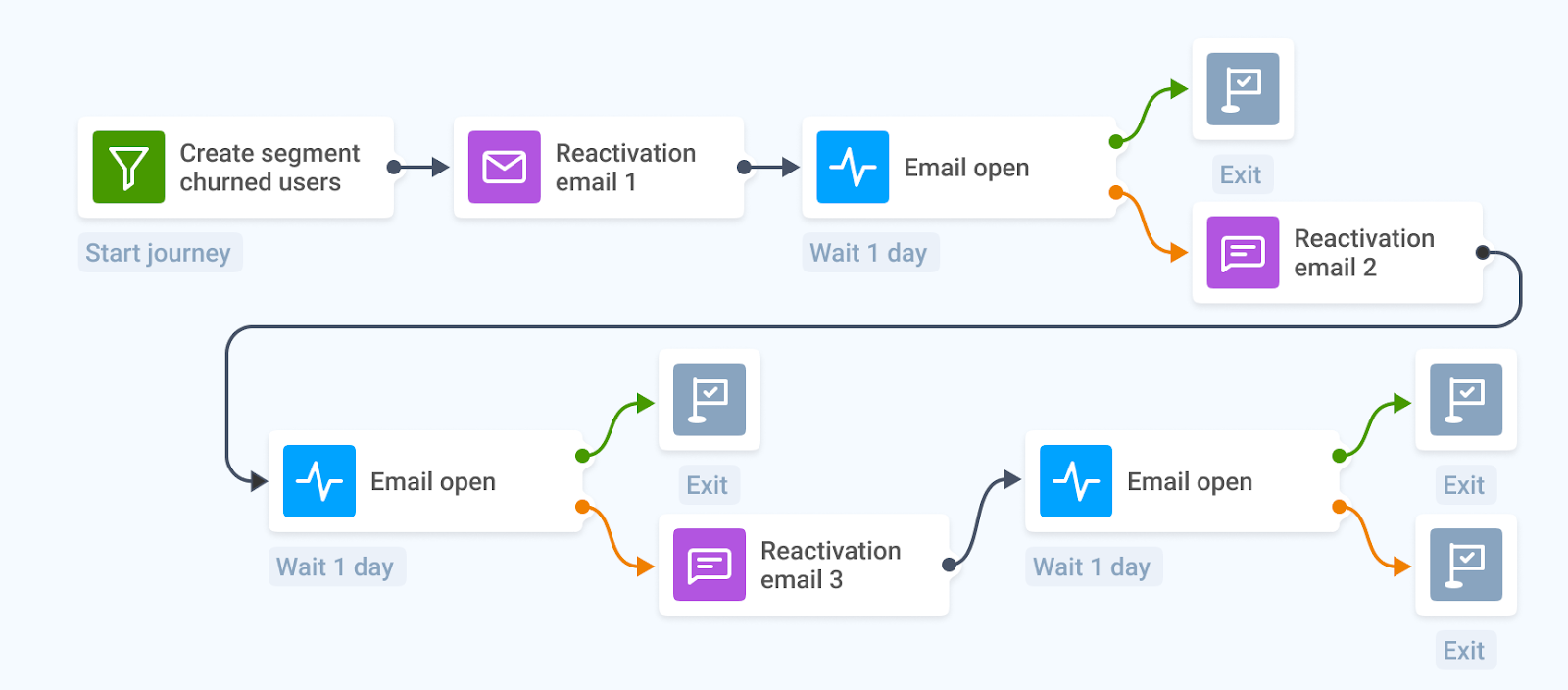
In Pushwoosh Customer Journey Builder, you can target churned users by using Start Segment element and get them back to the app with a series of reactivation emails:
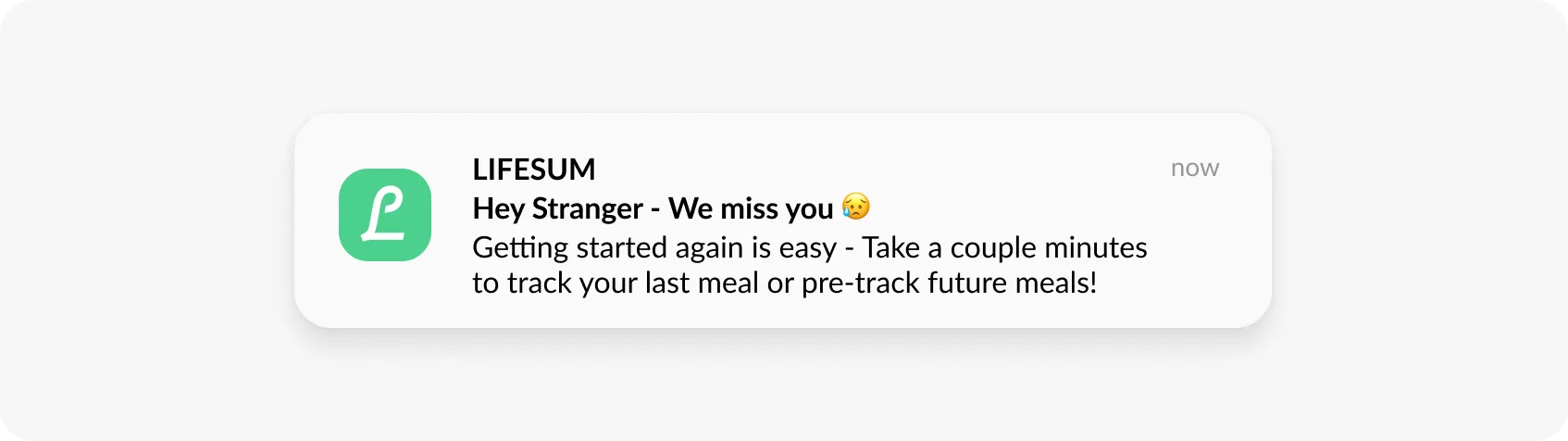
Let’s look at the example of the health app Lifesum. In its “We’ve missed you” push, the app motivates users to re-engage with the app by promising that getting back on track will be easy:
 💡Discover
strategies to boost your
paid subscribers retention.
💡Discover
strategies to boost your
paid subscribers retention.
Experiment with hybrid app monetization
Making a bet on both the subscription-based model and in-app purchases seems to be a smart strategy for boosting your app revenue. Here is how Jenny Pollock, Together Labs’ Lead Subscription Monetization Manager, sees it:
A multifaceted monetization strategy is essential. Offer micro-transactions alongside subscriptions. Offer unique value that drives FOMO. Players don’t want to let their Fortnite Crew subscription lapse or they’ll miss the exclusive monthly outfit and accessory item.
Offering only subscriptions isn’t enough to help you navigate economic and app ecosystem changes. At the end of the day, the best way to be successful is to have a strong product offering supported by multiple monetization options.
Grow your subscription-based app revenue with Pushwoosh
For subscription-based apps, it is crucial to show the app’s value at each stage of the funnel, whether it’s when a user has just finished a free trial or is thinking about upgrading their paid subscription. Effective communications — pushes, in-app messages, and emails — make that value most apparent to your customer at each stage of the customer journey.
Automated messaging allows you to easily send subscription offers at just the right times. You can make it possible with Pushwoosh, and also get to accurately track the effectiveness of these communications.
Discover Pushwoosh for subscription-based apps
Want to learn more about how Pushwoosh solutions can drive upgrades and maximize revenue for your subscription app?
Request a demo today and experience the platform’s full functionality with expert guidance