In 2026, iOS push notifications are more dynamic and data-driven than ever. With iOS 26, Apple introduced smarter priority notifications powered by Apple Intelligence, enhanced Live Activities with broadcast capabilities, and more refined controls over how and when users see messages.
This guide is designed for marketers and app teams who want to understand how Apple Push Notification Service (APNs) works — from iOS push notification setup and types to opt-in strategy, design specs, and benchmarks. And along the way, you’ll see how Pushwoosh helps you turn that technical layer into high-converting campaigns.
iOS vs Android push notifications: key differences
Both platforms offer powerful push capabilities, but they differ in delivery systems, permission models, media support, and engagement benchmarks. Understanding these differences helps teams tailor creative and timing for each platform.
| Aspect | iOS | Android |
|---|---|---|
| Delivery system | Apple Push Notification Service (APNs) | Firebase Cloud Messaging (FCM) |
| Opt-in model | Explicit opt-in required on all versions | Explicit consent required from Android 13+; automatic before that |
| Avg. opt-in rate | ~56% (Pushwoosh 2025 study) | ~75% (Pushwoosh 2025 study) |
| Avg. CTR | 1.71% | 2.75% |
| Rich media limits | Images up to 10 MB via NSE; videos up to 50 MB | Images up to 10 MB, video up to 50 MB |
| Action buttons | Up to 4 | Up to 3 |
| Live updates | Live Activities (iOS 16+), Broadcast push (iOS 26) | Live Updates API (Android 16) |
| Cross-platform scope | iOS, iPadOS, watchOS, macOS, visionOS | Android smartphones, tablets, ChromeOS |
Key insight: While Android leads in volume and opt-in rates, iOS users deliver higher customer lifetime value (CLV) and stronger per-message engagement once opted in. iOS also offers up to 4 action buttons vs Android’s 3 — use them.
What are iOS push notifications?
iOS push notifications are real-time short messages sent directly to users’ Apple devices — iPhone, iPad, Apple Watch, Mac, or Apple Vision Pro — whether the app is open, running in the background, or completely closed. They are delivered through Apple Push Notification Service (APNs), Apple’s secure cloud gateway that serves iOS, iPadOS, watchOS, macOS, and visionOS.
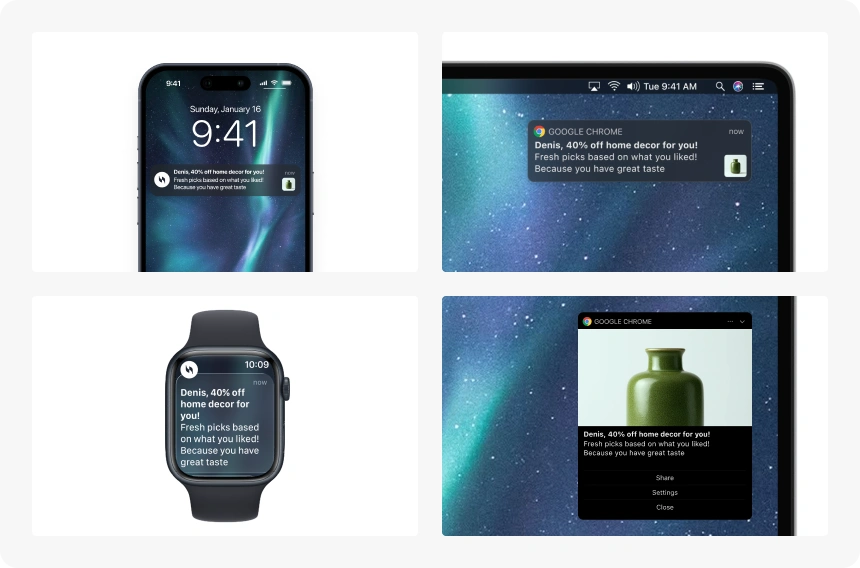
iOS notifications are permission-based: users must explicitly opt in before an app can send them messages. That makes quality, timing, and perceived value crucial from the very first interaction.
When done right, push notifications on iPhone drive engagement, re-activate inactive users, encourage purchases, and strengthen retention across the user lifecycle.
How Apple Push Notification Service (APNs) works
APNs is the provider server infrastructure that sits between your app server and your users’ Apple devices. Here is how the full delivery flow works:
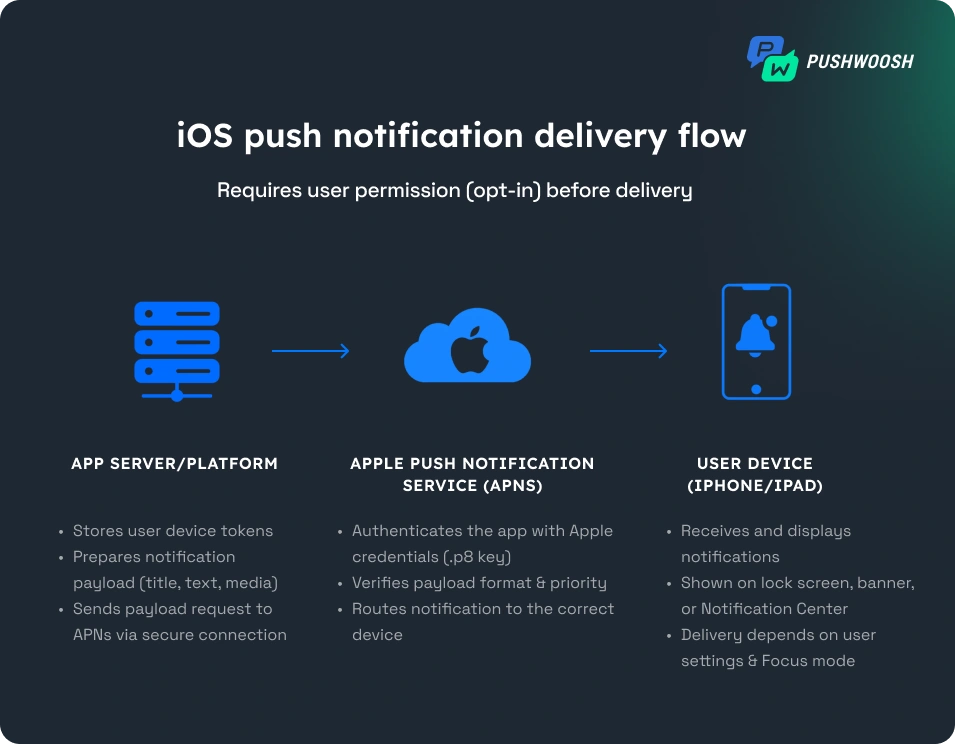
- User grants permission — the app displays an opt-in prompt. Without the user’s consent, APNs will not route any notifications for that app.
- Device token generated — once permission is granted, APNs issues a unique device token for the app-device pair. This token acts as a secure delivery address and must be renewed when users reinstall the app or upgrade devices.
- Provider server stores tokens — your provider server (or Pushwoosh as your engagement platform) stores device tokens and builds the notification payload: a JSON object up to 4 KB containing the title, body, media flag, and delivery parameters.
- Payload sent to APNs via HTTP/2 — your provider server authenticates with APNs using token-based authentication (.p8 key, current standard) or the legacy certificate-based method (.p12). APNs validates the payload and queues it for delivery.
- APNs delivers to device — the notification is routed to the target iPhone, iPad, or Apple Watch. It appears on the lock screen, in Notification Center, or as a banner — depending on the user’s iOS notification settings and Focus mode state.
Types of iOS notifications
iOS supports eight distinct notification types, each with different delivery behavior, visibility, and marketing use cases.
Remote (push) notifications
Remote notifications are sent from your provider server through APNs to the user’s device. This is the standard push notification that marketers work with — promotional alerts, order updates, re-engagement messages. They require explicit user opt-in and appear on the lock screen and in Notification Center.
Local notifications
Local notifications are scheduled and delivered by the app itself, without a server or APNs. They are used for reminders, alarms, or calendar events that do not require real-time server data. Local notifications do not require a network connection.
Silent (background) notifications
Silent push notifications carry a content-available flag in the payload and deliver a data payload to the app in the background without displaying any visible alert to the user. They are used to refresh app content, pre-fetch data, or trigger in-app state updates. Silent notifications are delivered at a lower priority and can be deferred by the OS to preserve battery.
Time-Sensitive notifications
Time-Sensitive notifications are a dedicated iOS category that can break through Focus mode and Scheduled Summary — but only when the content is genuinely time-critical: ride arrival, medication reminder, delivery at door. To use this category, your app must declare the Time Sensitive Notifications entitlement. Users can revoke Time-Sensitive access per app in iOS notification settings.
Critical alerts
Critical alerts bypass both Do Not Disturb and Focus mode completely, and play a sound even when the device is muted. They require a special entitlement from Apple and are restricted to healthcare (medication alerts, medical device notifications) and safety applications (severe weather, emergency services). Apple reviews entitlement requests case by case.
Communication notifications
Introduced in iOS 15, Communication notifications are a dedicated format for messages from real people — chat, calls, or collaboration. They surface at the top of the notification list and can be promoted to a Shared with You entry in apps like Messages or FaceTime. Apps must declare the Communication Notifications entitlement and provide a person object in the notification payload.
Provisional notifications
Provisional notifications allow apps to deliver notifications to Notification Center without requesting explicit permission first. Messages are delivered quietly — no sound, no lock screen — and the user sees a prompt to keep or turn off notifications after seeing the first provisional notification. This is a low-friction way to demonstrate notification value before asking for full opt-in.
Live Activities
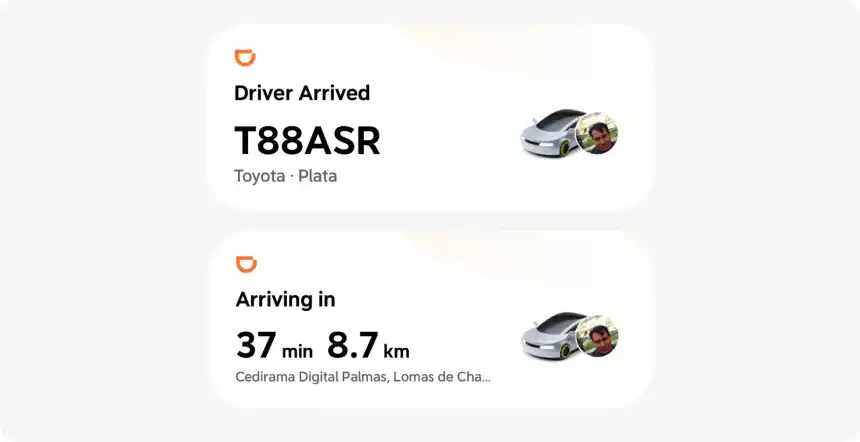
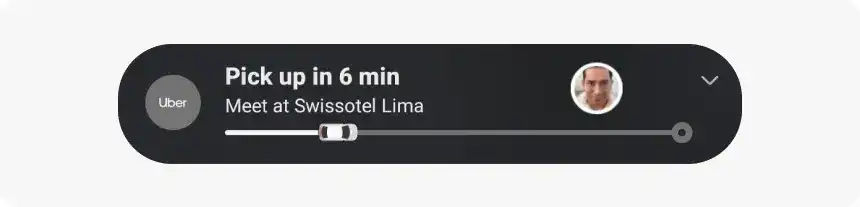
Live Activities are persistent, real-time notification surfaces that appear on the iPhone lock screen and in the Dynamic Island (iPhone 14 Pro and later). They are updated via push payloads with the content-state key and can be triggered remotely. Common use cases include delivery tracking, sports scores, flight status, and ride progress. See the dedicated Live Activities section below for setup and use cases.
iOS push notification setup
Before you can send push notifications on iPhone or iPad, you need to configure your app’s APNs connection and request user permission at runtime.
Setup checklist
- Register your app in Apple Developer Console. Generate an App ID and enable the Push Notifications capability for your iOS project.
- Create an APNs authentication key (.p8 file) in the Keys section of Apple Developer Console. This key authenticates your provider server with APNs via token-based authentication.
- In Xcode, add the Push Notifications capability to your target under Signing & Capabilities. Also add Background Modes if you plan to use silent (background) notifications.
- Request notification permission at runtime using
UNUserNotificationCenter.requestAuthorization. Trigger this after a meaningful user action — not on first app launch. - Register for remote notifications with
UIApplication.registerForRemoteNotifications(). Implementapplication(_:didRegisterForRemoteNotificationsWithDeviceToken:)to retrieve the APNs token. - Send the device token to your provider server or engagement platform (Pushwoosh). Tokens can rotate — implement
onTokenRefreshhandling to keep your records current. - For rich media notifications, add a Notification Service Extension to your Xcode project. The NSE intercepts the notification before display and downloads the media attachment. Without the NSE, images and videos will not appear in your pushes.
- Test delivery via Apple’s Push Notification Console in the Developer portal, or via your engagement platform’s test send feature.
What’s new in iOS 26 notifications
iOS 26 was released in September 2025 and brought several significant changes to how push notifications are delivered and displayed on iPhone and iPad. If your documentation or campaigns still reference iOS 18, update them — the audience notices version staleness.
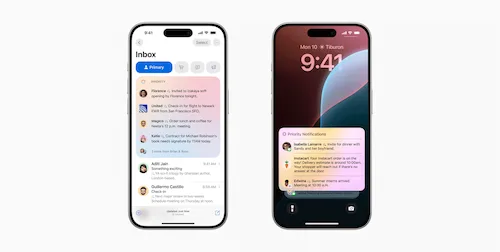
Priority notifications (Apple Intelligence)
Apple Intelligence now ranks incoming notifications by inferred importance and surfaces the most relevant ones at the top of the stack. Messages tied to real-time user context — delivery arriving, meeting starting, direct reply needed — are promoted automatically. Generic marketing blasts are demoted or grouped into Notification Summary.
Marketer implication: relevance signals are no longer just about open rates — they directly affect whether a notification is seen at all. Behavior-triggered, personalized messages will outperform scheduled blasts by an increasing margin.
Join the discussion 👇🏻
Smart notification summaries
Users can configure morning and evening summary deliveries for low-priority apps. Notifications held in summary do not show a lock screen interrupt. Time-Sensitive and Critical notifications bypass this behavior.
If your app primarily sends promotional content, a significant share of your audience on iOS 26 may receive it as part of a batched summary rather than as an instant alert. Frequency capping and value-focused copy become more important than ever.
Broadcast push notifications
iOS 26 introduces Broadcast push notifications via APNs — a new delivery mode that allows apps to push content to all subscribers simultaneously without maintaining individual device token lists. This is particularly useful for live sports, breaking news, and real-time event apps where the same message goes to millions of users at once.
Expanded Live Activities
Live Activities now update via broadcast APNs payloads, reducing the server load for high-volume real-time updates. The update frequency remains 5–15 seconds for most use cases.
Communication notifications update
iOS 26 expands Communication notification APIs, allowing more app categories to surface messages in the priority conversation thread. Apps building collaborative or social features should evaluate adopting this entitlement.
iOS Live Activities
Live Activities are one of the highest-engagement surfaces available to iOS apps. They display persistent, real-time content on the iPhone lock screen and in the Dynamic Island (iPhone 14 Pro and later) — without requiring the user to open the app.
How Live Activities work
Live Activities are started by the app using the ActivityKit framework and updated via push payloads carrying the content-state key. Each update replaces the current state display. Activities end either when the app explicitly ends them or after a maximum duration set at start time.
Updates can be delivered via push (from your server through APNs) or locally (from within the app). The push update priority affects how quickly the lock screen refreshes: high-priority updates appear within seconds; background-priority updates may be deferred.
Live Activity use cases
- Delivery tracking: “Your order is 3 stops away” — updates every minute until delivery.
- Ride sharing: driver name, car, ETA countdown — eliminates the need to open the app.
- Sports scores: live score, period, shot clock — broadcast to all subscribers simultaneously in iOS 26.
- Flight status: gate, boarding time, delay alerts — surfaced in Dynamic Island.
- Food delivery timer: countdown from order placed to delivered — with push notification fallback at key milestones.
Requirements
- iPhone: iOS 16.1+. Dynamic Island: iPhone 14 Pro and later.
- iPad: iPadOS 17+.
- Max activity duration: 8 hours; extendable once by the app.
- Payload size: content-state updates must stay within 4 KB APNs payload limit.
Web push notifications on iOS 16.4+ (Safari & PWAs)
Starting with iOS 16.4, Apple supports web push notifications for Progressive Web Apps (PWAs) added to the iPhone home screen. This is a significant gap-filler: for the first time, web-based products can send push notifications to iPhone users without requiring a native app install.
How it works
Web push on iOS uses the same W3C Push API and Safari service worker model as desktop web push. The user must add the PWA to their home screen, then grant notification permission through a standard browser prompt. Notifications are delivered via Apple’s push infrastructure, not FCM.
Requirements and limitations
- iOS/iPadOS 16.4 or later required. Web push is not available in in-app browsers (WKWebView).
- App must be added to home screen as a PWA. Notifications do not work for sites visited in Safari browser tabs.
- HTTPS required — service workers and push subscriptions require a secure origin.
- No background sync on iOS — some PWA background features that work on Android Chrome are not yet supported on iOS Safari.
Marketing opportunity
Web push on iOS is still underused — which makes it an easy win. Apps with a significant web presence — e-commerce, media, fintech — can reach iPhone users who have not installed the native app by prompting them to add the PWA to their home screen. Pushwoosh supports web push across all major platforms, including iOS 16.4+ PWAs.
iOS push notification design essentials
| Element | Specification |
|---|---|
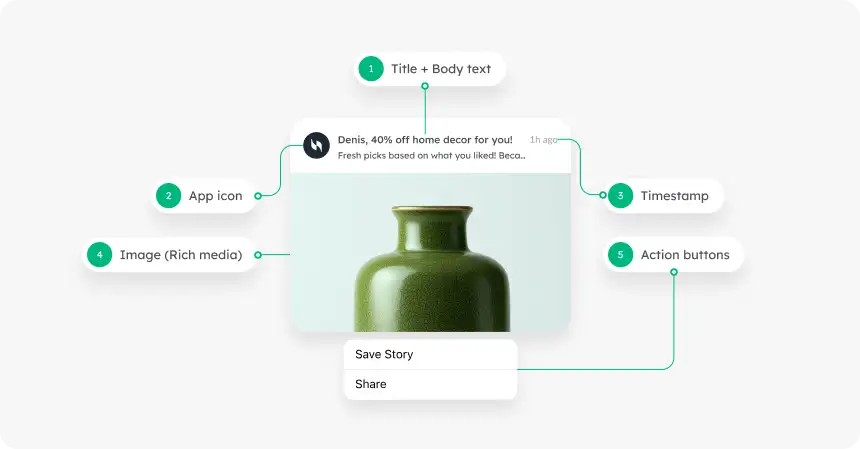
| Title | 25–50 characters; front-loaded with key information |
| Body text | Up to 150 characters; first 40 most visible on lock screen |
| Rich image | JPEG or PNG; up to 10 MB via Notification Service Extension |
| GIF / video | Up to 50 MB via NSE |
| Custom sound | Must be bundled in the app; 30 seconds max |
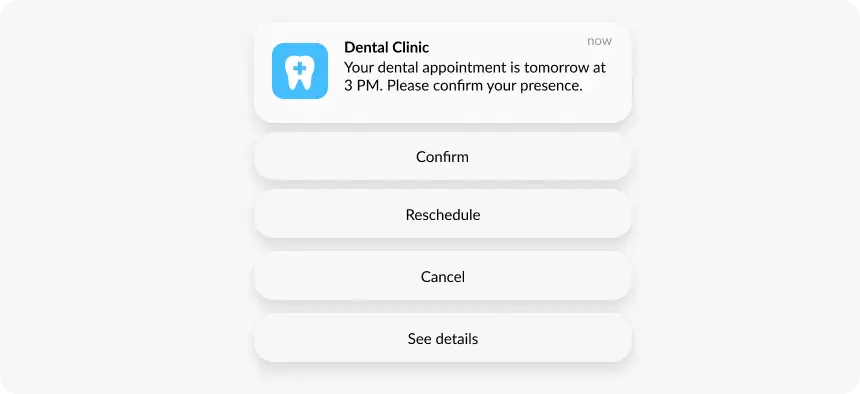
| Action buttons | Up to 4 (more than Android’s 3); 1–2 words each |
| App icon | System-managed; cannot be overridden |
| Payload size | 4 KB total (title + body + metadata) |
iOS push notification character limit
The iOS push notification character limit is 25–50 characters for the title and up to 150 characters for the body, with only the first ~40 characters of the body reliably visible on the Lock Screen. The hard ceiling is the payload rather than the copy: APNs rejects any notification whose total payload exceeds 4 KB.
Apple never truncates at a fixed number. iOS trims text to fit the space available, and that space shifts with screen size, text-size accessibility settings, whether the notification is stacked or expanded, and whether it appears on the Lock Screen, as a banner, or in Notification Center.
The reason is simple: there is no single safe length you can validate against. A title that fits on an iPhone 16 Pro Max gets cut on an iPhone SE, and a body that reads well expanded loses its second half inside a collapsed stack.
That’s why front-loading beats counting. Put the offer, the product name, or the number in the first few words, and treat everything after that as context some users will never read.
Key takeaway: write to 40 characters of body copy, not 150. If the message still makes sense when cut at 40, it works on every iPhone and in every notification state.
iOS push notification benchmarks (2025 data)
Based on Pushwoosh data from 600+ apps across major industries. All-industries average: opt-in rate 56.36%, CTR 1.71%.
| Industry | Opt-in rate | CTR |
|---|---|---|
| E-commerce & retail | 52.78% | 3.05% |
| Fintech | 69.64% | 2.09% |
| Action games | 44.17% | 0.46% |
| Hypercasual games | 23.01% | 0.82% |
| Media & entertainment | 59.93% | 0.83% |
| News | 51.84% | 1.55% |
| All-industries average | 56.36% | 1.71% |
iOS push notification best practices
Get opt-ins early with a pre-permission screen
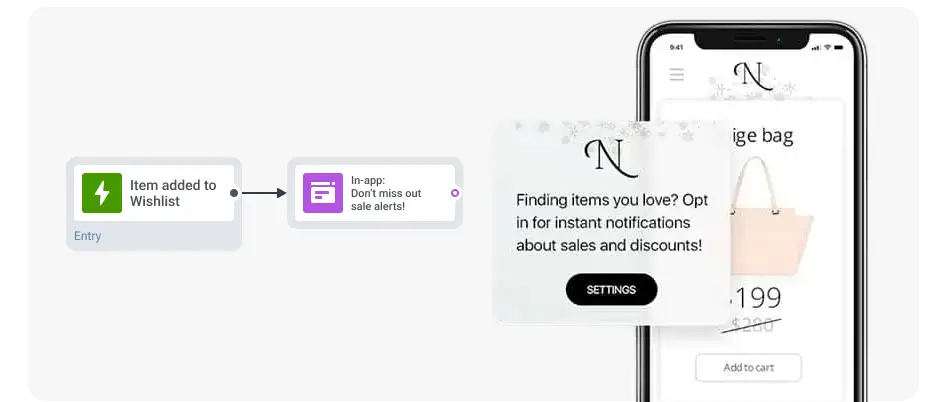
The average iOS opt-in rate is 56%. With a well-designed pre-permission flow, you can push this significantly higher. Show a custom in-app screen before Apple’s native prompt explaining what kind of notifications the user will receive and why they are valuable. Then trigger the system prompt after a meaningful user action — completing a purchase, finishing onboarding, reading a first article.
Respect Focus mode
Focus mode (introduced in iOS 15) allows users to filter which apps can interrupt them during work, sleep, or personal time. Only Time-Sensitive and Critical notifications bypass an active Focus filter. Sending regular promotional pushes to a user in Focus mode will result in silent delivery or suppression. Design your notification categories accordingly — and consider using provisional notifications to demonstrate value to users who have not yet granted full permission.
Personalize every message
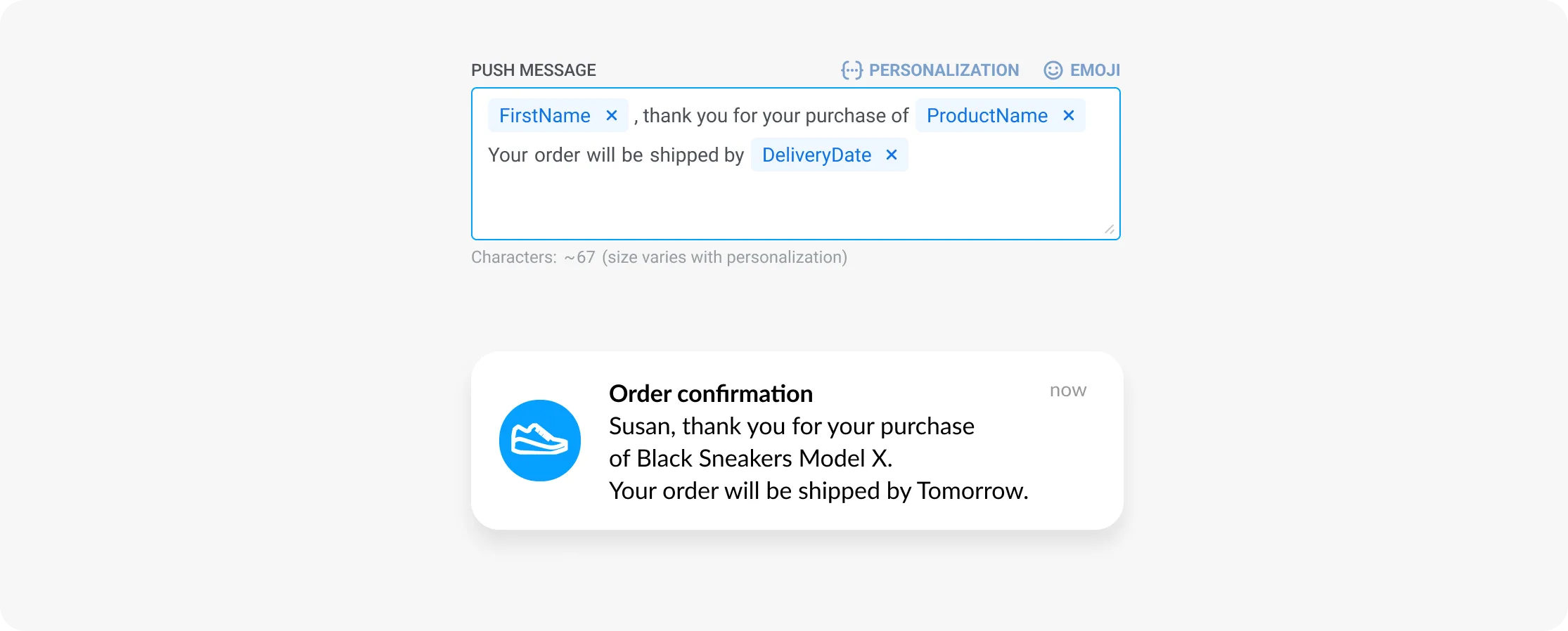
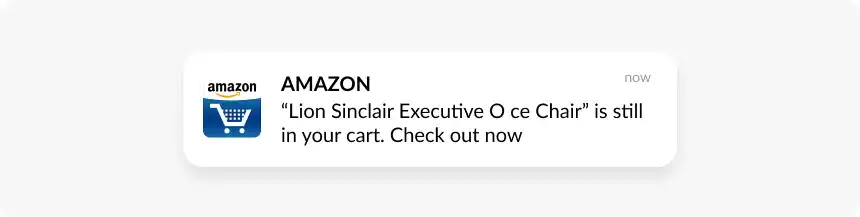
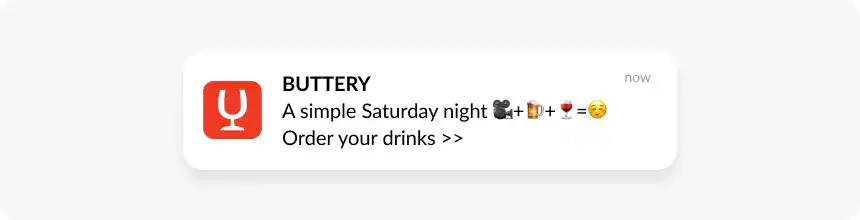
Use dynamic content to tailor notifications with the user’s name, product, location, or recent in-app action. iOS users are selective about what they allow on their lock screens — generic broadcasts accelerate opt-out. Behavior-triggered messages (“Added to cart”, “Subscription expiring in 3 days”) consistently outperform scheduled blasts.
Use Time-Sensitive notifications strategically
Time-Sensitive notifications cut through Focus mode and Notification Summary — but overusing this entitlement trains users to revoke it. Reserve Time-Sensitive for genuinely urgent content: order arriving now, boarding gate change, payment declined. Promotional messages sent with the Time-Sensitive flag will be perceived as spam and lead to permission revocation.
Optimize send timing with automation
Respect user time zones. Set a silence period for nighttime hours. Use Pushwoosh’s Best Time to Send feature to deliver each message at the individual user’s peak activity window — this data-driven approach analyzes engagement history and can increase CTR by up to 50% compared to fixed-time sends.
Add rich media via Notification Service Extension
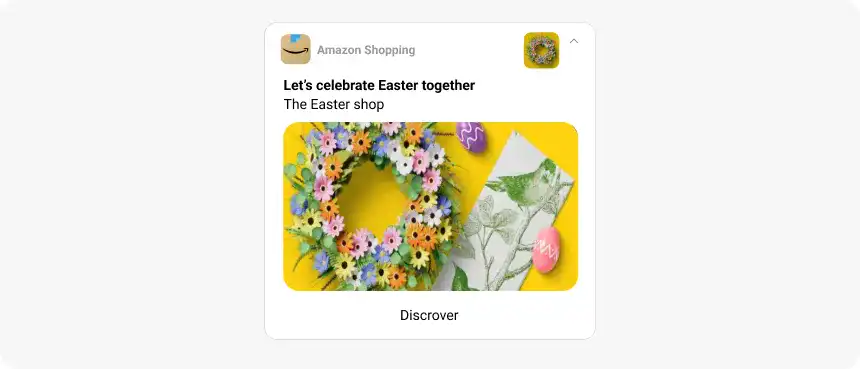
Notifications with images have higher CTR than text-only messages. To enable rich media, implement a Notification Service Extension in Xcode and include the mutable-content flag in your payload. Images up to 10 MB and videos up to 50 MB are supported — use this headroom for high-quality visuals, not low-res thumbnails.
Run A/B tests continuously
Test title copy, body text, emojis, CTA buttons, send time, and rich media. Track opt-in rate, opt-out rate, CTR, and downstream conversions. Small optimizations compound into significant performance differences — a 10% CTR improvement on iOS, where opt-in rates are lower, has an outsized impact on total campaign reach.
How to turn on push notifications on iPhone
Users control notifications per app in iOS settings. Here is how to enable, disable, and fine-tune them — useful both for your own testing and for guiding users who ask.
How to enable push notifications on iPhone (iOS notification settings)
- Open the Settings app on your iPhone.
- Tap Notifications.
- Scroll down and tap the app you want to manage.
- Toggle Allow Notifications to ON.
- Choose how you want to receive notifications: Lock Screen, Notification Center, and/or Banners.
- Optional: tap Sounds and Badges to customize alert behavior per app.
How to turn off push notifications on iPhone
- Open Settings > Notifications.
- Tap the app you want to silence.
- Toggle Allow Notifications to OFF to disable all notifications from that app.
- Or: keep Allow Notifications ON but uncheck Lock Screen to stop notifications from appearing while the screen is off.
Where are push notifications on iPhone? How to find past and missed ones
Notifications a user didn’t tap aren’t gone. iOS keeps every undismissed notification in Notification Center, and there are three places to look:
- Lock Screen — recent notifications appear here. Swipe up from the middle of the Lock Screen to reveal older ones.
- Notification Center — from any unlocked screen, swipe down from the top center of the display. Swiping down from the top-right corner opens Control Center instead, which is the single most common reason users believe their notifications vanished.
- App icon badges — the red badge counts what is waiting inside the app, even after the notification itself was cleared from Notification Center.
Notifications stay in Notification Center until the user clears them or the app removes them. iOS keeps no recoverable notification history: once a notification is swiped away, it is gone, and no Settings screen brings it back.
What this means for marketers: delivered is not seen. Users routinely clear an entire stack without reading any of it, which is why front-loaded copy and smart notification summaries matter more than send volume.
How to manage notifications in Focus mode
If you want to receive notifications only from specific apps during Focus: Settings > Focus > select a Focus (e.g. Work) > People and Apps > Apps > add the apps you want to allow. All other apps will be silenced during that Focus session.
Top iOS push notification services in 2026
Choosing the right platform affects deliverability, campaign sophistication, and total cost of ownership. Here is how the leading options compare across the dimensions that matter most for iOS push.
| Platform | APNs + HMS | Live Activities | No-code journeys | AI optimization | Pricing |
|---|---|---|---|---|---|
| Pushwoosh | Yes (both) | Yes | Yes (visual) | Yes (ManyMoney AI) | From $49/mo |
| OneSignal | Yes | Yes | Limited | Basic | Free tier + paid |
| Airship | Yes | Yes | Yes | Yes | Enterprise |
| Braze | Yes | Yes | Yes | Yes | Enterprise |
| MagicBell | Yes | No | No | No | Usage-based |
Pushwoosh is the only platform in this list that combines APNs + HMS delivery, Live Activities support, no-code journey orchestration, and autonomous AI optimization (ManyMoney AI) in a single mid-market solution. Compare Pushwoosh vs OneSignal or Pushwoosh vs Braze.
Pushwoosh — the best Apple push notification service
Improving iOS push performance is not about sending more messages. It is about precision — right message, right user, right moment — and the technical reliability to ensure messages actually arrive through APNs.
- Full APNs compliance: always up to date with the latest APNs protocols and iOS 26 changes.
- Omnichannel from one platform: iOS push, Android push, web push, in-app messages, email, SMS, WhatsApp.
- No-code Customer Journey Builder: build behavior-triggered automated flows without engineering support.
- Live Activities support: send and update Live Activities via push from Pushwoosh campaigns.
- Best time to send: per-user timing optimization for up to 50% higher CTR.
- ManyMoney AI: autonomous AI that finds ready-to-buy users, identifies revenue leaks, and optimizes campaigns 24/7.