E-commerce businesses operate in a highly saturated market: new e-tailers appear all the time. This is the reason why retaining existing customers is becoming crucial and comes before acquiring new ones. Satisfied customers will pay a 17% price premium for excellent service, and 81% will make another purchase if they had a positive experience. However, there are many challenges faced by e-commerce businesses today, and customer retention isn’t the easiest one to solve.
Trying to retain users is about investing in building a steady and rewarding relationship with them over time and employing every channel of communication to materialize this relationship.
How can your business get prepared for any e-commerce challenge and create a community of loyal customers? Let’s dive in and find out everything firsthand.
Challenge #1: Customer Retention Is Not a Business Priority
Challenge #2: Offers for New vs Retained Customers
Challenge #3: Lack of Coordination Between Online and Offline Processes
Challenge #4: Your Customer Data Sources Are Not in Sync
Challenge #5: Stay Up-to-Date with Personalization
Challenge #6: Customers Are Only Interested in One-Time Purchase
Challenge #7: Customers Are Not Satisfied with Your Products
Challenge #8: Second-Time Customers Leave Purchases at the Checkout
Challenge #9: Retained Customers Won’t Bring You Much Value
Challenge #10: Customers Show Little Trust in Your E-Commerce Brand
Challenge #11: Loyalty Program Issues
Challenge #12: Any Customer Retention Campaign Takes Time to Launch
Strategic Challenges of E-Commerce Apps
Challenge #1: Customer Retention Is Not a Business Priority
Retaining a customer is five times less expensive than acquiring a new one. According to surveys, 82% of companies are aware of this. Yet, 44% of businesses keep prioritizing customer acquisition over customer retention.
Does your company keep investing in acquisition too? Here are some reasons for you to reconsider your strategy, besides optimizing your costs.
Why Do E-Commerce Apps Need to Prioritize Customer Retention?
- Repeat customers are nine times more likely to convert.
- At that, retained clients spend an extra 25% on holiday shopping, 2021 Digital Economy Index states.
- In mobile marketing, e-commerce customer retention strategies look like a more reliable option, less troubled by the recent limitations to IDFA tracking and the general tendency to stricter user data privacy protection.
- Customer acquisition has its own challenges and gives companies less profit in return.
Solution
Remember that customer retention campaigns don’t cost as much as customer acquisition ones. All you’ll need is a reliable customer retention platform and a marketer with some strategic and copywriting skills.
💸Looking to reduce expenses and boost the ROI of your marketing efforts? Consider our strategy for optimizing customer retention costs. No need to freeze your initiatives or cut down on your customer engagement platform — instead, use its capacity to the max!
Challenge #2: New Customers Get the Best Offers. And What About the Retained Ones?
In the best-case scenario, current customers are excluded from receiving those offers. In the worst case, your previous purchasers are still shown the same banners — “20% off for new customers” — with no special offer for current customers.
As a result, those who have already paid you may feel underappreciated.
One of the best customer retention strategies that e-commerce companies can use is not just to focus on retaining customers but to keep acquiring new customers without overlooking the old ones.
Solution
1. Segment your audience carefully to avoid showing the offers for new customers to your repeat visitors.

With Pushwoosh Customer Journey Builder, you can present the same offer to different audiences
- Consider adding a premium loyalty program that will imply a personal customer discount on each purchase. It may be growing steadily or depend on the number of items purchased, the total of the order, and the like.

Customize your communication with loyal customers
Data Synchronization Challenges
Challenge #3: Losing Customers to the Lack of Coordination Between Online and Offline Processes
There may be many questions to ask while speaking about sync challenges in e-commerce retention. Are there enough supplies in stock? Will the order be delivered on time? There is still a great deal of offline work that goes into online stores, so you should pay double attention to data synchronization and well-established communications.
Solution
Sync your data from online and offline systems along with your offers from different communication channels. Using Pushwoosh, you can upload your external data and combine this information with the in-app and website user data — with the help of Events and Tags.

Using Pushwoosh, you can sync your online and offline systems
Challenge #4: Your Customer Data Sources Are Not in Sync
E-commerce businesses have many touchpoints with their customers — they collect user data from websites, apps, and offline sources. Synchronizing all of them is crucial to deliver up-to-date and consistent messages to your customers via all communication channels.
Here’s a bad example:
A group of customers gets a push notification — “10% off for loyalty program members”. After that, they see a pop-up message on your website — “10% off for all customers”. At this very moment, you are about to lose a loyal customer.
Solution
Make sure your platform provides omnichannel communication by default like Pushwoosh does. Send messages related to the same offer using different communication channels.

Reach your customers via the most relevant channels
Challenge #5: E-Commerce Customers Have Acquired a Taste for Personalization
You should never stop refining your in-app recommendation system as well as personalizing your messages. However, this goal is not easily achieved.
According to PWC, customers are unlikely to notice how new technology works unless it malfunctions or interrupts the seamless, friendly experience. In short, your e-commerce messaging should be targeted and personalized in the best way possible. Your customers shouldn’t have to wonder why they are receiving this particular message. If you succeed in personalization, you’ll get 40% of your customers spending more than they planned, BCG has found.
Solution
Choosing a service you can rely on is one of the biggest challenges in e-commerce. Pushwoosh provides all the tools you need for granular customer segmentation and message customization. You can make use of the benefits of multi-language and dynamic content, upload your own self-made in-app and email templates and edit them right in the app.
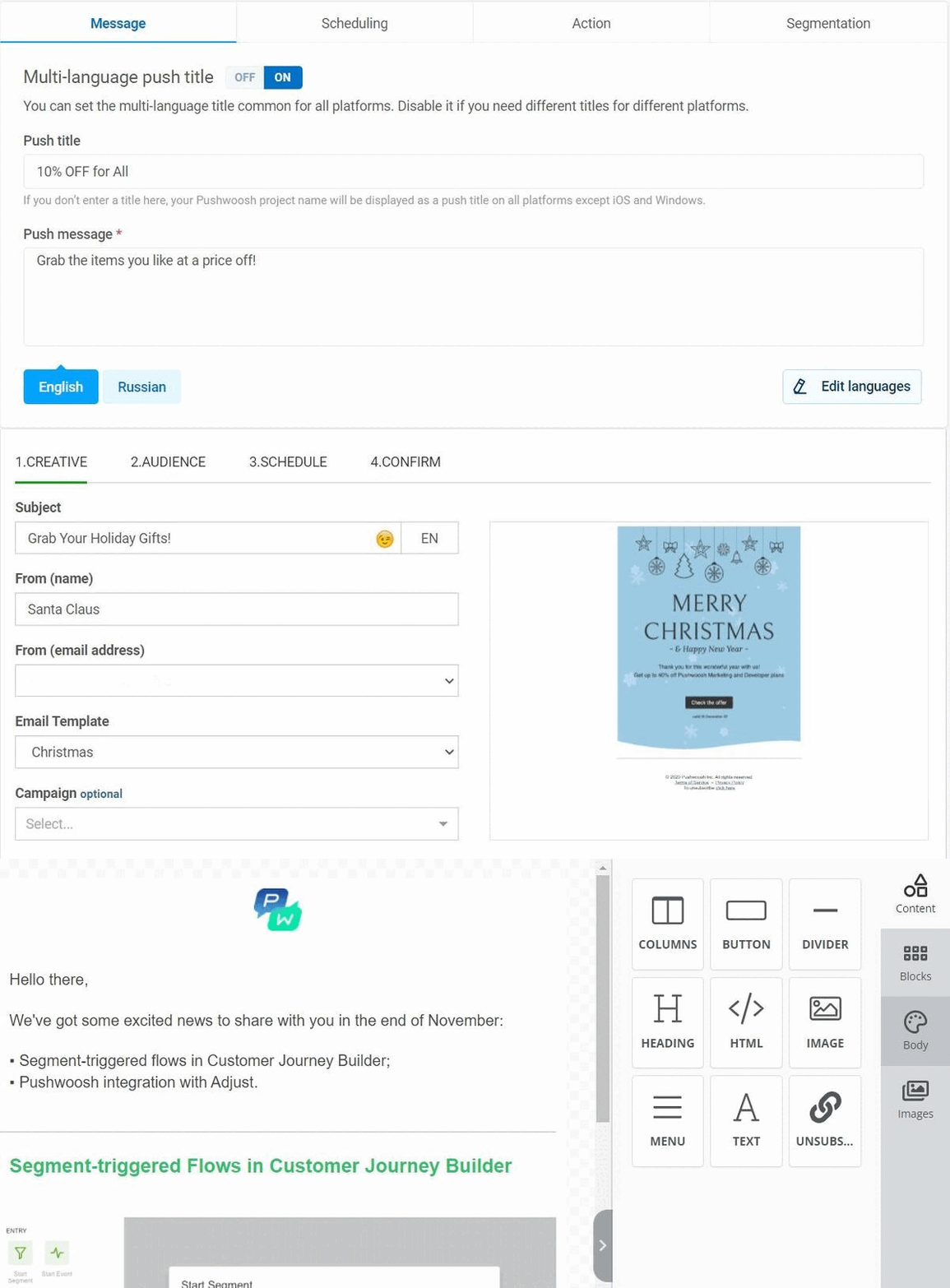
Personalize your communications easily with Pushwoosh
Learn more about how customer online shopping patterns changed and what tweaks you may have to consider in your communications:
Download the Pushwoosh Data Study
Fundamental E-Commerce Customer Retention Challenges
Challenge #6: Customers Are Only Interested in One-Time Purchase
Here comes the moment when you need to make your offering not only well-targeted and personalized but straightforward. The best way to keep your customer’s interest high is by offering some special discounts right after the first purchase.
Solution
Here are several steps you can take:
-
Cross-sell — recommend more items to purchase in the first order.
-
Offer a coupon for the second purchase.
-
Reach out to your purchasers later when you see they haven’t shown any activity for a while.

Made with Pushwoosh Customer Journey Builder
-
Hook your customers with a premium loyalty program — give them a personal discount with every order instead of promising: “You’ll receive reward points someday after your next purchase”.
-
Send a post-sale message with a replenishment reminder. For example:

Challenge #7: Customers Are Not Satisfied with Your Products
If customers don’t like what they get, they won’t make a second purchase. However, providing high-quality, unique products may not be enough — customers may not like your app or website interface, lack of payment methods, shipping cost, or estimated delivery date.
Solution
- Hold NPS surveys, gathering first-hand data
Learn customers’ preferences and details of their experience to suggest something more suitable next time. If your product line is large enough and especially if you’re a multi-brand e-commerce store, you can always recommend a different item to purchase.
- Bet on customer experience
If the purchase or post-purchase experience was perfect, and it was only the quality of the product that disappointed your customers, it’s already good news. Next time, your customers will know that they can rely on your online store for purchasing other products or brands.
Challenge #8: Second-Time Customers Leave Purchases at the Checkout
Normally, repeat customers are less likely to abandon their carts, but the second-time experience may not be as impressive as the first one.
Let’s take an example — the first time, delivery was free, but your customers have to pay for it the second time. Besides, they are not loyal yet after the first purchase, while competitors may offer better delivery terms. That’s it — a customer may choose your competitor’s online store. Can you prevent this?
Solution
Provide app onboarding and great customer experience.
Wow fact: customer experience drives more than two-thirds of customer loyalty in e-commerce, outperforming brand and price combined. Tell your customers everything they should know about your product and service: what your e-commerce app is about; how it is different from others; what extra benefits and perks it can provide.
Read more about how to craft an effective user onboarding flow
Challenge #9: Retained Customers Won’t Bring You Much Value (You Fear)
Statistics prove the opposite, though — repeat customers tend to spend more, especially during the holiday season.
Solution
Segment out your high-value customers and focus on them in your communications.
Centering retention efforts around high-value customers, as opposed to average customers, can yield considerably higher value in terms of ROI. Digging into metrics such as customer lifetime value, average order value, purchase frequency, price sensitivity, and so on helps identify high-value customers. Besides, you can find out who your most-valued clients are using RFM analysis.
With Pushwoosh, you can identify your loyal customers in several ways:
- Pull out the needed customer data from your favorite external analytics system, upload the contacts to Pushwoosh as a .csv file, and then use it as a segment in your campaigns.
- Make a sequence of events using Pushwoosh Customer Journey Builder: For example, If the customer makes three purchases (you can track it by using Tags), they join the loyalty program and start getting special promotions.

Challenge #10: Customers Show Little Trust in Your E-Commerce Brand
Trust takes time to build. It depends on the perceived value, your e-commerce brand awareness, customer satisfaction with the purchased products, and the shopping experience during repeat purchases.
If you overwhelm your customers with promotions and head-on sales, you may scare your clients away. To avoid this, let them get to know you first — by sharing some useful pieces of content and trying to engage them with your brand.
Solution
Nurture your customers with brand image campaigns and editorials you may send via email. For example:

Branded Email from the Zara Home App
Challenge #11: Discrepancy Between What Customers Seek in a Loyalty Program and What You Can Actually Provide
According to the recent loyalty industry data study, a business and its customers may consider different aspects of a loyalty program as the most beneficial. Today’s retailers are overlooking the loyalty benefits that customers want — which are often the tried-and-true, essential benefits, like free shipping.
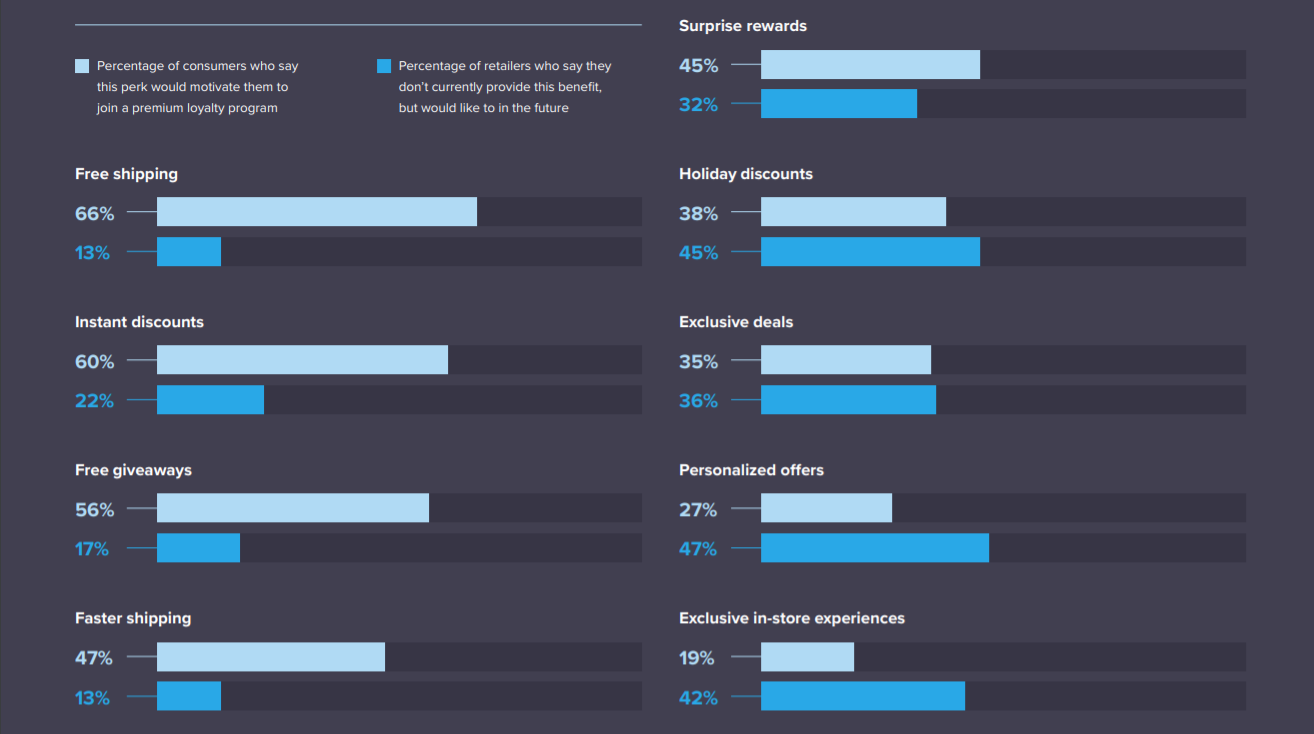
Source: Loyalty Industry Data Study 2021
Solution
- Hold A/B tests to gain first-hand (zero-party, right) data on which benefits your customers appreciate the most. For starters, you may not even have to provide the oh-so-desired free shipping to all of your customers — only to one group of your A/B test audience split.
- Include the most sought-after features into the higher levels of your loyalty program: reserve free shipping for your most frequent customers, provide free items only with every second purchase and offer instant discounts on each repeat order.
Internal Challenge
Challenge #12: Any Customer Retention Campaign Takes Time to Launch
Usually, it takes about three weeks from drafting a campaign to its official launch. In customer retention e-commerce campaigns, starting three triggered messaging sequences a month is considered a good record. Is it possible to speed up the internal processes?
Try to avoid overspamming and check twice that your communication flow is well-balanced.
Solution
Many departments are involved in a marketing campaign — designers, copywriters, and others. Communication difficulties are likely to happen, so at least try to minimize the possibility of any technical issues.
Pushwoosh is a reliable solution that gives a boost to your marketing at each
stage.
In the beginning, it offers
ready-to-use templates
that any e-commerce business can adjust to its needs. Besides, Pushwoosh users
can benefit from a simple yet powerful content builder — you can create push
notifications, in-apps, and emails right in the interface.
Then, when everything is ready for setup, Pushwoosh will ensure that all messages are sent and delivered on time. Compared with any other messaging platform, Pushwoosh has no limit on the number of API requests per unit of time. As a result, it will deliver all messages to a million-user audience in a few hours, while competitors may take more than a day to do it.
Choosing the Right Customer Retention Technology Partner
Although there are many customer retention challenges faced by e-commerce companies, all the efforts you make to retain a purchaser pay off. Use the advice introduced in this article and choose the right platform to conquer new marketing peaks and create your own community of dedicated fans.
What’s the challenge in choosing the right platform? How does Pushwoosh cover that?
Discover Pushwoosh for E-Commerce